


Surviving the Audit Why You Need Automatic Electronics Design Audit Trails

At a Glance
Stop scrambling before audits. Automatic electronics design audit trails capture proof as you work, so evidence is always ready when you need it.


An audit should not feel like a rescue mission. Yet many electronics teams still prepare for audits by searching old emails, opening archived folders, checking local file copies, and asking engineers to remember why a change was made months ago.
That approach creates pressure for everyone. Engineering teams lose time. Quality teams struggle to build a clear evidence trail. Compliance teams are left trying to connect decisions, approvals, release records, and product data after the fact.
Automatic electronics design audit trails solve this problem by capturing proof while work happens. The audit record becomes part of the design flow. Teams do not need to stop engineering work to build the story later. Instead, the story is created as the design moves through reviews, commits, approvals, releases, and lifecycle changes.
Key Takeaways
- Audit readiness should be built into daily engineering work, not rushed in the final week before an audit.
- Automatic audit trails capture event logs, version history, review records, release activity, and access changes with less manual effort.
- Traceability reduces stress for engineering, quality, and compliance teams because proof is easier to find and easier to trust.
- Altium Agile Teams supports audit readiness through project histories, structured workflows, role-based access, single sign-on, event logs, and connected release processes.
- The best audit trail is not a separate activity. It is a natural by-product of disciplined design work.
Why Audit Readiness Must Be an Ongoing Capability
Audit readiness works best when evidence is created during daily work. A last-minute audit scramble is risky because memory fades and project context moves on. The engineer who approved a footprint change may now be on another program. The supplier issue that drove a part change may be buried in a chat thread. The release package may exist, but the reason for the release may be harder to prove.
This is where many teams feel the gap between having files and having evidence. A file shows what was released. A strong audit trail helps explain how the design reached that point, who reviewed it, what changed, and why the approved state can be trusted.
Quality-led teams know this pattern well. Documented information, design change control, review evidence, and authorization records all matter in a controlled product process. External guidance on ISO 9001 design and development changes also points to the need for records on design changes, reviews, and authorization.
The lesson is simple. Audit readiness is not an event. It is a capability. It should be designed into the way teams work every day.
What an Electronics Design Audit Trail Should Capture
A useful audit trail shows who did what, when it happened, what changed, and which product data was affected.
Audit trail element | What it proves | Why it helps |
Event logs | User action, time, and affected object. | Teams can confirm activity without asking people to recreate it. |
Version history | How the design changed across commits and releases. | Teams can compare states and trace design decisions. |
Design review records | Who reviewed, what was raised, and how it was closed. | Compliance and quality teams can see evidence of review and closure. |
Release records | Which files, outputs, and BOM data were released. | Manufacturing can work from the approved product state. |
Access control history | Who had permission to view or change data. | IT and compliance teams can check data governance and user control. |
Workflow records | How the design moved through review, approval, and release steps. | Leaders can see whether the process was followed consistently. |
Change context | Comments, tasks, linked issues, or reasons for change. | Teams can explain not only what changed, but why it changed. |
The record should be complete, but it should not be painful to create. If engineers must fill out extra logs by hand, the audit trail will be late, thin, or inconsistent. Manual evidence capture also creates variation between teams. One engineer may document a change well. Another may rely on memory, email, or informal notes.
A stronger approach is to let the platform capture the record as part of normal engineering activity. The system becomes the place where work happens and where evidence is created.
How Automatic Event Logs Reduce Compliance Stress
Automatic event logs reduce stress because teams do not need to build evidence after the fact. Modern platforms like Altium Agile Teams, for example, support event monitoring in the following way: event logs record user actions and include details such as when the event occurred, who invoked it, and what object or user was affected. Those logs can support regulatory compliance by making audit trails easier to export and review.
This is the right model for modern electronics work. Engineers should not have to choose between making progress and keeping records. The platform should capture the record in the background as people work.
That matters because audit pressure often appears when evidence is fragmented. One part of the story may sit in a design file. Another may sit in an email. Another may sit in a meeting note, an approval thread, or a release folder. The more places the evidence lives, the more effort it takes to prove control.
Automatic event logs help reduce that effort. They give teams a structured record of activity that can be reviewed, sampled, exported, and used to support an audit response.
Why Version History Is More Than Backup
Version history is not only a way to restore old files. It is a way to explain design evolution. In Altium Agile Teams, project history can show major events for a PCB, multi-board, or harness project, including creation, commits, releases, copies, and MCAD exchanges. That kind of history helps teams connect change events to project context.
For an auditor, this matters. The question is rarely just, “Do you have the latest file?” The better question is, “Can you show how the design reached this state and who controlled the journey?”
Version history helps answer that question. It gives teams a timeline of engineering activity. It helps show how design work progressed, when major changes were made, and how release points were created. It also helps teams compare previous and current design states when investigating issues or explaining decisions.
This can be especially valuable when changes are linked to supplier updates, component availability, manufacturability feedback, or quality findings. In those cases, the design file alone is not enough. Teams need a connected record that explains the path from problem to decision to approved release.
Traceability Helps Engineering and Compliance Teams Work Together
Traceability turns audit work from a hunt into a guided path. The NIST digital thread program highlights the need for better communication of product designs to manufacturing and quality, and for feedback from those teams to reach design engineers. In electronics, that same flow supports audit readiness. The design record, review record, release record, and lifecycle record should connect.
When traceability is weak, compliance teams ask engineering for help. Engineering stops to search. Quality waits. The audit clock keeps running. The work becomes reactive, and the team spends more time finding evidence than explaining the process.
When traceability is strong, the team can move from a part, board revision, release, review, or user action to the related history with much less friction. The evidence is easier to find because it is connected to the work itself.
This also improves collaboration. Engineering can stay focused on technical work. Quality can review evidence without slowing every design decision. Compliance teams can see a clearer line between requirements, actions, approvals, and released outputs. Leaders can have more confidence that the process is controlled and repeatable.
The Audit Trail Should Be Invisible to Daily Work
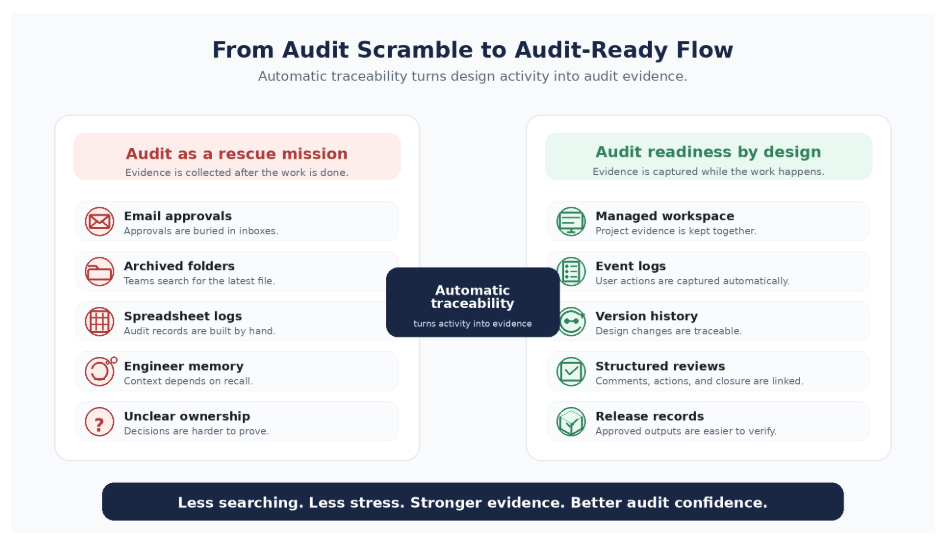
The best audit trail is almost invisible to the people doing the work. This does not mean the process is casual. It means the record is captured by the system, not by extra admin. Engineers still follow reviews, approvals, and release workflows. The difference is that the evidence is generated as part of the workflow
Manual audit prep | Automatic audit trail |
Search email for approvals. | Review approvals in the project record. |
Ask engineers why a change was made. | Trace the change to comments, tasks, reviews, and release history. |
Check folders for the latest file. | Use managed project and release history. |
Build audit logs in spreadsheets. | Export event logs from the platform. |
Depend on tribal knowledge. | Depend on structured project evidence. |
Recreate the timeline after the event. | Review the timeline as captured during the work. |
Treat audit readiness as a special exercise. | Treat audit readiness as part of normal design control. |
This is an important mindset shift. Audit readiness does not need to slow teams down. Done well, it reduces friction because people know where evidence lives, how reviews are captured, and how releases are controlled.
It also reduces the personal burden on engineers. Instead of relying on memory, teams can rely on the record. That is better for the engineer, better for the quality system, and better for the organization.
How Altium Agile Teams Supports Audit-Ready Electronics Design
Altium Agile Teams supports audit readiness by adding structure around people, processes, and data.
- Role-based permissions help control who can access and change project data.
- Single sign-on helps manage identities through the organization’s existing identity system.
- Event logs capture user actions and support exportable audit evidence.
- Structured design reviews create clearer approval and closure records.
- Project histories help teams trace commits, releases, and other major design events.
- PLM connectors link released engineering data to lifecycle governance.
- Managed workspaces help reduce reliance on uncontrolled local files and disconnected folders.
- Connected release processes help teams understand which product data was approved for downstream use.
The result is less audit drama. Engineering teams can keep working. Compliance teams can find evidence faster. Quality teams can review decisions with more confidence. Leaders gain better visibility into whether the design process is controlled without making every task feel heavy.
This is the real value of automatic audit trails. They do not just help during an audit. They improve the operating rhythm of electronics design by making evidence easier to capture, easier to find, and easier to explain.
A Simple Audit Readiness Checklist
Use this checklist before your next design release, not the week before your next audit.
- Confirm each project is managed in a shared workspace with clear ownership.
- Use role-based access and single sign-on for user control.
- Run design reviews through a structured workflow with checklist items.
- Link review comments to actions and closure evidence.
- Release through a defined process and publish required data to PLM when needed.
- Review project history after major milestones to confirm the record is complete.
- Export and sample event logs on a regular schedule so audit access is familiar.
- Check that released files, BOM data, and supporting records are aligned.
- Confirm that access permissions still match current project responsibilities.
- Capture change context while the decision is fresh, not after the audit request arrives.
The checklist should be simple enough to use regularly. The aim is not to create more administration. The aim is to make sure the evidence is already in place when someone asks for it.
Frequently Asked Questions About Electronics Design Audit Trails
What is an electronics design audit trail?
An electronics design audit trail is a record of project actions, changes, reviews, approvals, releases, and access events. It helps teams prove how a design changed over time and how the approved design state was reached.
Why should audit trails be automatic?
Automatic audit trails reduce manual logging and missing evidence. They capture the record while engineers work, which makes the record more complete, more consistent, and easier to trust.
Do audit trails only matter for regulated industries?
No. Regulated teams need audit trails for compliance, but any team can use them to improve change control, root cause analysis, supplier issue response, product release confidence, and engineering governance.
What is the first step toward better audit readiness?
Start by moving project work into a managed workspace where reviews, releases, version history, and user actions can be captured in one connected record.
How can teams avoid the last-minute audit scramble?
Teams can avoid the scramble by treating audit evidence as part of daily design work. Use structured reviews, controlled releases, managed access, and automatic event logs so the evidence is created as work progresses.

About Author
Related Resources
Related Technical Documentation
Table of Contents
- Key Takeaways
- Why Audit Readiness Must Be an Ongoing Capability
- What an Electronics Design Audit Trail Should Capture
- How Automatic Event Logs Reduce Compliance Stress
- Why Version History Is More Than Backup
- Traceability Helps Engineering and Compliance Teams Work Together
- The Audit Trail Should Be Invisible to Daily Work
- How Altium Agile Teams Supports Audit-Ready Electronics Design
- A Simple Audit Readiness Checklist
- Frequently Asked Questions About Electronics Design Audit Trails
- What is an electronics design audit trail?
- Why should audit trails be automatic?
- Do audit trails only matter for regulated industries?
- What is the first step toward better audit readiness?
- How can teams avoid the last-minute audit scramble?
Solutions for Every Role and Team
- Discover and evaluate design options earlier
- Develop in one shared workspace
- Scale with control and compliance
- Connect every stage of hardware development
Learn More
Thank you, you are now subscribed to updates.