
Mobile menu
  • Solutions
    • Octopart Discover Go beyond part search to discover viable solutions, evaluate tradeoffs, and make better decisions earlier
    • Altium Develop Design advanced PCBs in Altium Designer, working independently or connecting reviewers, sourcing data, and release coordination when needed
    • Altium Agile Teams Bring structure to multidisciplinary electronics development and collaboration without sacrificing speed
    • Altium Agile Enterprise Connect context from intent through release with an intelligent, governed, extensible platform
  • Resources & Support
    Free Altium 365 Tools
    • Gerber Compare
    • Online PCB Viewer
    Resources & Support
    • Learning Hub
    • Support Center
    • Documentation
    • Webinars
    Altium Community
    • Forum
    • Bug Crunch
    • Ideas
  • Education & Training
    • Student Lab Free access to professional PCB design software, training, and learning resources for students
    • Educator Center A comprehensive education platform providing curriculum, software, training, and classroom resources for educators
    • Altium Education Curriculum Free college- and university-level PCB design curriculum designed to prepare students for real-world engineering careers
    • Altium Professional Training Flexible on-demand and instructor-led training courses that help engineers build and advance their PCB design skills
  • Search Open
    Search Close
Sign In
Requirements Portal

Main menu

  • Home
  • PCB Design
    • Collaboration
    • Component Creation
    • Data Management
    • Design Outputs
    • ECAD/MCAD
    • HDI Design
    • High Speed Design
    • Multi-Board
    • PCB Layout
    • PCB Routing
    • PCB Supply Chain
    • Power Integrity
    • RF Design
    • Rigid Flex
    • Schematic Capture
    • Signal Integrity
    • Simulation
  • Software
    • Discover
    • Develop
    • Agile Teams
    • Agile Enterprise
    • Altium 365
    • Altium Designer
  • Education
    • Programs
    • Altium Academy
    • Engineering News
    • Guide Books
    • Newsletters
    • Podcasts
    • Projects
    • Training Courses
    • Webinars
    • Whitepapers
Learning Hub Requirements Portal AI Agents for Engineering Requirements

AI Agents for Engineering Requirements

Agentic Requirements Engineering just shipped. Learn how to use AI agents to accelerate your requirements workflows.

Good requirements keep the whole team aligned, trace directly to design decisions, and make verification straightforward. Most engineers know this, but the tools available have always made it harder than it should be.

Agentic Requirements Engineering, our newest capability in Requirements Portal, removes this bottleneck. In this webinar you get an exclusive first look at how AI agents work inside Requirements Portal and see what that means for your requirements workflows in practice.

What You'll Learn

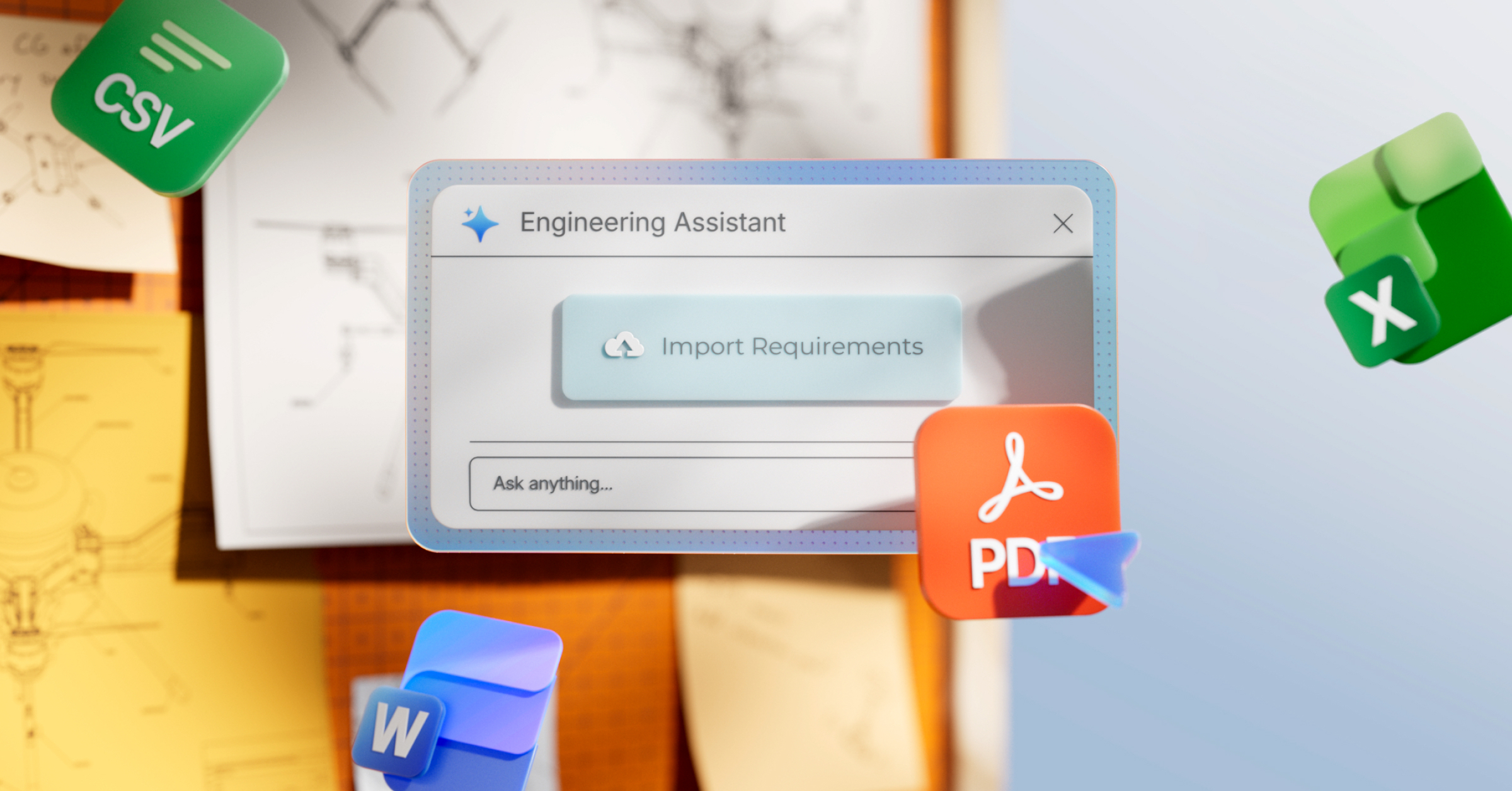
  • Capture and Share Requirements: See how to import requirements from any source and refine them with the Engineering Assistant, so your whole team has a shared starting point before the first design decision is made.
  • Build Repeatable Processes with AI Skills: Learn how to encode your team's standards, templates, and vocabulary into reusable AI Skills that keep requirements workflows consistent across every project.
  • Automate Always-On Quality Checks: See how Background Agents continuously monitor your requirements and surface quality, traceability, and coverage issues proactively, so your team catches mistakes before they spread.

Why Attend

  • Learn how to delegate requirements admin to AI agents, so your team spends more time on engineering decisions and less time maintaining documents.
  • See how every discipline gets accurate, context-aware answers from their requirements directly, without chasing context across documents.
  • Learn how to surface requirements health, verification coverage gaps, and compliance risks as early signals, not after-the-fact reports

Who Should Attend

  • Requirements Owners: Systems Engineers, Technical PMs, and NPD Leads responsible for keeping the team aligned.
  • Implementation Engineers: Electronics, mechanical, software, and verification engineers who need clear, accessible requirements during design.
  • Technical Leadership: Engineering Directors, VPs, and Program Managers accountable for delivery, compliance, and risk.

Reserve Your Spot

Register to see Agentic Requirements Engineering live, and bring your questions.
 

Requirements portal

Registration has recently closed. Check back soon for on-demand webinar.

Related Resources

00:41:17 Requirements ‑ Driven Design in Practice Learn how a requirements‑driven workflow connects intent to design and verification enabling your team to iterate faster. Watch Video
00:26:36 From Scattered Documents to Agile Requirements Discover how Requirements Portal transforms scattered documents into traceable requirements to accelerate hardware development. Watch Video

Related Technical Documentation

Creating Requirements Creating Requirements

There are three ways to create requirements in Requirements Portal: Creating manually Importing Requirements Use the Engineering Assistant to generate requirements based on a prompt This page describes how to create Requirements by manually adding the necessary information. To get more insights on the other two options, please use the links to get to the corresponding documentation. To add a new…

Read Documentation
Connections Graph and Status Connections Graph and Status

The other features in the Requirements Module are the Connections Graph and Status. Connections Graph The connections graph shows the parent-child, connected copy or master-follower relationships for all the requirements within the module. It also shows whether a requirement is verified or not. The user can easily differentiate this by looking at the colour code in the connections graph. To…

Read Documentation
Agentic Requirements Engineering Agentic Requirements Engineering

AI agents provide substantial advantages for engineering tasks like requirements capturing by significantly enhancing efficiency and automating complex, repetitive workflows. Requirements Portal's Engineering Assistant leverages AI technologies to provide you with fast, automated review tool for your requirements that allows you to ask questions about requirements in your current project in free…

Read Documentation
Insights Insights

The Insights feature in the requirements module provides a comprehensive visual summary of the current requirements status within the specification/section within your project. This interactive tool offers a high-level overview of various aspects, such as the state, verification status, and discussion activity on the requirements related to requirements across different folders, specifications,…

Read Documentation
Specifying the Product Specifying the Product

In this part of the tutorial, we will go through one of the primary user flows that can get you started using Requirements Portal: Gather and write requirements Breakdown requirements Review and improve requirements Approve and release specifications Creating a New Project On Requirements Portal's Home page (accessed when you open Requirements Portal from the nine-dot menu at the top right of the…

Read Documentation
QuickNav - Platform Key Capabilities QuickNav - Platform Key Capabilities

The Altium Platform (Altium 365) on which the various solutions from Altium – Altium Develop, Altium Agile Teams and Altium Agile Enterprise – are delivered, provides a myriad of features and functionality (depending on the solution you are subscribed to) to allow all of the key stakeholders, across multiple disciplines, to connect and collaborate in the creation of product designs in a secure,…

Read Documentation
Working with Requirements Working with Requirements

Altium's Requirements Portal is a requirements management tool purpose-built for electronic systems development. It enables the live exchange of formalized Requirements instances across your design projects, linking structured specifications to design data and verification activities. The complete documentation for Requirements Portal is available in the sub-pages here. See Features Explained for…

Read Documentation
New in Requirements Portal New in Requirements Portal

Requirements Portal is under continuous development. This page outlines new features and enhancements made to Requirements Portal in key updates. Update - 1 October 2026 This release includes bug fixes to enhance the overall functionality and user experience. Update - 21 September 2026 [collapse collapsed class="" title="Key Highlights" id="key_highlights_update_1_october_2026" data-inclusion-in…

Read Documentation
Grouping Requirements Grouping Requirements

In engineering projects, it is common for your Systems to have a large number of Specifications, containing many Requirements. In the Requirements Module, Specifications can be grouped into Folders. Additionally, each Specification can be further subdivided into Sections, Subsections etc. allowing easier navigation and organization of the requirements within your project. Organizing…

Read Documentation
Rest API and Python API Documentation Rest API and Python API Documentation

This page provides the reference for Requirements Portal's REST API. Using the REST API, you can get and modify data from Requirements Portal or even write data back into Requirements Portal and thus update information. Additionally, this gives you the possibility to connect/integrate with other applications. Accessing the Rest API in Requirements Portal using the Tokens To access the REST API in…

Read Documentation

AI Agents for Engineering Requirements

Created: July 14, 2026
At a Glance
Agentic Requirements Engineering just shipped. Learn how to use AI agents to accelerate your requirements workflows.
Go Deeper with AI:
ChatGPT Perplexity Claude Gemini Grok
5 videos
  • Hosted by Alkaios Bournias Varotsis, Ph.D. - Senior Product Marketing Manager at Altium
    00:41:21 • Jul 29, 2026
    Hosted by Alkaios Bournias Varotsis, Ph.D. - Senior Product Marketing Manager at Altium
    00:41:21 • Jul 29, 2026

    Agentic Requirements Engineering just shipped. Learn how to use AI agents to accelerate your requirements workflows. 

    View the presentation slides here.

  • Présenté par Majdi Thouabtia - Field Application Engineer
    00:27:39 • Jul 30, 2026
    Présenté par Majdi Thouabtia - Field Application Engineer
    00:27:39 • Jul 30, 2026

    La fonctionnalité Agentic Requirements Engineering vient de sortir. Apprenez à utiliser des agents IA pour accélérer vos processus de gestion des exigences.

  • Präsentiert von Konstantin Arnold - Field Application Engineer
    00:56:58 • Jul 30, 2026
    Präsentiert von Konstantin Arnold - Field Application Engineer
    00:56:58 • Jul 30, 2026

    Agentic Requirements Engineering ist soeben erschienen. Erfahren Sie, wie Sie mithilfe von KI-Agenten Ihre Anforderungsabläufe beschleunigen können.

  • Presentato da Francesco Cecchetti - Field Application Engineer
    00:41:45 • Jul 30, 2026
    Presentato da Francesco Cecchetti - Field Application Engineer
    00:41:45 • Jul 30, 2026

    L'Agentic Requirements Engineering è appena stato rilasciato. Scopri come utilizzare gli agenti AI per accelerare i tuoi flussi di lavoro relativi ai requisiti.

  • Presentado por Natalia Coria Perez - Field Application Engineer
    00:30:28 • Jul 30, 2026
    Presentado por Natalia Coria Perez - Field Application Engineer
    00:30:28 • Jul 30, 2026

    Agentic Requirements Engineering ya está aquí. Aprende a usar los agentes de IA para acelerar tus flujos de requisitos.

Product: Requirements Portal Webinars Altium 365 AI & Machine Learning Systems and Product Design Requirements Management
Other Recordings
Clear ×
Region
Language

Agentic Requirements Engineering just shipped. Learn how to use AI agents to accelerate your requirements workflows.

Good requirements keep the whole team aligned, trace directly to design decisions, and make verification straightforward. Most engineers know this, but the tools available have always made it harder than it should be.

Agentic Requirements Engineering, our newest capability in Requirements Portal, removes this bottleneck. In this webinar you get an exclusive first look at how AI agents work inside Requirements Portal and see what that means for your requirements workflows in practice.

What You'll Learn

  • Capture and Share Requirements: See how to import requirements from any source and refine them with the Engineering Assistant, so your whole team has a shared starting point before the first design decision is made.
  • Build Repeatable Processes with AI Skills: Learn how to encode your team's standards, templates, and vocabulary into reusable AI Skills that keep requirements workflows consistent across every project.
  • Automate Always-On Quality Checks: See how Background Agents continuously monitor your requirements and surface quality, traceability, and coverage issues proactively, so your team catches mistakes before they spread.

Why Attend

  • Learn how to delegate requirements admin to AI agents, so your team spends more time on engineering decisions and less time maintaining documents.
  • See how every discipline gets accurate, context-aware answers from their requirements directly, without chasing context across documents.
  • Learn how to surface requirements health, verification coverage gaps, and compliance risks as early signals, not after-the-fact reports

Who Should Attend

  • Requirements Owners: Systems Engineers, Technical PMs, and NPD Leads responsible for keeping the team aligned.
  • Implementation Engineers: Electronics, mechanical, software, and verification engineers who need clear, accessible requirements during design.
  • Technical Leadership: Engineering Directors, VPs, and Program Managers accountable for delivery, compliance, and risk.

View the presentation slides here.

Author

Author

Alkaios is a Senior Product Marketing Manager at Altium, where he leads go-to-market efforts for Requirements & Systems Portal. With over a decade of experience in advanced engineering design and manufacturing, he’s passionate about making new technologies and modern design practices accessible to broader teams. His background spans both hardware and software domains, with previous roles at nTop and 3D Hubs, where he worked with engineering teams on generative design, DfM, and agile engineering processes. He holds a Ph.D. in additive manufacturing and printed electronics from Loughborough University, UK.

More content by Alkaios Bournias Varotsis, Ph.D.

Author

Author

Majdi Thouabtia’s background is in electrical engineering, with several years of experience in hardware development and technical project management. He has worked across the full hardware lifecycle, from EMC-compliant circuit design and PCB layout to prototyping, testing, and production. Throughout my career, Altium Designer has been a key tool in his daily work, so he is especially proud to now be part of the team behind it.

Before joining Altium, he contributed to projects in the EV charging and IoT sectors, leading development efforts and collaborating with cross-functional teams and external partners. He holds a Master’s degree in Electrical Engineering from FAU Erlangen-Nürnberg.

More content by Majdi Thouabtia

Author

Author

Konstantin is a Field Applications Engineer (FAE) at Altium and holds a B.Eng.(EE) and a M.Sc.(SEEM) in electronics and is based in Soest, Germany. He is a technical enthusiast with a passion for Electrical and Electronic Design with 10+ years industry experience in R&D, NPI, Product Definition for semiconductors, embedded systems, power electronics, Inverter, SMPS and industrial measurement systems. As an Altium user from the beginning of his career, he appreciates a lean PCB design workflow for High Speed Designs, MCAD/FEM Integration and Supply Chain handling to accelerate design cycle times with outstanding quality at the same time. He is always passionate about innovative technical problems that challenge the status quo, can classify them within the project/company framework and strive for practical & customer-oriented solutions that offer added value for society.

More content by Konstantin Arnold

Author

Author

Francesco holds a Master's degree in Electrical Engineering from EPFL, Switzerland. He is currently part of the Field Applications Engineering team at Altium. During his studies, his primary focus was on bioelectronics and the microfabrication of biomedical implants. After graduating, Francesco transitioned into a technical sales role with a global supplier and manufacturer of custom magnetics, where he was responsible for both technical and sales discussions, serving as the liaison between design engineers, manufacturing engineers, and customers.

More content by Francesco Cecchetti

Author

Author

Natalia holds a Master’s in Electronic Design and brings nearly 15 years of experience in hardware design, testing, and field applications engineering. Her expertise includes high-level hardware architecture, schematic capture, board bring-up, and debugging. Comfortable in the lab and in customer-facing roles, Natalia has spent the last three years providing technical guidance in PCB and 3D design for Additive Manufactured Electronics (AME). Her role includes pre and post sales support, along with onboarding training for new users.

More content by Natalia Coria Perez

Related Resources

00:41:17 Requirements ‑ Driven Design in Practice Learn how a requirements‑driven workflow connects intent to design and verification enabling your team to iterate faster. Watch Video
00:26:36 From Scattered Documents to Agile Requirements Discover how Requirements Portal transforms scattered documents into traceable requirements to accelerate hardware development. Watch Video

Related Technical Documentation

Creating Requirements Creating Requirements

There are three ways to create requirements in Requirements Portal: Creating manually Importing Requirements Use the Engineering Assistant to generate requirements based on a prompt This page describes how to create Requirements by manually adding the necessary information. To get more insights on the other two options, please use the links to get to the corresponding documentation. To add a new…

Read Documentation
Connections Graph and Status Connections Graph and Status

The other features in the Requirements Module are the Connections Graph and Status. Connections Graph The connections graph shows the parent-child, connected copy or master-follower relationships for all the requirements within the module. It also shows whether a requirement is verified or not. The user can easily differentiate this by looking at the colour code in the connections graph. To…

Read Documentation
Agentic Requirements Engineering Agentic Requirements Engineering

AI agents provide substantial advantages for engineering tasks like requirements capturing by significantly enhancing efficiency and automating complex, repetitive workflows. Requirements Portal's Engineering Assistant leverages AI technologies to provide you with fast, automated review tool for your requirements that allows you to ask questions about requirements in your current project in free…

Read Documentation
Insights Insights

The Insights feature in the requirements module provides a comprehensive visual summary of the current requirements status within the specification/section within your project. This interactive tool offers a high-level overview of various aspects, such as the state, verification status, and discussion activity on the requirements related to requirements across different folders, specifications,…

Read Documentation
Specifying the Product Specifying the Product

In this part of the tutorial, we will go through one of the primary user flows that can get you started using Requirements Portal: Gather and write requirements Breakdown requirements Review and improve requirements Approve and release specifications Creating a New Project On Requirements Portal's Home page (accessed when you open Requirements Portal from the nine-dot menu at the top right of the…

Read Documentation
QuickNav - Platform Key Capabilities QuickNav - Platform Key Capabilities

The Altium Platform (Altium 365) on which the various solutions from Altium – Altium Develop, Altium Agile Teams and Altium Agile Enterprise – are delivered, provides a myriad of features and functionality (depending on the solution you are subscribed to) to allow all of the key stakeholders, across multiple disciplines, to connect and collaborate in the creation of product designs in a secure,…

Read Documentation
Working with Requirements Working with Requirements

Altium's Requirements Portal is a requirements management tool purpose-built for electronic systems development. It enables the live exchange of formalized Requirements instances across your design projects, linking structured specifications to design data and verification activities. The complete documentation for Requirements Portal is available in the sub-pages here. See Features Explained for…

Read Documentation
New in Requirements Portal New in Requirements Portal

Requirements Portal is under continuous development. This page outlines new features and enhancements made to Requirements Portal in key updates. Update - 1 October 2026 This release includes bug fixes to enhance the overall functionality and user experience. Update - 21 September 2026 [collapse collapsed class="" title="Key Highlights" id="key_highlights_update_1_october_2026" data-inclusion-in…

Read Documentation
Grouping Requirements Grouping Requirements

In engineering projects, it is common for your Systems to have a large number of Specifications, containing many Requirements. In the Requirements Module, Specifications can be grouped into Folders. Additionally, each Specification can be further subdivided into Sections, Subsections etc. allowing easier navigation and organization of the requirements within your project. Organizing…

Read Documentation
Rest API and Python API Documentation Rest API and Python API Documentation

This page provides the reference for Requirements Portal's REST API. Using the REST API, you can get and modify data from Requirements Portal or even write data back into Requirements Portal and thus update information. Additionally, this gives you the possibility to connect/integrate with other applications. Accessing the Rest API in Requirements Portal using the Tokens To access the REST API in…

Read Documentation
Back to Home
Logo Agentic RE

Better Requirements
Less Busywork

Build better hardware with AI agents that live and act in your requirements tool.

Learn More

Altium Develop
Manage Engineering Requirements

Capture requirements and link them to electronic designs, systems, verification, and test cases.

Learn More
Altium Develop
Requirements Portal

Iterate faster with a requirements management tool your whole team can access.

Learn More
Altium Develop
Verify & Validate

Plan and link test cases to requirements and electronic designs.

Learn More
Platform-based Solutions
  • Octopart Discover
  • Altium Develop
  • Altium Agile Teams
  • Altium Agile Enterprise
Tools
  • Altium Designer
  • Octopart
Platform
  • Altium 365
Company
  • Our Customers
  • Trust Center
  • Newsroom
Software Capabilities
  • PCB Layout and Design
  • Requirements Management
  • Electronics Data Management
  • IT Security
  • Electronics Manufacturing
  • Electronics Supply Chain
  • Engineering Management
Resources & Support
  • Status
  • Downloads
  • Learning Hub
  • Support Center
  • Bug Crunch
  • Forum
  • Documentation
  • Ideas
  • Education
  • Professional Training / Certification
  • Webinars
  • Beta Program
Education
  • Student Lab
  • Educator Center
  • Altium Education Curriculum
Careers
  • Career at Altium
  • Copyrights & Trademark
  • Privacy policy
  • Cookie policy
  • Terms of Service
  • Legal
© 2026 Altium LLC.