







Building a Supply Risk Plan That Survives 2027

At a Glance
This article focuses on creating a robust supply risk plan to navigate the challenges anticipated in 2027, particularly regarding supplier contracts and cost fluctuations. It provides actionable steps for sourcing managers, such as auditing vendor lists, setting buffer rules for critical parts, and developing a scoring system for suppliers beyond price.


With supplier contracts up for renewal and Q1 budgets due, a sourcing manager at an industrial equipment maker starts the team’s 2027 supply plan in November by reviewing the team’s 2026 costs and component notices. Like many buyers this year, the team has absorbed higher prices on some STMicroelectronics automotive MCUs, which climbed 15 to 20% before a third 2026 price increase landed in August.
Then, in September, word came that Murata is phasing out some general-purpose MLCCs, including families used on several of the team’s boards. The MCU price increases feed into a revised cost model, and the affected MLCCs enter engineering’s qualification queue.
By building a supply risk plan, the team decides in advance how to respond to changes like these: which parts need protection, who approves extra inventory, and when engineering must qualify an alternate. The plan’s rules and owners can be settled before Q1 orders go out, while engineering finishes longer qualifications on its own schedule.
Key Takeaways
- Settle the plan before contract renewals close. Q1 also brings first-half production buys, and Micron expects memory to be harder to source in 2027 and 2028 than it is today.
- Start with the approved vendor and manufacturer lists. Flag sole-source, single-region, NRND, and EOL parts, and give engineering deadlines to qualify alternates.
- Protect critical parts, and score suppliers on more than price. Set buffer rules for parts whose shortage would stop production or delay deliveries, and add channel status, commit performance, lifecycle notices, and terms to supplier scorecards.
- Test the plan against a dated event. Run one scenario, such as the June 23, 2027 Section 301 increase on China-origin chips, and check lifecycle status for parts on every active BOM quarterly.
Why Finish the Plan by Year-End
When Gartner surveyed sourcing and procurement leaders in mid-2024, 42% ranked supply disruption among the top three risks to their team’s future success. Memory is the clearest example for 2027. Micron expects memory to be harder to source in 2027 and 2028 than it is today, and on its September 30 earnings call, CEO Sanjay Mehrotra said the company has committed more than 75% of its 2027 output to customers. A buyer who waits until spring to place 2027 memory forecasts could have a hard time finding uncommitted supply.
Beyond memory challenges, sourcing managers face Q1 deadlines for contract renewals and first-half production buys. A plan finished in December can set terms for both, while one finished in March may reach only later buys. For a closer look at supply by component type, see Will 2027 Loosen Up? The Category-by-Category Outlook, and use the five steps below to get started.
Five Steps to a 2027 Supply Risk Plan
1. Audit the Approved Vendor and Manufacturer Lists
Go through both lists and flag any part that is sole-source, single-region, or without a qualified alternate, along with parts marked not recommended for new designs (NRND) or end of life (EOL). In McKinsey’s Supply Chain Risk Pulse 2025, 95% of the 100 companies surveyed reported visibility into at least tier-one supplier risks, but only 42% into tier two or beyond, which typically includes the wafer fabs and assembly sites that produce a part. Ask suppliers and distributors where each critical part is fabricated and assembled, and note where two approved sources share the same site.
Memory also deserves a closer look. Check DDR4 and LPDDR4 lifecycle status by part number, not by memory type. When Micron issued EOL notices for both in June 2025, it said supply would continue for long-term customers. Ask your supplier for written confirmation of the specific part numbers, quantities, and support period for your account.
MLCCs carry a different kind of risk. Leading Japanese and Korean makers are moving capacity from consumer parts toward AI applications, and Dell, HP, ASUS, and Acer have begun qualifying Chinese makers Viiyong and Chaozhou Three-Circle. Flag any MLCC sourced only from Japanese and Korean makers.
Close the audit by sending engineering a prioritized list of parts that need alternates, with qualification deadlines tied to production needs.
2. Set Buffer Rules for Critical and Long-Lead Parts
With the audit done, decide which parts need a buffer. Start by defining a critical part as one whose shortage would stop production or delay a customer delivery, and rank sole-source, long-lead, and allocated parts highest. For each critical part, check that usable stock and confirmed open orders cover every build, with each delivery due before the build that needs it. Name who approves extra safety stock, since it ties up cash and can involve non-cancelable orders.
Lead times show why this can’t wait. In August 2026, TrendForce News reported that power device lead times were mostly above 30 weeks, with some at 52. With those lead times, most power parts need to be ordered at least seven months before the build, and some sole-source parts a year ahead. For memory, send forecasts to suppliers this quarter, then confirm the quantities and delivery dates they accept.
If engineering keeps a watchlist of hard-to-replace parts, as described in Set Your Component Watchlist Now, Not After the Shortage, use that as your starting point. Once the BOM is frozen and procurement starts buying for production, it can set its own below-threshold stock alerts at production quantities.
3. Score Suppliers on More Than Price
Once buffer rules are set, the next question is which suppliers will deliver on confirmed orders. Most supplier scorecards weigh price and on-time delivery, but for 2027, add four criteria that show how each supplier performs when supply is tight:
- Authorized-channel status: whether the supplier is authorized for each product line it sells you, with documentation that traces parts back to the manufacturer.
- Allocation and commit performance: how the quantities and delivery dates the supplier accepted in 2026 compare with what shipped.
- Lifecycle notices: how promptly and completely the supplier passes along manufacturer notices, including the affected part numbers.
- Cancellation and rescheduling terms: what the supplier allows, and who carries the cost of excess inventory if demand drops.
Keep lifecycle status and country of origin with each part on the Step 1 list rather than on the scorecard, since both describe the part, not the supplier.
Weigh the four criteria alongside price, and rescore suppliers at quarterly plan reviews. Compare China-origin quotes on landed cost at current duty rates, since a higher base price from a non-China source may end up costing less after tariffs.
4. Run One Scenario Against a Dated Event
A scenario shows how the plan holds up under one specific change. Pick one dated event and work out its effect on the 2027 plan. For programs that import into the US, a good candidate is June 23, 2027, when the second Section 301 action on China-origin chips moves from its current 0% rate to a level the Office of the US Trade Representative (USTR) will publish at least 30 days ahead.
That increase is separate from the 50% Section 301 duty already in force since January 2025 on listed China-origin parts in Harmonized Tariff Schedule (HTS) headings 8541 and 8542. For many programs, June 23 lands in the middle of the year’s builds. To see how that affects your 2027 plan, start with four questions:
- Which BOM lines carry China-origin 8541 or 8542 parts?
- Which of those lines have a qualified non-China alternate?
- What is the landed cost at two or three plausible tariff rates, and who bears that cost under the purchase terms?
- Would bringing parts into the US before June 23 reduce the exposure enough to justify the added cash, storage, and obsolescence risk?
On that last question, the duty rate generally depends on the date goods enter the US, not the purchase order date (19 CFR 141.69). Before moving buys forward, confirm classification, origin, and entry timing with your customs broker, or with the distributor if it is the importer of record.
Two earlier dates also belong on your calendar. China’s suspension of its ban on gallium, germanium, and antimony exports to the US ends November 27, 2026, and the US-China trade truce runs to January 10, 2027, unless extended. Rerun the scenario when USTR publishes the June rate, then adjust affected buy dates and quantities.
5. Monitor Lifecycle Status on Every Active BOM
Murata’s reported MLCC discontinuation shows why lifecycle checks need dates attached. Distributor Component Sense reports that the notice covers select part numbers across nine series, with written confirmation of requirements due by December 31, 2027, a last order date of March 31, 2028, and last shipment by March 31, 2029. Get the notice from Murata or an authorized distributor and confirm which of your part numbers it covers before acting. Then put the confirmation deadline on the plan calendar.
Every supplier handles discontinuations a little differently. Ask each one how much advance warning it gives before discontinuing a part, and whether it follows IPC/JEDEC J-STD-048A, the notification standard for product discontinuance.
Between quarterly reviews, assign one person to read manufacturer and distributor notices as they are received, update the Step 1 list, and alert engineering when a part on an active BOM is affected.
At the quarterly plan review, load every active BOM into the Octopart BOM Tool, which shows lifecycle status (Active, NRND, EOL, or Unknown) for each matched line. Add new NRND or EOL lines to the Step 1 list, and check any line marked Unknown with the manufacturer.
Keep the Plan to One Page
When we looked at the sourcing manager’s situation earlier, the MCU price increases and the Murata news had just landed on the team’s desk. The finished plan now fits on one page (you can check an example plan below). For each critical exposure, it lists the trigger, who acts, and who approves extra inventory or spending.
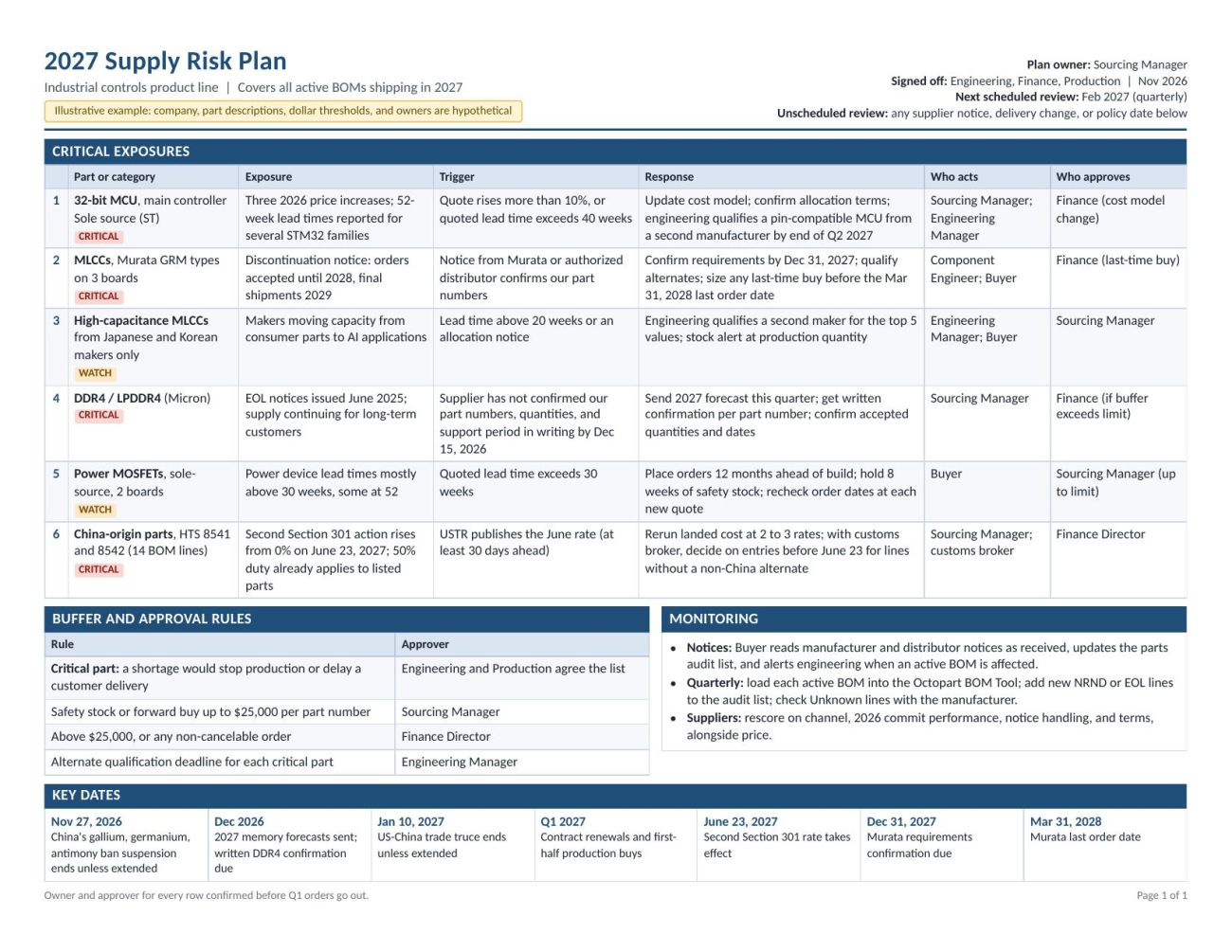
The team reviews the plan every quarter and whenever a supplier notice, delivery change, or policy date affects it. So when the next MCU price increase or MLCC discontinuation notice arrives, the response already has an owner and an approval path.
The fastest way to start the Step 1 audit is to load your active BOMs into the Octopart BOM Tool and filter for NRND and EOL lines. That list becomes the foundation for the rest of the plan. The goal is a one-page draft reviewed with engineering, finance, and production before December contract renewals close.

About Author
Related Resources
Related Technical Documentation
Table of Contents
Solutions for Every Role and Team
- Discover and evaluate design options earlier
- Develop in one shared workspace
- Scale with control and compliance
- Connect every stage of hardware development
Learn More
Thank you, you are now subscribed to updates.