






How Hardware Teams Are Shifting From Reactive to Proactive Supply Chain Management

At a Glance
Learn how hardware teams are moving from reactive supply chain management to proactive component risk monitoring using real-time BOM data, obsolescence management, approved alternates, and closer engineering-procurement collaboration.


At its core, “resilience” is deceptively simple: anticipate problems and do something about them before they impact your business. But shifting from reactive crisis management to preventive adaptation requires foresight and visibility into the critical data points that foster risk, as well as cross-functional collaboration and ownership. Properly enabled, teams are getting there. Here’s how.
Proactive electronics supply chain management means identifying component availability, lifecycle, cost, and sourcing risks before they affect a design or production schedule. Instead of relying on periodic BOM reviews and disconnected spreadsheets, hardware teams can integrate real-time component intelligence, automated BOM monitoring, obsolescence management, and cross-functional engineering and procurement workflows directly into product development.
Key Takeaways
- Shifting component intelligence and real-time distributor data directly into the ECAD design environment prevents costly redesigns and downstream obsolescence surprises before a design is locked.
- Identifying alternative components and establishing live BOM monitoring reduces end-of-life (EOL) response times and replaces manual, error-prone spreadsheet updates.
- Unifying engineering and procurement views within a shared, cloud-based platform eliminates data silos, closing the communication gap where supply chain risks typically slip through.
- Proactive obsolescence management can reduce related disruption costs by up to 80%, allowing engineering and procurement teams to shift focus from reactive firefighting to innovation.
Why Reactive Supply Chain Management Keeps Happening
In most organizations, the data needed to catch risk early exists, somewhere. It's just not where anyone has time to look for it. The problem is often fragmented supply chain visibility rather than a complete lack of data.
Component data often sits in a spreadsheet that's updated quarterly, at best. The BOM lives in a separate file that only syncs with the design when someone remembers to export it. Lifecycle status, if tracked at all, is checked manually against distributor websites, leaving status tags like Not Recommended for New Designs (NRND) to go unnoticed. By the time someone connects the dots ("this part shows NRND" to "this part is on twelve active boards"), a change order is long overdue. These disconnected workflows prevent teams from seeing component lifecycle risk in the context of the designs, BOMs, and production schedules that depend on those parts.
The difference between a team that catches a shortage early and one that finds out at the worst possible time is monitoring. Teams that stay ahead of component risk have built a system (tools, data sources, and workflows) that surfaces problems while there's still time to act on them. Teams that fail to pivot are stuck reacting to problems that have already become production crises.
But data isn’t the only culprit. Organizational structure and siloed mindsets leave risk unowned, and, therefore, falling through the cracks. Engineers are focused on design. Procurement is focused on cost and lead time. Neither has a shared, live view of how the two intersect, so risk gets discovered at handoff points instead of being prevented upstream.

What Proactive Teams Do Differently
You don’t need to increase your headcount or necessarily even acquire more data. Success despite disruption requires refining internal workflows and embedding the kind of systematic governance that only automated tools can truly sustain.
Proactive supply chain management shifts component risk identification earlier in the product development lifecycle. Instead of responding after a sourcing problem affects production, engineering and procurement continuously evaluate component availability, lifecycle status, cost, and alternatives while designs are still flexible.
1. Component data lives inside the design environment, not next to it
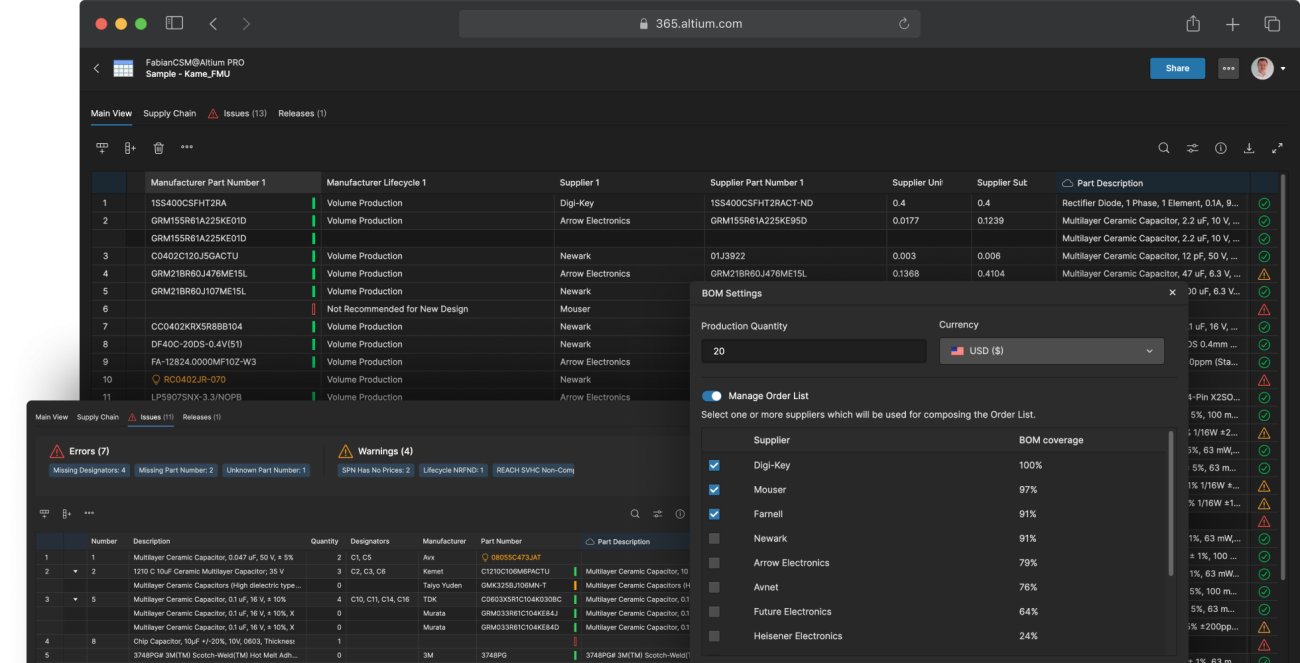
The biggest improvements come from shifting BOM and component data out of static spreadsheets and into a system connected directly to the ECAD environment via Altium Agile Teams. When engineers see live pricing, stock levels, lead times, and lifecycle status (including NRND and EOL flags) directly inside the ECAD environment, they make supply-chain-aware decisions before the design is locked.
This approach brings supply chain intelligence into component selection, allowing engineers to consider availability and lifecycle risk alongside electrical performance and design requirements.
2. Automated BOM monitoring replaces manual status checks
Automated BOM monitoring turns component risk management from a periodic review into a continuous process. To be sustainable, processes must be practical. Live data feeds don't just help track risk, but give engineers and procurement the immediate visibility needed to identify and execute component changes early. Connecting the central part library to up-to-date distributor and manufacturer data turns BOM monitoring into an active guardrail that surfaces shortages, price spikes, and lifecycle shifts automatically.
This allows teams to detect changes in availability, lead times, pricing, and lifecycle status while there is still time to qualify an alternate or adjust the design.
3. Obsolescence gets managed before it's a crisis
Rather than scrambling when a part is marked Not Recommended for New Designs (NRND) or End-of-Life (EOL), proactive teams establish approved substitutes ahead of need. Modern BOM management tools surface suggested alternative parts and deliver precise multi-board ‘where-used’ visibility down to the exact board revision. Teams can see every design impacted by an EOL or NRND part in seconds, then swap in a pre-approved alternate, turning what used to be a lengthy investigation into an immediate impact assessment and risk mitigation.
4. Procurement and engineering work from the same view
Proactive teams don't treat BOM risk as a procurement problem. A shared, cloud-based BOM portal (rather than a spreadsheet passed back and forth) means procurement can flag a sourcing risk in context, and engineering can see the cost and availability impact of a design decision before it ships to manufacturing. Co-designing the BOM between the two functions closes the gap where most risk inadvertently slips through.
5. Structure replaces manual re-checking
None of this scales if it depends on someone remembering to check. Proactive teams standardize the work through configurable workflows so every part request or engineering change automatically checks against lifecycle and availability data. Repeatable processes trump ad-hoc efforts every time.
The Payoff: Risk and Cost Avoided
The numbers are worth writing to the CFO about. A 2025 ByteSnap survey of electronics manufacturers found that companies managing obsolescence proactively cut related costs by up to 80% compared with those who respond after the fact.
Electronics manufacturers see hundreds of thousands of components reach end-of-life every year (nearly 473,000 in 2023 alone, according to Z2Data) and close to 30% of those arrive with no advance product change notice at all, leaving no lead time to react. The operational benefit comes from increasing the amount of time available to respond. A lifecycle warning discovered during design may require a simple alternate-part decision, while the same warning discovered immediately before production can require expedited sourcing, redesign, or schedule changes. That’s a lot of risk that could and should be thwarted early in the process.
But the case for proactive supply chain management isn't just about avoiding a shortage crisis (although that’s imperative in 2026 and beyond); it’s about stopping the time-consuming investigative hunts and firefighting so your people can better spend their time. When component risk is visible early and BOM data is trustworthy by default, engineers spend less time investigating problems and procurement spends less time firefighting, creating space for strategic innovation and continuous improvement to flourish.
Building the Monitoring System, Not Just Buying a Tool
Shifting from reactive to proactive isn't a single tool purchase, but means connecting people, processes, and data so that risk is visible and actions enabled with trustworthy data right where decisions actually get made. That's the model behind Altium Agile Teams, a platform that gives multidisciplinary electronics teams the structure and control to collaborate without slowing down. It brings together role-based access, structured design reviews, live BOM visibility with connections to distributor and manufacturer data, a central part library with lifecycle and alternative-part management, and configurable workflows that make part requests and change reviews consistent instead of manual. Engineering and procurement work from the same live data, so a shortage risk gets caught while there's still time to design around it, not after the build is already scheduled.
Component risk isn't going away. But teams that build the monitoring system now are the ones who'll catch the next shortage in a status alert, not in a missed production date.
Modernizing your supply chain workflows doesn't require extra headcount or complex IT setups. See how Altium Agile Teams delivers live BOM intelligence, automated risk monitoring, and seamless cross-functional collaboration.

About Author
Related Resources
Related Technical Documentation
Table of Contents
Speed at Scale. Structured Repeatability. Secure Flexibility.
- Start up fast with out‑of‑the‑box workflows
- Collaborate using ECAD‑MCAD codesign tools
- Manage BOMs with live supply chain part data
- Manage access and security as teams scale
Contact Us
Thank you, you are now subscribed to updates.