Download PDF




Migration Guide CADSTAR to Altium Designer Develop


Smooth Transition from CADSTAR to Altium Designer Develop
For the purpose of this migration guide we are going to focus on importing CADSTAR Schematic and PCB Designs, if
you require other files migrated please refer to their specific guide.
Legacy Translation
Before You Start to Import
This guide will show you how to import data from your legacy system into Altium Designer Develop. What it will not ask
is “why do you want to do it?” Customers frequently ask about data import facilities before we go forward however we
need to ask ourselves why.
"We have 20 years of data, and I don’t want to leave it behind.
- Does the data include all necessary information to create a robust representation within Altium?
- Is it easier to “draw a line in the sand” and start new designs in the new system rather than re-work the imported data to make it usable?
"Our service bureau doesn’t use Altium but they can import Altium data. Our Altium system can import their data, is this a reliable way to pass designs between our companies?
- How do you maintain library integrity?
- Who has design authority?
- How do you plan to verify the data?
"We have some ‘golden’ designs that we need to bring into Altium Designer Develop so that we can up-issue them.
- How do you plan to verify the imported data?
- How much re-work is going to be allowed after importing?
- Do you need to take advantage of additional features of Altium once imported and how do you plan to achieve this?
"We have a library of trusted parts which we’d like to bring into Altium.
- Are there any exotic parts that you may have trouble representing within Altium?
- Do you need to add Altium-specific features (like 3D models) for every part?
- How much redundancy, duplication and error is present in your library?
So, after considering these points you should read on if you still wish to import your legacy data into Altium.
Preparing to Migrate Your Legacy Data
Never forget that migration of data follows the «garbage in....more garbage out» principle. So we need to consider four distinct phases of the process, this is best shown in the flow diagram below:
1. Prepare original data
|
2. Export data
|
3. Import data
|
4. Post import
|
Step 1: Prepare Original Data - Pre-Translation Tidy Up
It is prudent to clean and tidy your design within your legacy system before trying to export. We’ve put together a check list to help you:
Schematic considerations:
-
Single pin components representing power objects?
-
Connectors represented as one-gate-per-pin with over 256 «gates».
-
Ambiguous connectivity.
-
Hidden pins or implicit connections.
-
Local net names.
-
Case sensitivity.
-
Do the schematic symbols call up the correct PCB footprints?
-
Does the schematic match the PCB?
PCB considerations:
- Large number of graphical objects or drawing primitives on documentation layers.
- Star point earths.
- Deliberate DRC violations.
- Objects extending beyond the environment.
- Known PCB layer assignments.
- Do the auto-named nets match with schematic?
Library considerations:
- Schematic symbols matching with PCB footprints.
- Correct supply chain information and BoM. parameters
- Need to import 3D information?
- Correct representation of custom pads, copper shapes, solder mask and resist?
Step 2: Save Data in a Suitable Format
Supported Versions and File Formats
The following table details the versions of all the file types of CADSTAR Designs that can be migrated into Altium Designer Develop. Note that this list is updated all of the time, so please check with us for specific systems and versions before undertaking migration.
| TYPE | SYSTEM | VERSION | FORMAT |
| Schematic | CADSTAR | 18 | ASCII (.csa) |
| PCB | CADSTAR | 18 | ASCII (.cpa) |
| Schematic Library | CADSTAR | 18 | ASCII (.csa) |
| PCB Library | CADSTAR | 18 | ASCII (.cpa) |
The importer supports up to CADSTAR version 17. The importer does not support binary CADSTAR files. The binary CADSTAR file must be converted to CADSTAR archive file before importing to Altium Designer Develop. The CADSTAR archive file has the extension .cpa or .csa. The importer supports the following CADSTAR file types:
- PCB design
- PCB component library
- Schematic design
- Part library and schematic symbol library
The following table describes the types of CADSTAR files the importer supports with the description of how to convert CADSTAR binary files to CADSTAR archive files and the equivalent Altium Designer Develop output.
| CADSTAR FILE TYPE | EXPORT TO CADSTAR ARCHIVE | ALTIUM DESIGNER DEVELOP OUTPUT |
| PCB design (.pcb) | Use CADSTAR File->Export to convert the binary pcb design (.pcb) to CADSTAR PCB archive (.cpa) | Altium Designer Develop PCB document (.PcbDoc) |
| Schematic design (.scm) | Use CADSTAR File->Export to convert the binary schematic design (.scm) to CADSTAR schematic archive (.csa) | Altium Designer Develop schematic document (.SchDoc) |
| PCB Library (.lib) | Use the archive tool in CADSTAR Libraries->PCB Components... to convert the binary pcb library (.lib) to CADSTAR PCB archive (.cpa) | Altium Designer Develop PCB library (.PcbLib) |
| Part Library (.lib) and Schematic Symbol Library (*.lib) |
The part library (.lib) file is already in ASCII file format. You do not need to do any conversion on the part library. Use the archive tool in CADSTAR Libraries->Schematic Symbols to convert the binary symbol library (.lib) to CADSTAR schematic archive (.csa) | The importer uses both the parts.lib and the symbol schematic archive (.csa) to output an Altium Designer Develop schematic library (.SchLib) |
Step 3: Import Data into Altium
Using the Import Wizard for CADSTAR Files
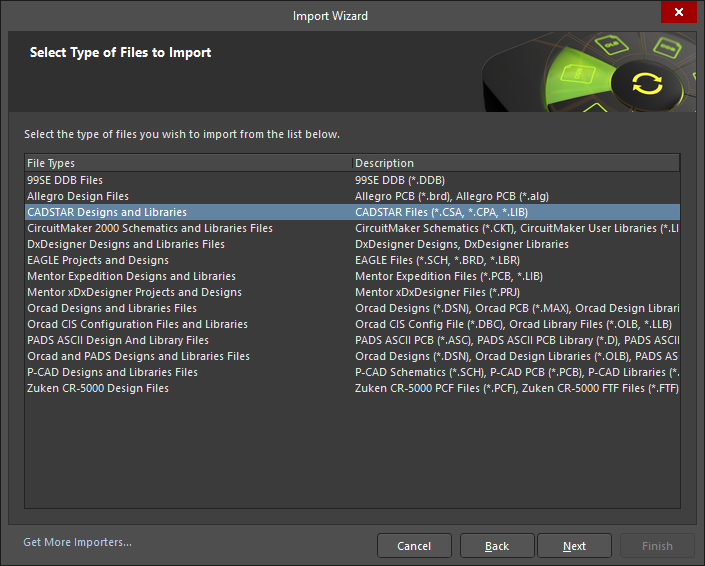
The Import Wizard can be launched from the Altium Designer Develop File menu. Choose the CADSTAR Designs and Libraries option as shown in the screenshot below. On the “Importing CADSTAR Design Files” screen, click the Add button to choose the CADSTAR files. Multiple files can be translated at the same time. Step- by-step instructions on using the Import Wizard follow next.
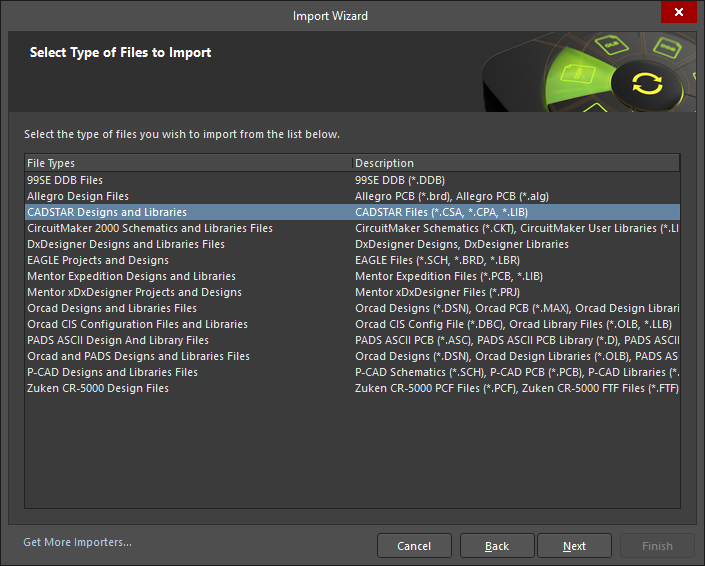
Starting the Import Wizard for CADSTAR Files
Step-by-Step Import Instructions on Importing a CADSTAR Design
The following CADSTAR Design, has been exported from CADSTAR in PCB archive (.cpa) and Schematic archive (.csa) format.
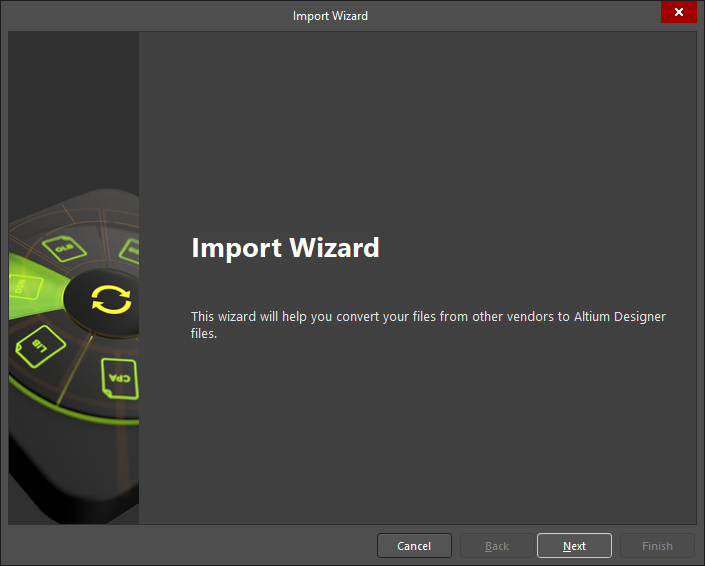
- Start the Import Wizard with File » Import Wizard
- Select Type of Files to Import—>CADSTAR Designs and Libraries.
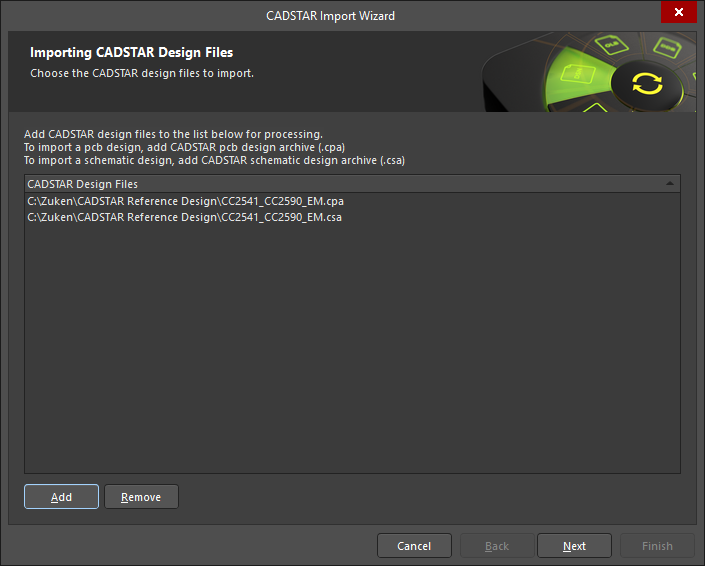
- Add the file(s) to be translated. In this case, both the Schematic and PCB files are going to be added, specifically “Reference_Design_CC2541. CSA” and “Reference_Design_CC2541.CPA”. By importing them at the same time, Altium will automatically create a project containing both files.
NOTE:
You can add as many design files at this point. However, if you add files of a different file name,
separate projects will be created.
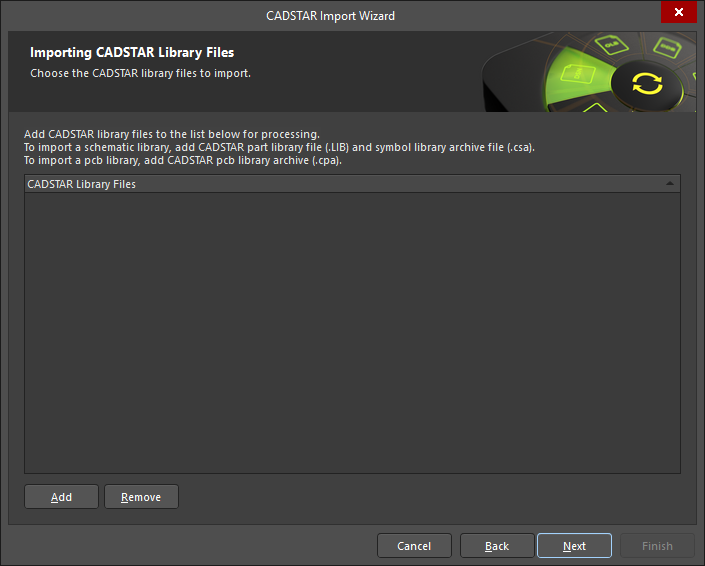
- In the next step you can add your Schematic or PCB Libraries to import (if available).
NOTE:
Because the library part and decal information is included in the source files, it is not necessary to
add libraries for schematic or PCB files to successfully translate. Only add libraries to this screen if
you wish to independently translate entire libraries for later use in Altium Designer Develop.
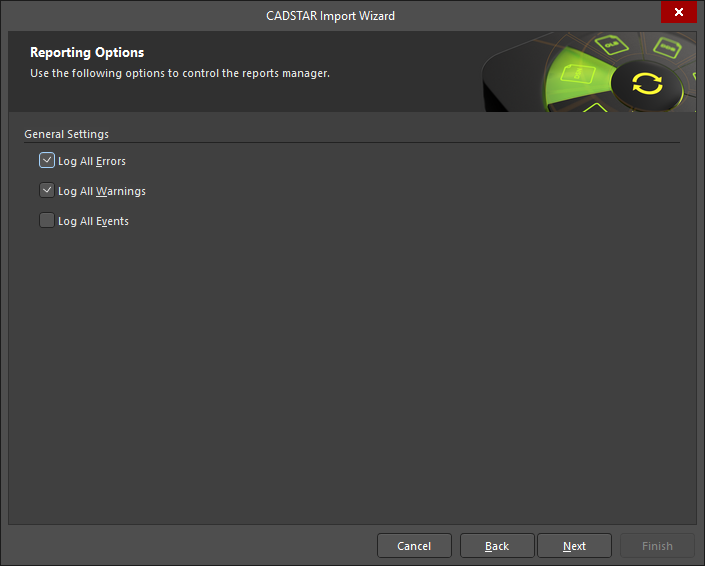
- Set the options for what level of reporting is done after the translation has completed..
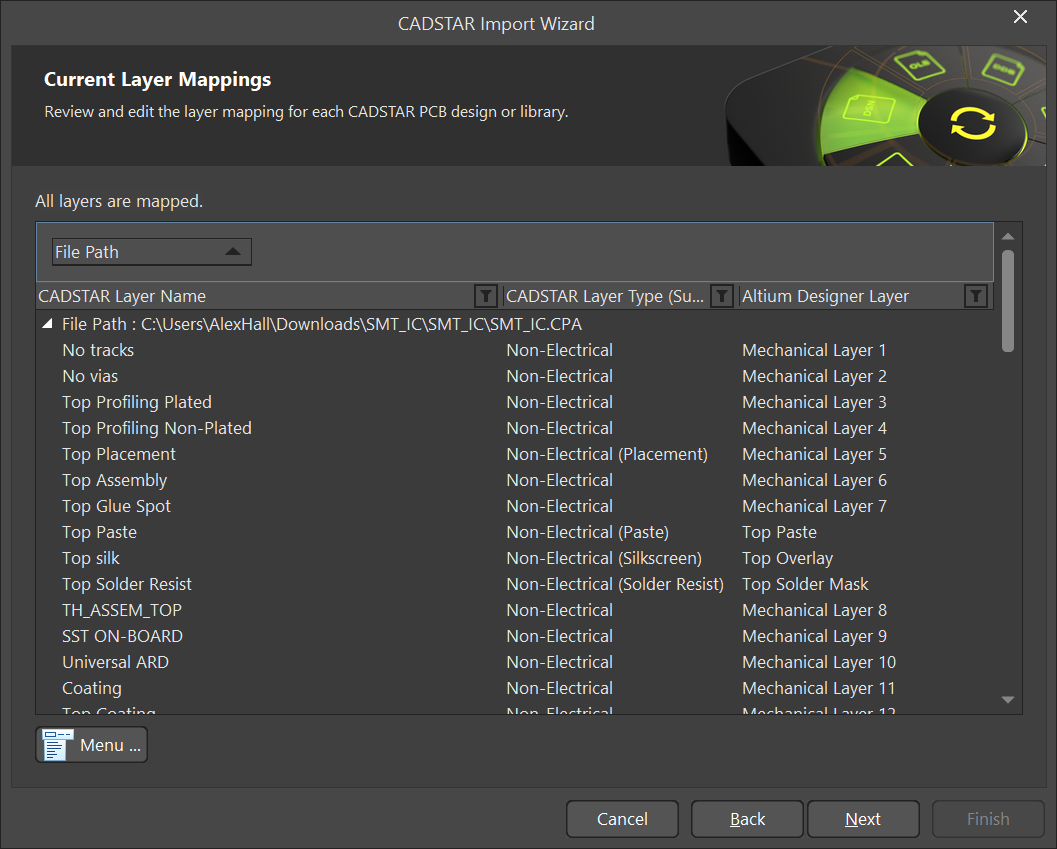
- Layer Mapping
CADSTAR PCB files will be analysed before translation to best determine how layer definitions in CADSTAR will be mapped to Altium Designer Develop layers. Efforts will be made to ensure, for instance, CADSTAR silk layers map to Altium silkscreen layers. Layer mapping can be manually adjusted if desired. In addition, CADSTAR layers can be set to “No Layer” if information from a particular layer can be discarded. Specific to internal layers, CADSTAR’s inner signal layers will be initialized as Altium signal layers (e.g., “Mid Layer 1”). CADSTAR’s Powerplane layers will be initialized as Altium Plane Layers (e.g., “Internal Plane 1”), which are negative- image planes similar to CADSTAR’s Powerplanes. CADSTAR’s inner layers defined as Split/Mixed layers will be initialized as Altium signal layers if any trace or other positive image electrical data is present. If the Split/ Mixed layer only has pour shapes it will be initialized as an Altium Plane layer, and imported with all split, embedded, and isolated plane areas intact. This setting, as mentioned, can be changed manually by the user.
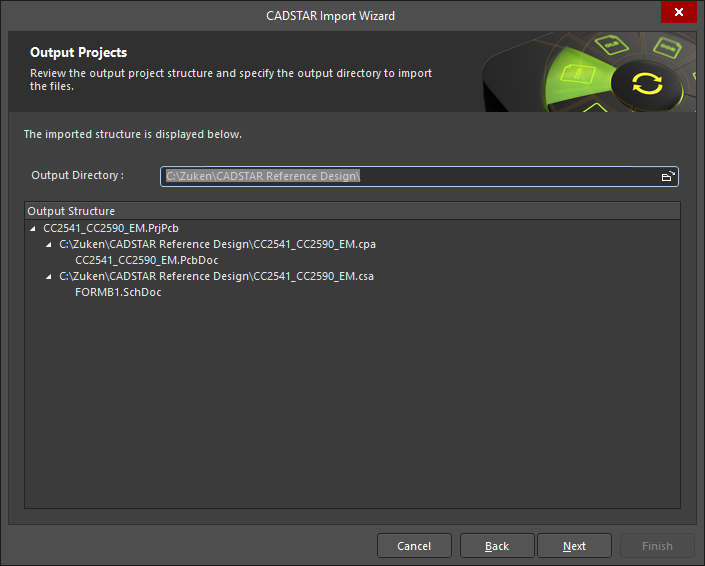
- A preview of the files being translated, and their output directories are shown. You can change the main output directory if desired.
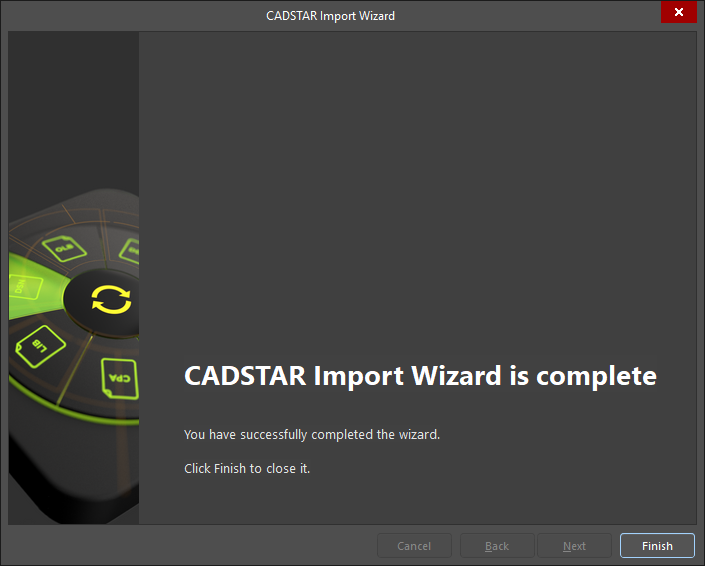
- Click the final Next button and the Import Wizard will take care of the rest.
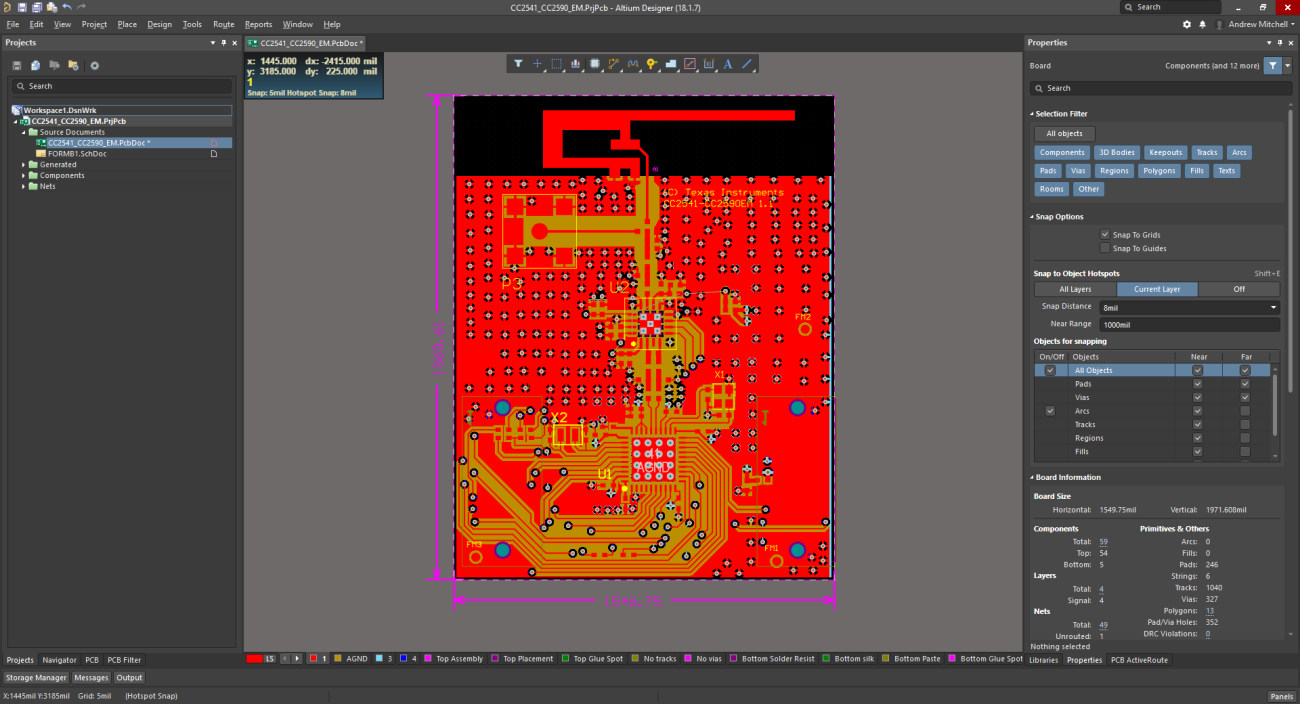
- Congratulations, your design has now been imported into Altium Designer Develop! Follow the Post Import Tidy Up checks to ensure the design has been fully checked and verified. Details on how to carry out some of these checks can be found in the ‘Bringing Together Imported Schematic and PCB Designs’ guide.
Step 4: Post Import Tidy Up
We’ve put together a verification checklist for you:
Physical check
- View » Fit Document
- Board shape and cutouts
Electrical check
- Netlist
Rules
- Have all rules been imported
- DRC check
- Check settings for polygons - Island removal, min primitive size
- Thermal reliefs, direct connect
- Check power plane settings
- Power plane Pull-back
- Solder mask, Paste mask rules
- Via Tenting
- Testpoint assignments
Power check
- Nets
- Planes
- Polygons
Documentation check
- Layers
- Text/Strings
- Legends
PCB reports
- Number of components/nets
- All nets routed
Getting Help
Main article: Documentation and Help
The best way to learn is through doing, Altium and Altium Designer Develop provide a number of ways to help you do
that:
- F1 over any object, editor, panel, menu entry or button to open a brief description in your web browser.
- Shift+F1 while running a command for a list of shortcuts you can use in that command.
- Search the Altium Documentation, on the Altium Website.
- Visit the Video Library where you can watch over 150 short training videos, each detailing the exact steps needed to complete a task.
See Also
Below are references to other articles and tutorials in the Altium Designer Develop Documentation Library that talk more about the conceptual information as well as walking you through specific tasks. Remember, you can also browse through the Help contents, and use F1 and What’s This at any time in a dialog for more details.
- For more PCB project options, refer to the tutorial, From Idea to Manufacture - Driving a PCB Design through Altium Designer Develop.
- For a tutorial that steps you through all the basics of creating components, read A Look at Creating Library Components.
- For a tutorial that steps you through all the basics of editing multiple objects, read Editing Multiple Objects.
- For an overview of Altium Designer Develop’s FPGA design, development and debugging capabilities, read Soft Design.
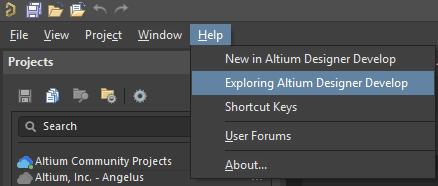
A great place to start your journey through all the new possibilities with your Altium Designer Develop installation. On the top left of Altium Designer Develop you can find the Help » Exploring Altium Designer Develop link
From here, you can easily access the Documentation where the “Getting Started with Altium Design Solutions”category will ease your start into using Altium.
Related Resources
Related Technical Documentation
Table of Contents
Solutions for Every Role and Team
- Discover and evaluate design options earlier
- Develop in one shared workspace
- Scale with control and compliance
- Connect every stage of hardware development
Learn More
Thank you, you are now subscribed to updates.