

Why Modern Electronics Teams Are Moving to a Cloud ECAD Platform

At a Glance
Discover why modern electronics teams are abandoning file-based workflows for cloud ECAD platforms like Altium Agile Teams to scale hardware collaboration.


For electronics organizations, velocity alone is no longer enough to win the market. The real challenge is scaling that speed across distributed teams, complex projects, and growing regulatory requirements. Organizations are discovering that the very foundational infrastructure they use to design hardware is actively impeding their ability to innovate.
To scale safely and effectively, forward-thinking electronics teams are abandoning fragmented file exchanges in favor of unified, cloud-native Electronic Computer-Aided Design (ECAD) platforms. This transition represents a fundamental shift in how hardware is conceived, managed, and manufactured.
Key Takeaways
- File-based workflows force engineers into functional silos, causing delayed feedback loops, manual hand-off errors, and costly downstream surprises.
- Cloud-native ECAD platforms centralize project data, allowing distributed teams to securely access, review, and comment on designs in real time, directly within the browser.
- Advanced cloud platforms eliminate file-locking bottlenecks, enabling multiple PCB designers to co-author the same board simultaneously without version conflicts.
- Unlike generic IT storage, hardware-specific platforms like Altium Agile Teams synchronize ECAD, MCAD, and live supply chain data into one cohesive, multidisciplinary environment.
For decades, hardware development relied on localized file management. In these legacy environments, collaboration is a manual, asynchronous process where engineers work in rigid functional silos: electrical engineers operate strictly within their ECAD tools, mechanical teams in MCAD, software teams in IDEs, sourcing in spreadsheets, and compliance in separate systems altogether.
When teams attempt to collaborate across these boundaries, it is usually through a patchwork of meetings, emails, shared drives, and exported files. This inherently creates friction. Coordination depends entirely on human effort. In a file-based ecosystem, alignment is a recurring task, not a given. Every time a PCB designer needs to verify the physical clearance of a component, they must export a STEP file, email it to the mechanical engineer, and wait for verification. Feedback is often delayed, and manual handoffs introduce errors.
The ramifications of this disjointed approach extend deep into the product lifecycle. Decisions take much longer, and worse, surprises show up downstream where they cost significantly more to fix. If a custom silicon chip or a highly specific semiconductor package requires a footprint adjustment, communicating that change across a fragmented system often results in outdated schematics lingering on local hard drives. Multiple designers editing the same board sequentially can introduce massive conflicts and costly rework. Incomplete version control leads directly to outdated, unreliable component libraries. Manual approvals drastically slow down product releases and open severe compliance gaps.
The administrative overhead of this approach actively drains energy from engineering creativity and innovation. At a certain size, even the most talented engineers spend more time managing processes than creating electronics. Industry research shows that the cloud-based Electronic Design Automation (EDA) market continues to expand rapidly as organizations move design and verification processes online to accelerate product development, improve team synchronization, and reduce manual engineering overhead. According to a 2024 Protolabs survey, most organizations are developing new products faster to stay competitive, dictating an urgent need for infrastructure that supports rapid execution without administrative drag.
The Paradigm Shift: Cloud-Native ECAD and the Single Source of Truth
Cloud-native ECAD platforms replace isolated file drops with continuous, real-time collaboration. By moving the core design environment to the cloud, organizations establish a true single source of truth. Shared data fundamentally replaces file transfers, and shared context replaces status meetings.
Centralizing all project data allows any member of a large, distributed team to drop into a project, whenever and wherever they like, and always trust the data. This structural shift drastically reduces coordination overhead. Visibility into what is happening and why it is happening becomes automatic rather than something that requires chasing people down.
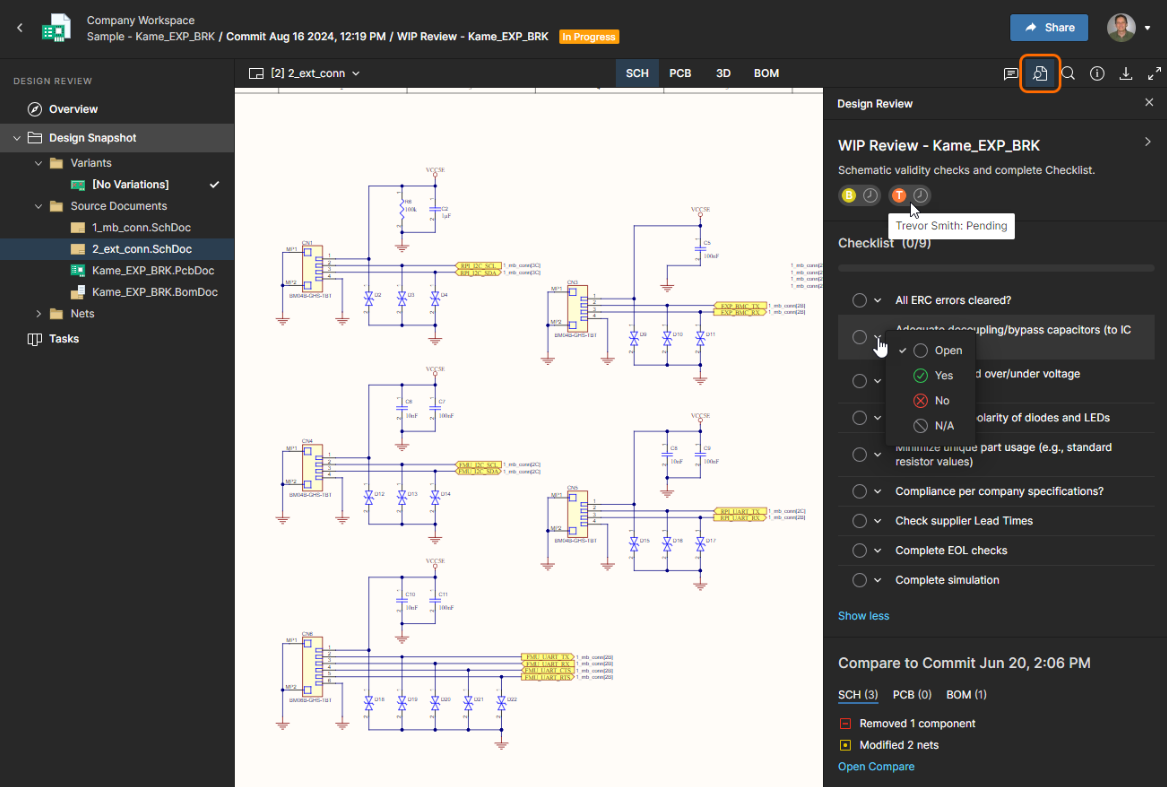
When a design review is conducted in a cloud-native platform, stakeholders do not need to download software or package files into a ZIP archive. They can streamline design reviews with real-time, in-browser commenting and structured sign-offs. Reviewers can leave comments and generate tasks directly within the design documents without needing any intermediate documents. This means a manufacturing engineer can flag a potential solderability issue on a dense Ball Grid Array (BGA) directly on the specific layout coordinate, and the designer sees it instantly within their native ECAD environment.
Comparing ECAD Methodologies
|
Capability |
File-Based Workflow |
Cloud-Native ECAD Platform |
|
Data Accessibility |
Locked in local drives or manual network transfers |
Real-time global access with role-based permissions |
|
Version Control |
Manual tracking susceptible to overwrites and conflicts |
Automated lifecycle management and complete revision history |
|
Team Collaboration |
Sequential hand-offs and isolated design reviews |
Concurrent engineering and asynchronous, in-browser commenting |
|
Component Sourcing |
Static spreadsheets requiring manual price/stock updates |
Live connections to supply chain intelligence and centralized part libraries |
Eliminating Version Conflicts with Concurrent Engineering
One of the most transformative advantages of a purpose-built cloud ECAD platform is the ability to support true concurrent engineering without the fear of data loss.
Because the cloud platform understands the intricate object data of the PCB—down to the individual vias, polygons, and component parameters—it allows for safe, simultaneous co-authoring. Multiple designers can work in parallel on the same board, accelerating complex layouts. When time pressure is severe, one engineer can route the memory interfaces while another optimizes the switch-mode power supply (SMPS) layout on the exact same board. PCB co-authoring also improves the quality of end designs by automating previously manual processes, reducing the likelihood of human error.
This level of collaborative power requires robust infrastructure. A modern solution enables engineering managers to bring their entire crew onto a platform for concurrent collaboration, supporting up to 25 concurrent ECAD authors and up to 250 project collaborators who can work simultaneously from anywhere in the world.
Unifying the Multidisciplinary Ecosystem
Cloud platforms seamlessly bridge the gap between electrical and mechanical domains. The ECAD-MCAD collaboration ensures perfect alignment, allowing an engineer to bring the PCB to the latest state into the MCAD tool as a native assembly with a single click. This synchronization allows mechanical engineers to identify physical interference before a physical prototype is ever fabricated.
Similarly, cloud ECAD platforms allow procurement teams to manage BOM data in a cloud portal rather than a disconnected spreadsheet. By integrating with real-time component supply chain data, teams can deliver component insights directly to engineers designing PCBs. This visibility saves hours normally wasted comparing prices on distributor websites, allowing teams to pivot away from end-of-life components before the design is locked.
Altium Agile Teams: Purpose-Built for Hardware
Organizations face a distinct paradox: they desperately need startup speed with enterprise control. Altium Agile Teams is engineered to give growing organizations fast, structured, and flexible multi-disciplinary collaboration, providing control without burdensome complexity that slows adoption or innovation.
Agile Teams is purpose-built for connected electronics design and through its adoption, organizations leverage enterprise-grade capabilities tailored specifically for hardware governance:
- Structured data: You can maintain a central part library and enforce the structure of the library across the whole team, boosting the reuse of preferred components.
- Enterprise security: Single sign-on helps you easily manage and secure digital identities and control user access via your existing identity management system, and enterprise-level event monitoring logs user actions, detailing exactly when an event occurred, who invoked it, and what object or user was affected.
- Ecosystem integration: The platform integrates your ecosystem to connect directly to Jira and PLM tools such as Duro PLM or Arena® PLM, ensuring data consistency across the enterprise.
The transition from file-based systems to a cloud-native ECAD platform is a strategic necessity for any modern hardware organization. The friction of manual handoffs, disconnected supply chain data, and isolated design environments creates unacceptable risks in today's rapid development cycles. Altium Agile Teams gives engineering organizations the best of both worlds. By establishing a secure, intelligent, single source of truth, organizations can empower their electrical, mechanical, and procurement teams to move as fast as a startup while operating with the exact discipline of a large enterprise.
Ready to leave file-based frustration behind? Start accelerating your engineering workflows and your multidisciplinary collaboration with Altium Agile Teams, the fastest, most secure way to design electronic hardware at scale. Experience enterprise-level collaboration without the enterprise-level friction. If you need more information to decide for yourself, contact us or sign up for a free 30-day trial of Altium Agile Teams to transform how your team builds hardware.
Frequently Asked Questions
Why can't we just use generic cloud storage like Google Drive or standard PLM vaults for our hardware designs?
While basic cloud or desktop collaboration tools provide off-site backups, they lack the precision and security that electronics design demands. A generic cloud drive treats complex hardware designs as opaque files. It cannot interpret the relational data between a schematic symbol, a PCB footprint, and a mechanical model. If two engineers open the same file, the system simply locks it or creates a conflicted copy. A true cloud ECAD platform understands the intricate object data, allowing for safe, simultaneous co-authoring without data loss.
How does a cloud ECAD platform prevent version control conflicts during collaborative design?
Modern cloud platforms shift the paradigm from "file sharing" to true "PCB co-authoring." Because the platform is native to the design data, multiple engineers can work in parallel on the exact same board. Agile Teams, for instance, automates processes that were previously manual, tracking all changes and significantly reducing the likelihood of human error. You can have up to 25 concurrent ECAD authors working simultaneously from anywhere in the world without overwriting each other's work.
How does this approach improve component sourcing and supply chain management?
The global semiconductor supply chain is notoriously volatile, and managing a Bill of Materials (BOM) in a disconnected spreadsheet is a severe liability. Cloud ECAD platforms bring component data to exactly where engineers design PCBs, integrating live connections to component supply chain intelligence. This allows teams to pivot away from end-of-life (EOL) components or parts with excessive lead times before the design is locked, saving hours normally wasted comparing prices across distributor websites.

About Author
Related Resources
Related Technical Documentation
Table of Contents
- Key Takeaways
- The Hidden Costs of File-Based Workflows
- The Paradigm Shift: Cloud-Native ECAD and the Single Source of Truth
- Comparing ECAD Methodologies
- Eliminating Version Conflicts with Concurrent Engineering
- Unifying the Multidisciplinary Ecosystem
- Altium Agile Teams: Purpose-Built for Hardware
- Frequently Asked Questions
- Why can't we just use generic cloud storage like Google Drive or standard PLM vaults for our hardware designs?
- How does a cloud ECAD platform prevent version control conflicts during collaborative design?
- How does this approach improve component sourcing and supply chain management?
Solutions for Every Role and Team
- Discover and evaluate design options earlier
- Develop in one shared workspace
- Scale with control and compliance
- Connect every stage of hardware development
Learn More
Thank you, you are now subscribed to updates.