








Murata vs Samsung vs Yageo: How to Choose the Right 10 µF MLCC for a 5V Rail


Choosing the right component is rarely as simple as matching a part number to a datasheet. In real designs, engineers have to balance electrical performance, voltage margin, reliability, price, availability, and lifecycle risk before a part is approved for the BOM.
In this article, we follow a practical workflow for selecting a 10 µF MLCC for a 5 V power rail decoupling network in a microcontroller-based embedded system. The goal is simple: show how to choose the right component for your next design by focusing on real-world behavior, not just datasheet specs.
We’ll compare three real parts and narrow them down step by step using the same criteria engineers actually use to qualify parts, all while using Octopart as the working tool.
Key Takeaways
- A 10 µF MLCC isn't always 10 µF in your circuit. DC bias and voltage rating can significantly reduce effective capacitance.
- Lifecycle status and qualified alternates are just as important as electrical performance. An EOL part can force a costly redesign.
- Comparing parts in one workflow improves decision-making. Octopart brings together specs, pricing, stock, lifecycle, and alternates to simplify component selection.
When a “Simple” Capacitor Isn’t Simple
Engineers usually begin with a few known part numbers pulled from an older design, an AVL, or a quick parametric search like “10 µF, 0805, ceramic capacitor.”
So, let’s say we shortlist three parts for this design:
- GRM21BR61A106KE19L (Murata)
- CL21A106KOCLRNC (Samsung)
- CC0805KKX5R7BB106 (Yageo)
On paper, they look identical. The differences only show up once you look beyond the headline specs.
Step 1: Define the Real Requirements
Before opening a single datasheet or comparing specs, lock in what the circuit actually needs. In this case, we’re dealing with a 5 V digital rail powering an MCU and a handful of fast-switching peripherals.
Application: 5 V digital rail decoupling (MCU + peripherals)
What the system really looks like:
- Nominal voltage: 5 V
- Transient spikes: up to ~6-7 V during load
- Load profile: fast-switching digital loads (high di/dt)
- Frequency range: kHz to low-MHz decoupling
- PCB: 2-4-layer, space-constrained
Translating this into real capacitor requirements:
- Capacitance: 10 µF nominal
- Effective capacitance under bias: ≥ 4-6 µF at 5 V
- Voltage rating: ≥ 10 V minimum, preferably 16 V
- Dielectric: X5R or X7R
- Package: 0805 (density vs. derating trade-off)
- ESR/ESL: low enough for high-frequency decoupling
This is where most selections quietly go wrong. On paper, all three claim “10 µF.” In reality, under 5 V DC bias, the effective capacitance can drop by 50-70%.
Step 2: Compare Electrical Characteristics
This is where engineers move beyond datasheet headlines and start asking: How do these components behave under real operating conditions?
Parameter | GRM21BR61A106KE19L | CC0805KKX5R7BB106 | CL21A106K0CLRNC |
Capacitance | 10 µF | 10 µF | 10 µF |
Voltage Rating (DC) | 10 V | 16 V | 16 V |
Dielectric | X5R | X5R | X5R |
Height | 1,250 µm | 850 µm ↓ | 950 µm |
1. Voltage Rating and DC Bias Derating
- Murata: 10 V
- Samsung: 16 V
- Yageo: 16 V
On a 5 V rail, this difference is more significant than it seems. A general rule with MLCCs is:
- A 10 V-rated capacitor at 5 V bias can lose 50-70% of its capacitance
- A 16 V-rated capacitor under the same conditions retains significantly more
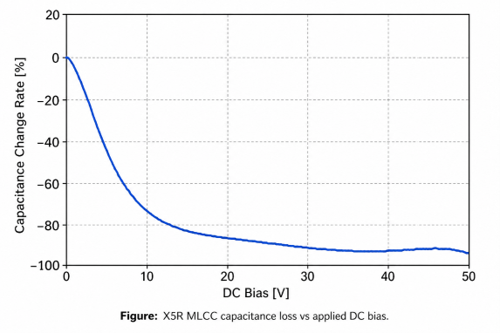
What this means in reality:
- Murata (10 V) may behave closer to 3-4 µF
- Samsung/Yageo (16 V) may retain 5-7 µF
2. Capacitance Stability vs Operating Conditions
All three are X5R dielectric:
- Temperature variation: ±15%
- Voltage dependence: significant
- Aging: logarithmic drop over time
On paper, they look similar. In practice, higher voltage-rated parts tend to be more stable because they operate further from their stress limits.
3. Impedance Behavior (ESR + ESL)
At higher frequencies:
- Smaller packages = lower ESL
- MLCCs already have very low ESR
Since all are 0805:
- ESL is broadly comparable
- Suitable for mid-frequency decoupling
At this level, PCB layout will matter more than capacitor selection.
Here:
- Murata looks technically viable
- Samsung and Yageo offer better electrical margin due to a higher voltage rating
At this step, many engineers stop, and that’s often where mistakes begin.
Step 3: Thermal and Reliability Considerations
In real boards, MLCC failures typically come from:
- Mechanical stress
- Electric field stress
- Long-term dielectric degradation
Now connect that back to the earlier observation: voltage rating doesn’t just affect capacitance; it also affects electric field stress inside the dielectric.
Key insight:
- Lower voltage rating = higher electric field stress
- Higher stress = higher risk of capacitance loss or mechanical failure over time
In practical terms:
- Murata (10 V): electrically acceptable, but closer to its stress limits
- Samsung and Yageo (16 V): more relaxed operation, better long-term robustness
And this is the part that rarely shows up in quick comparisons. In dense embedded designs, with tight layouts, thin PCBs, and repeated thermal cycling, that extra voltage margin often becomes a deciding factor.
Step 4: Pricing and Availability
This is where the decision shifts from engineering to sourcing. Performance doesn’t matter if the part can’t be sourced consistently. Industry data shows that 80% of PCB designs require component replacements at some point due to availability or cost issues.
The pricing and availability view on Octopart gives a clear, consolidated view of up-to-date market pricing and inventory across distributors:
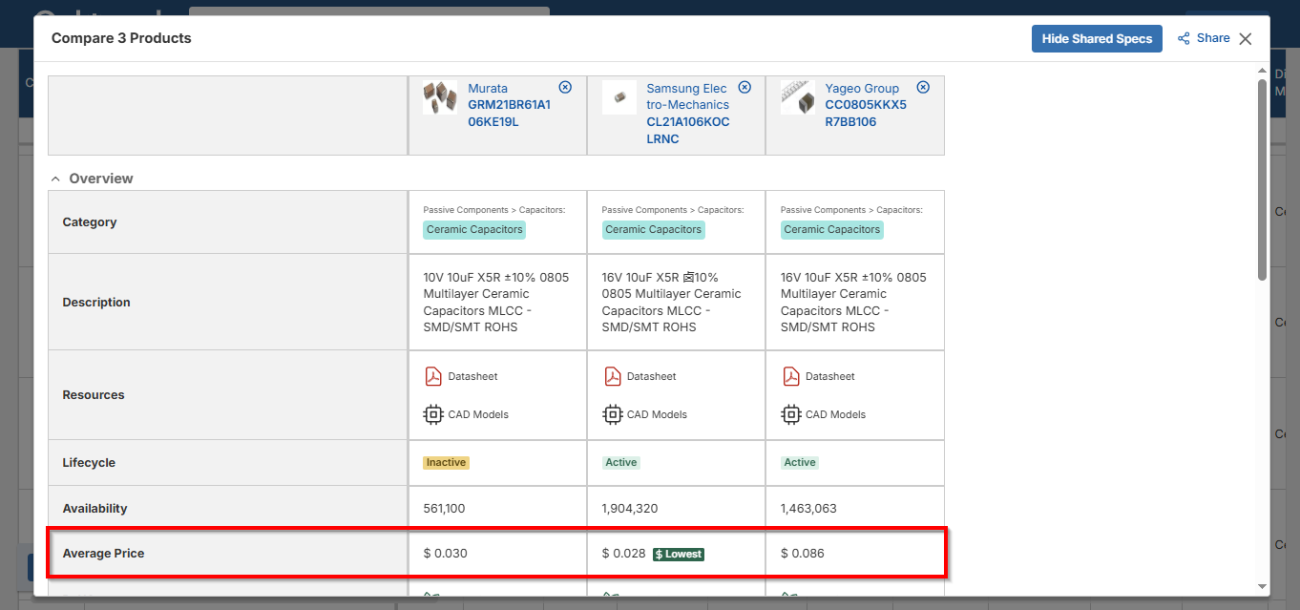
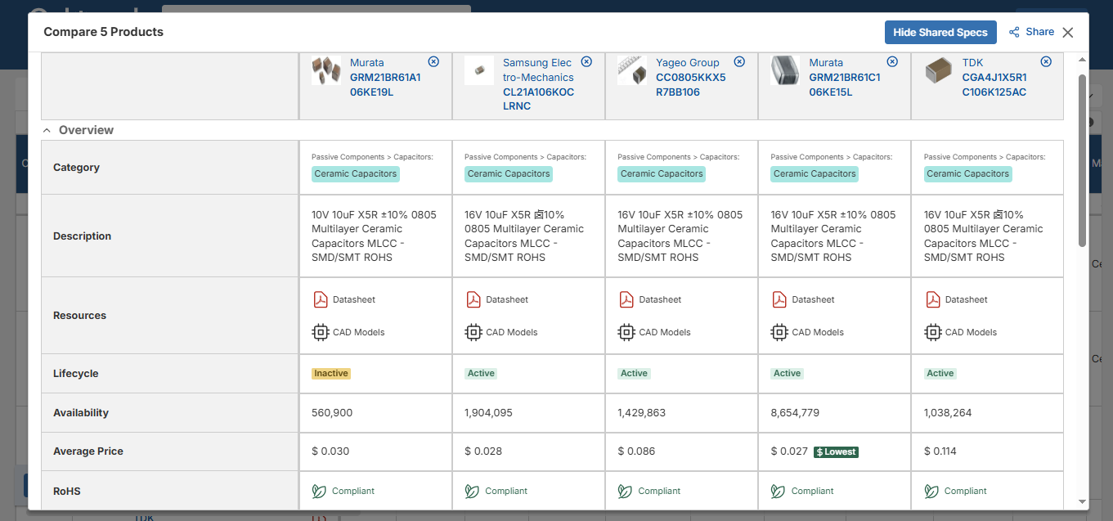
- Samsung: lowest cost ($0.028)
- Murata: slightly higher ($0.03)
- Yageo: noticeably higher ($0.08)
Now combine that with supply dynamics:
- Samsung: typically strong multi-distributor presence
- Murata: highly reliable, but sometimes tighter allocation
- Yageo: widely available, but pricing fluctuates
Important takeaway: The cheapest component isn’t always the most cost-effective choice. Supply stability matters more than unit price.
Step 5: Lifecycle and Sourcing Risk Assessment
This is the step many workflows skip. It’s where strong designs break later. Up to this point, the GRM21BR61A106KE19L from Murata still looks like a valid option. Electrically acceptable, widely used footprint, and nothing obviously wrong.
But once you check its lifecycle status on Octopart, one detail changes the entire picture: GRM21BR61A106KE19L is flagged as EOL.
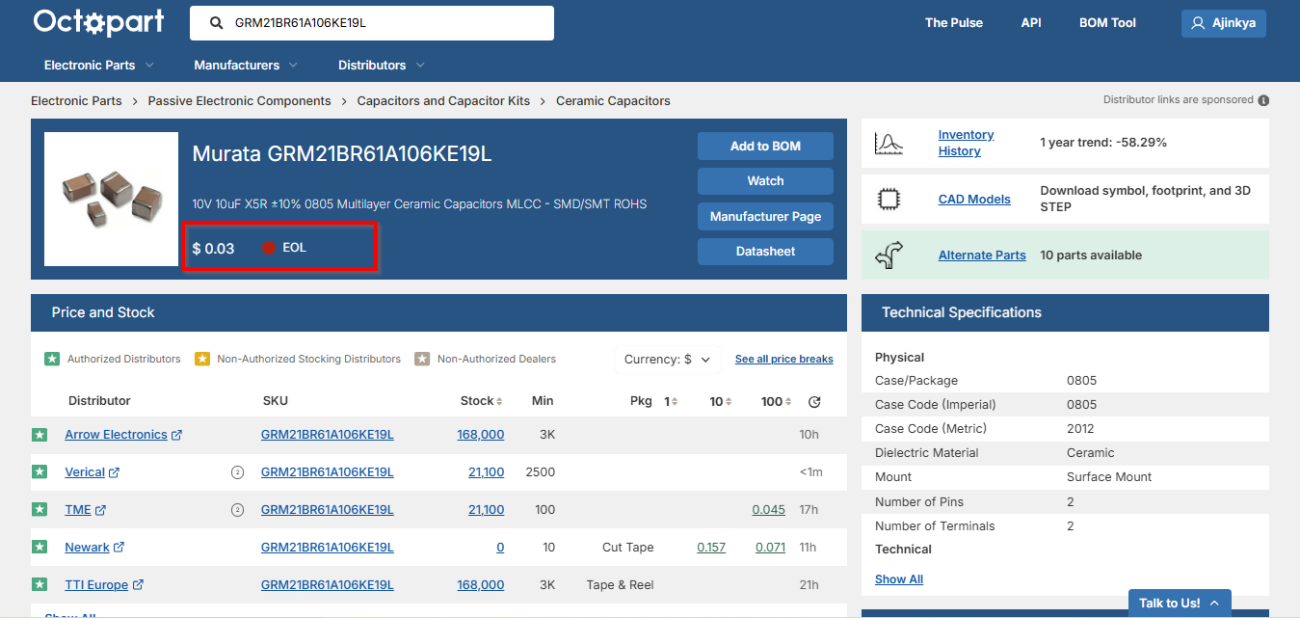
That single flag outweighs almost everything we’ve discussed so far.
Designing in an EOL part means:
- Future redesign risk
- Procurement issues
- Qualification delays
And none of these show up in the datasheet or during the early design phase. Industry data shows that product redesigns triggered by part obsolescence can cost anywhere between $20,000 and nearly $2 million.
At this stage, Octopart doesn’t just flag lifecycle risk, but also identifies alternate parts within seconds. Instead of manually searching across suppliers, you get immediate visibility into compatible replacements, along with pricing, stock, and key specs, so you’re not just finding alternates, you’re validating them within the same workflow.
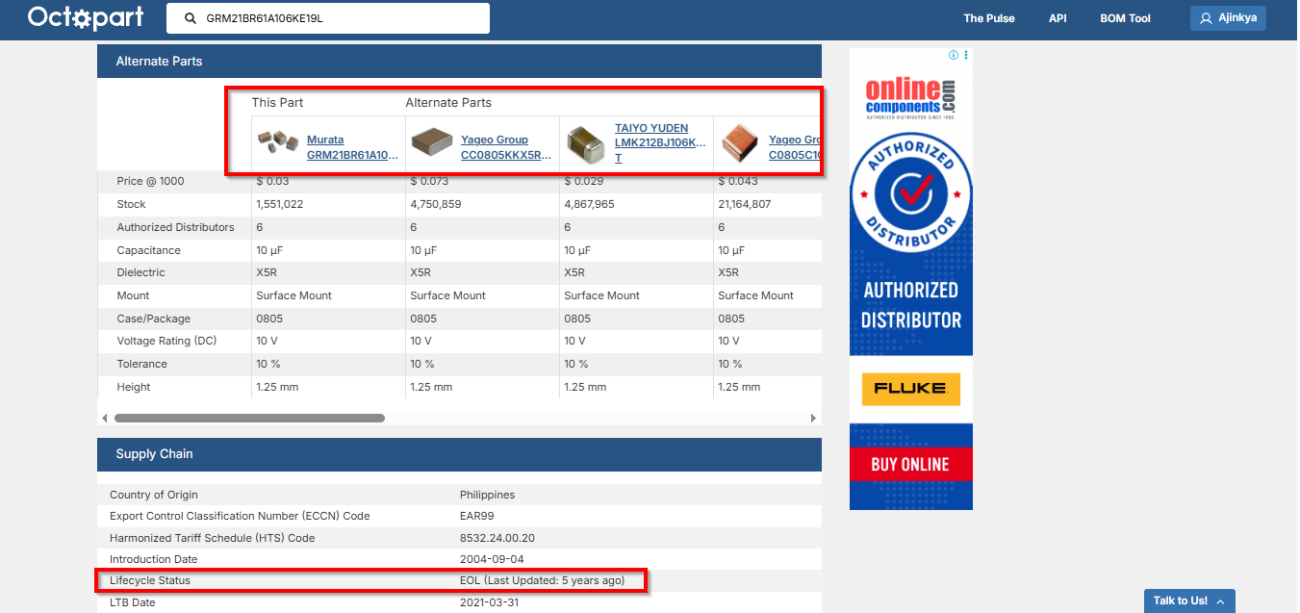
A few alternates that come up quickly:
- GRM21BR61C106KE15L (Murata) - 10 µF, 16 V, 0805
- CGA4J1X5R1C106K125AC (TDK) - similar spec variant
For any design moving into mass production, the priority shifts to:
- Multiple sourcing paths
- High inventory visibility
- Long lifecycle stability
Why This Matters in the Workflow
This isn’t just a lifecycle flag. It actually changes your decision path:
- The original Murata part was 10 V
- The suggested replacements are 16 V
So, without doing anything manually, Octopart effectively nudges you toward:
- Higher voltage margin
- Improved DC bias retention
- A more robust, future-ready option
That’s a subtle but important upgrade in design quality.
Quick Engineering Interpretation
At this point:
- Original Murata part eliminated (EOL risk)
- Murata alternates technically stronger (16 V upgrade)
- Samsung and Yageo already aligned with a 16 V strategy
So instead of restarting the search, you now have:
- A validated Murata upgrade path
- Two validated multi-vendor alternatives
The question shifts from “which part works” to “which option gives the least risk over the product’s lifetime”.
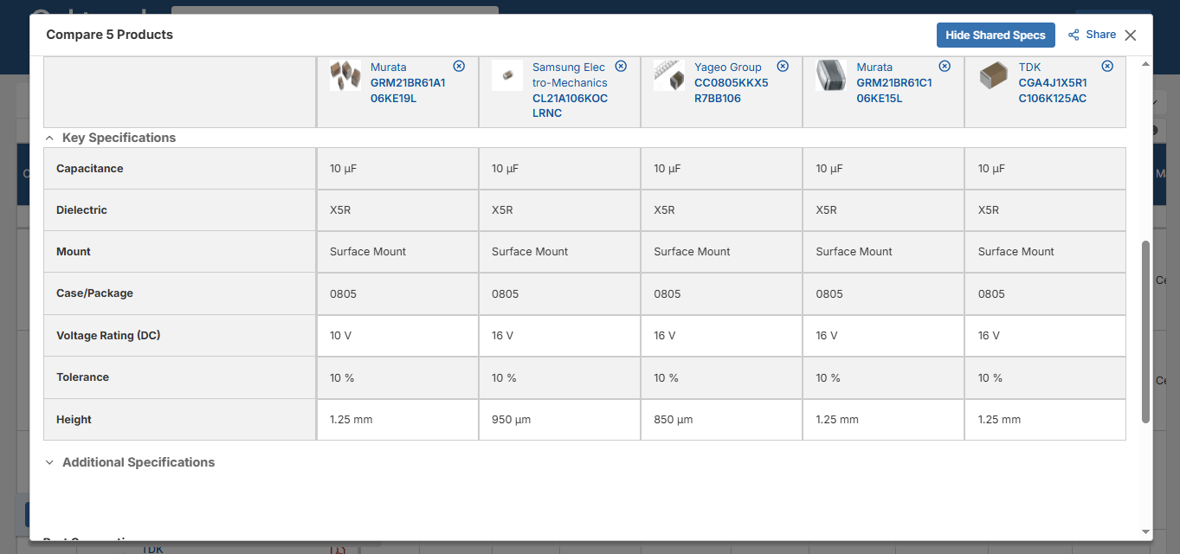
Step 6: Using Octopart Compare to Make the Final Call
Instead of jumping between tabs, Octopart aligns all key parameters in one view:
- Voltage rating
- Capacitance
- Package
- Pricing tiers
- Stock levels
- Lifecycle
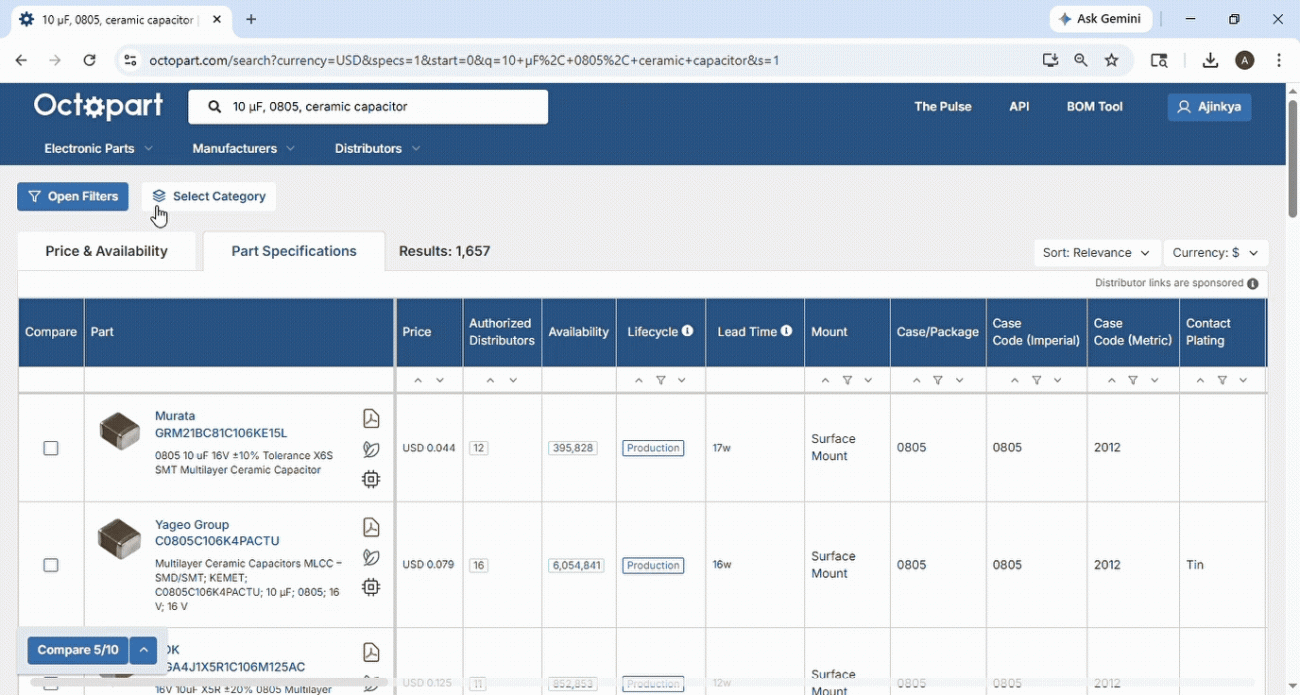
What the comparison quickly reveals:
- Original Murata part limited by 10 V rating and EOL
- Murata and TDK suggested by Octopart - same footprint, upgraded to 16 V
- Yageo - similar performance, higher cost
- Samsung - competitive, but priced above Murata alternate
Octopart doesn’t just suggest a technically valid alternate, like GRM21BR61C106KE15L, it also highlights where the better price sits.
Final Decision
For this application (5 V rail decoupling), the best choice is:
Murata: GRM21BR61C106KE15L
Why:
- 16 V rating, stronger DC bias performance
- Higher effective capacitance under load
- Lowest cost among comparable options
- Strong availability and lifecycle position
- Consistent Murata quality and trusted performance across production
Step 7: Think Beyond One Part
This is where design experts do things differently. Even if Murata GRM21BR61C106KE15 is the best option:
- Qualify at least two alternates
- Diversify across manufacturers and regions
- Lock them into your AVL early
Alternate 1: CL21A106KOCLRNC (Samsung)
- Strong cost-performance balance
- Valid 16 V alternative for the same footprint
- Low-profile, space-efficient package
Alternate 2: CC0805KKX5R7BB106 (Yageo)
- True second-source flexibility
- Often more readily available across distributors
- Useful for AVL compliance or regional sourcing
MLCC shortages are not just a lesson from the past. The risk is rising again as AI infrastructure, electric vehicles, and high-performance computing drive demand for high-capacitance, automotive-grade MLCCs, while manufacturers prioritize capacity for these higher-value applications. Building flexibility into your design early helps avoid costly redesigns and sourcing disruptions later. A product tied to a single component, supplier, or region is far more vulnerable than one designed with multiple qualified alternatives from the start.
Frequently Asked Questions
How does Octopart help engineers choose the right part for a design?
Octopart consolidates the information engineers need to qualify a component into one workflow. Instead of switching between distributor sites, manufacturer datasheets, and spreadsheets, engineers can compare voltage ratings, dielectric types, package sizes, pricing tiers, stock levels, and lifecycle status side by side. This makes it faster to identify the best-performing, best-priced, and most reliably sourced option before the BOM is finalized.
How do I find a drop-in replacement when a part is flagged as EOL?
Search the original part number on Octopart to check its lifecycle status. When a part is flagged as EOL, Octopart surfaces compatible alternates with matching footprint, capacitance, and voltage rating alongside current pricing and inventory. This allows engineers to validate replacements within the same workflow rather than restarting the search manually across multiple suppliers.
How can I reduce sourcing risk before going into mass production?
Qualify at least two alternates from different manufacturers early in the design process and lock them into your AVL before production begins. Using Octopart to track inventory levels, lead times, lifecycle status, and cross-manufacturer availability helps identify sourcing risks before they become costly disruptions.

About Author
Related Resources
Related Technical Documentation
Table of Contents
- Key Takeaways
- When a “Simple” Capacitor Isn’t Simple
- Step 1: Define the Real Requirements
- Step 2: Compare Electrical Characteristics
- Step 3: Thermal and Reliability Considerations
- Step 4: Pricing and Availability
- Step 5: Lifecycle and Sourcing Risk Assessment
- Step 6: Using Octopart Compare to Make the Final Call
- Step 7: Think Beyond One Part
- Frequently Asked Questions
Solutions for Every Role and Team
- Discover and evaluate design options earlier
- Develop in one shared workspace
- Scale with control and compliance
- Connect every stage of hardware development
Learn More
Thank you, you are now subscribed to updates.