




Stop Chasing Signatures: How Automated Design Sign-offs Accelerate Release Cycles

At a Glance
Stop chasing hardware approvals through spreadsheets and discover how automated design sign-offs reduce administrative friction to accelerate release cycles.


The development of embedded electronics requires precise coordination across multiple engineering disciplines. In most organizations, however, hardware development processes grind through friction. These bottlenecks rarely stem from a lack of engineering talent; it occurs because teams operate in functional silos, relying on disconnected tools. Electrical engineers work within their ECAD environments, mechanical teams use MCAD, software engineers reside in IDEs, sourcing professionals manage procurement in spreadsheets, and compliance teams rely on entirely separate systems.
This distance is especially evident during scaling efforts: without a unified approval process, teams revert to manual sign-off. Engineers must email PDF schematics, record approvals in spreadsheets, and chase scattered signatures. Independent research from Tech-Clarity indicates that engineers waste one-third of their product development time on non-value-added administrative tasks, leaving only half of their day for actual product design. Shifting to a structured, automated verification environment addresses these issues and reduces risk.
Key Takeaways
- Relying on disconnected tools and file-based exchanges turns agile hardware development into a tangled, manual mess that wastes valuable engineering hours.
- Moving approvals directly into the design environment lets your team run asynchronous reviews. Instead of exporting static PDFs, teams can mark up layouts, pin feedback, and assign action items directly inside the active workspace.
- Configurable workflows and role-based access controls keep approvals running automatically while strictly defining who can view, edit, or approve your design assets.
- When you link real-time component data and early DfM feedback directly into your sign-off process, your BOM stays continuously synced. This means you aren't going to get hit with those expensive, late-stage production surprises that keep engineering teams awake at night.
The Inefficiency and Risk of Manual Hardware Approvals
Software developers can patch a flawed release over the air by Friday afternoon. Hardware engineers don't have that luxury. Their development is constrained by the physical realities of global supply chains, PCB fabrication, and silicon wafer semiconductor manufacturing. If a printed circuit board is sent to fabrication with an unapproved component footprint or a layer stack-up error, the physical FR4 boards are ruined. If a mechanical fit issue is missed during a manual sign-off, the final enclosure will fail, resulting in costly re-spins and severely delayed time-to-market.
When engineers manage approvals manually, coordination depends entirely on human effort. Decisions take longer, and surprises inevitably surface downstream, where they cost considerably more to fix. Every time someone exports a file and emails it for review, that data is essentially frozen in time, opening the door for version control vulnerabilities. If multiple engineers try to edit the same board without concurrent access, it can introduce conflicts and extensive rework.
Comparing Manual Routing to Automated Workflows
A practical approach to addressing these inefficiencies is to adopt a unified workspace that shares data in real time. The following table illustrates the operational differences between legacy file routing and an automated environment:
Capability | Legacy Manual Collaboration | Automated Multidisciplinary Co-Creation |
Design Reviews | Coordination requires meetings, emails, and handoffs. Feedback loops take days or weeks. | Coordination is built into the platform, live and direct. Feedback happens in context, constantly. |
Data Synchronization | Data is transferred between roles and tools. Changes cause delays and surprises downstream. | Data is shared in real time, in one environment. Changes are visible immediately, across disciplines. |
Approval Tracking | Engineering change orders are managed via spreadsheets, frequently leading to miscommunication. | Change orders are tracked automatically, with context and approvals managed in-system. |
Alignment | Alignment is reactive and periodic. | Alignment is automatic and integrated. |
In-Context Sign-offs: Removing Delays Without Reducing Accountability
Let’s look at in-context design reviews as a prime example of doing things better. We all know the traditional drill: a manager reviews a static PDF, logs their feedback in a separate tracking tool, and then waits for the designer to decipher the notes and make the changes. It's tedious, and it slows everything down.
With platforms like Altium Agile Teams, design reviews no longer require formal meetings or file packaging. Reviewers can run processes asynchronously across distributed teams, leaving comments and generating tasks directly within the design documents. Feedback happens in real time, bringing in all necessary stakeholders without the need for intermediate files.
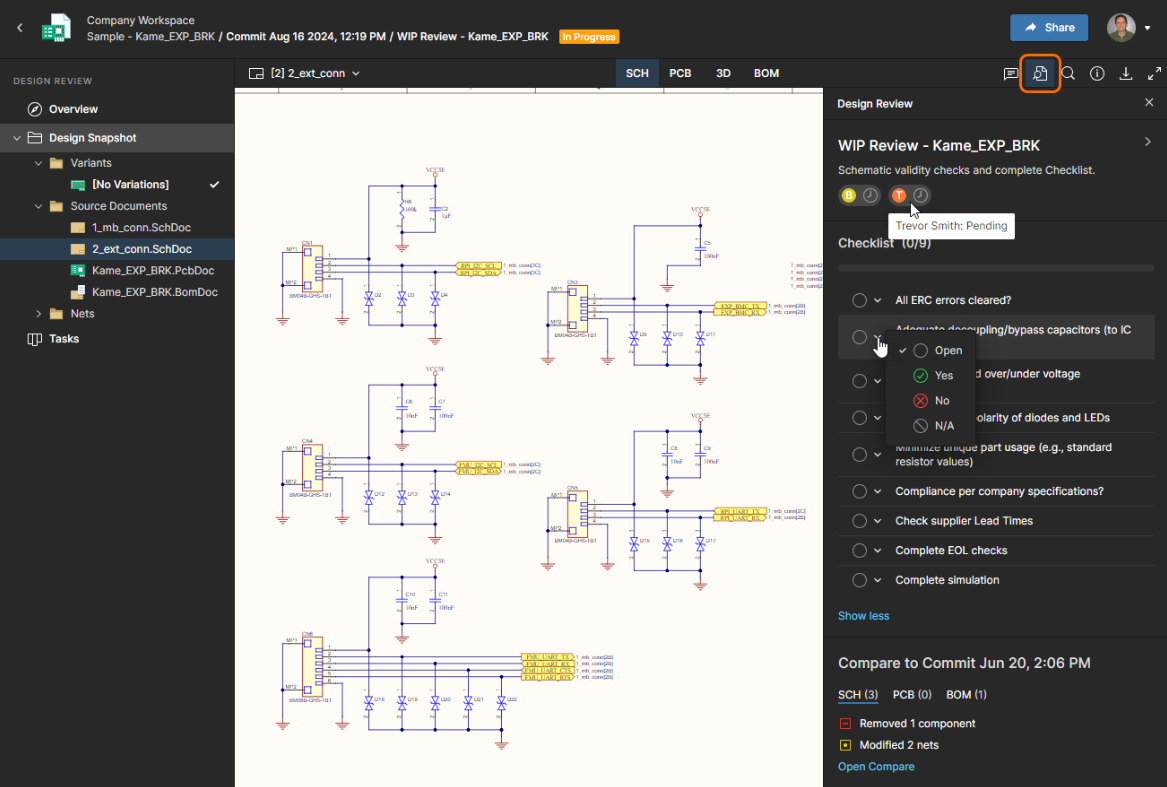
PCB co-authoring takes this a step further by letting multiple electronics engineers tackle the same layout concurrently, meaning complex boards are completed faster. Plus, the system tracks every individual action, automating those previously manual steps and cutting down on human error.
Architecting a Structured Approval Process
If you want to scale your operations without burying your engineers in unnecessary complexity, your workflow needs structure. This means setting up automated processes for new part requests, design reviews, publishing to a PLM system, and process-based project creation. By baking best practices right into the platform, you eliminate the process variations that waste time and cause rework.
When your team submits a design for sign-off, the software automatically routes the request based on granular, role-based team permissions, which allows engineering managers to define exactly who can view, edit, or approve specific assets to safeguard intellectual property.
This concurrent workflow extends to mechanical engineering constraints, too. Through advanced ECAD-MCAD codesign, users can pull the PCB's latest state into the MCAD tool as a native assembly with a single click, without losing any mating or constraints. The platform exposes copper, masks, rigid flex, and harnesses as separate elements or as full multiboard assemblies. Because you catch mechanical fit issues early through this synchronized 3D data, mechanical engineers can confidently sign off on enclosure requirements long before anyone manufactures a physical prototype.
Validating the Supply Chain Before Release
A hardware design sign-off means nothing if you can't actually procure the components you specified. The electronics supply chain is volatile, and approving a BOM without real-time intelligence is a reliable way to halt manufacturing.
Instead of relying on rigid, outdated spreadsheets, modern platforms manage BOM data right in a centralized cloud portal to automate supply chain validation. Because engineering and sourcing departments can both see continually updated availability and risk data, picking components becomes truly collaborative rather than just throwing a list over the wall.
Before anyone puts a final signature on a release candidate, procurement managers can use intelligent tools to standardize and clean the BOMs, easily resolving duplicates and formatting quirks. Because this portal acts as a controlled part library, teams can proactively define alternative parts, making replacements fast and painless if primary components hit unexpected end-of-life status.
Traceability and Automated Design Sign-Offs
For teams working in regulated industries, tracing every decision is a strict requirement. Rather than scrambling to compile scattered signature documents prior to an audit, hardware teams rely on enterprise-level event monitoring. By capturing a complete, centralized audit trail of all changes and actions, your team maintains accountability systematically.
A 2026 industry report from MMC Ventures highlights that product and engineering teams are facing intense pressure to reduce time to market, even as hardware becomes increasingly complex. Maintaining velocity requires verifiable confidence in the data being released to manufacturing. Turnkey connectors with tools like Duro PLM or Arena PLM mesh data and reduce manual errors during the handoff from engineering to operations. Governing lifecycle states and automated checks prevent unauthorized drafts or obsolete items from sneaking into the official release.
By automating approvals, embedding feedback directly into the design, and validating supply chain data in real time, you can finally ditch the friction of legacy processes. The result? A structured, predictable oversight model that keeps everyone aligned, protected, and fully ready for manufacturing.
Frequently Asked Questions About Automated Design Sign-Off
How does an automated design sign-off hold up during a compliance audit compared to a physical or PDF signature?
Traditional signatures require manual verification and document retrieval, which often leaves gaps in accountability. Automated environments, on the other hand, use enterprise-level event monitoring to record every single action. These logs capture exactly when an action happened, who invoked it, and what object or user was affected. This creates a clean, exportable audit trail that simplifies regulatory reporting and definitively proves compliance.
Do procurement and compliance teams need CAD experience to participate in these automated reviews?
No. A connected hardware environment brings electrical, mechanical, and software engineers into a shared workspace alongside procurement, project management, and other non-engineering colleagues. These stakeholders access the system through a user-friendly cloud portal instead of a complex engineering tool, letting them review BOM data, check lifecycle states, and approve requirements without ever having to navigate an ECAD platform.
What happens to an active design review if a specified component suddenly becomes unavailable?
In manual processes, you usually discover supply chain shortages after design approval and right before manufacturing—the worst possible time. Automated platforms maintain a live connection to component supply chain data. This means reviewers can evaluate sourcing decisions using real-time pricing, availability, and lifecycle risk indicators right in the context of the design. If a part faces an unexpected availability issue, your team can proactively define alternative components and quickly swap them out long before the final release is signed off.

About Author
Related Resources
Related Technical Documentation
Table of Contents
- Key Takeaways
- The Inefficiency and Risk of Manual Hardware Approvals
- Comparing Manual Routing to Automated Workflows
- In-Context Sign-offs: Removing Delays Without Reducing Accountability
- Architecting a Structured Approval Process
- Validating the Supply Chain Before Release
- Traceability and Automated Design Sign-Offs
- Frequently Asked Questions About Automated Design Sign-Off
- How does an automated design sign-off hold up during a compliance audit compared to a physical or PDF signature?
- Do procurement and compliance teams need CAD experience to participate in these automated reviews?
- What happens to an active design review if a specified component suddenly becomes unavailable?
Solutions for Every Role and Team
- Discover and evaluate design options earlier
- Develop in one shared workspace
- Scale with control and compliance
- Connect every stage of hardware development
Learn More
Thank you, you are now subscribed to updates.