




Cloud, On-Premises, Air-Gapped: Choosing the Right EDA Deployment Model

At a Glance
Compare cloud, on-premises, and air-gapped EDA across security, compliance, cost, updates, collaboration, and operating effort.


Key Takeaways
- Cloud, on-premises, and air-gapped EDA are different operating models. The right choice follows the data, rules, users, and workflows in scope.
- Cloud services can provide managed security, rapid updates, and easier collaboration. Buyers still own identity, permissions, endpoints, sharing, and data handling.
- On-premises deployment gives more local control but also keeps patching, backup, monitoring, resilience, and specialist skills close to the customer.
- Air-gapped deployment is the most restrictive model. It suits written isolation needs, but it adds transfer friction, duplicated services, patch delay, and recovery work.
EDA deployment debates often start with a slogan: cloud is modern, on-premises is controlled, or air-gapped is safest. None of those statements is complete. A secure result depends on the system boundary, the controls inside it, the people who operate it, and the engineering work it must support.
The better decision starts with requirements:
- What design data is involved?
- Who needs access?
- Which laws, contracts, export rules, or customer controls apply?
- How quickly must teams share, review, patch, release, and recover?
Once those answers are clear, the architecture becomes easier to compare.
Three Deployment Models
Model | Core architecture | Typical operating pattern |
Cloud | The provider runs the service on remotely hosted infrastructure. Users connect through managed networks and identities. | Shared access, provider-led platform operations, online collaboration, and regular service updates. |
On-premises | The organization runs the software and data on infrastructure it controls at its own site or data centre. | Local administration, local integrations, customer-led patching, and customer-led resilience. |
Air-gapped | A defined system has no direct external network path and uses controlled transfer points. | Dedicated services inside the boundary, strict transfers, limited connectivity, and deliberate update cycles. |
A deployment can also be hybrid. For example, a team may keep controlled design data on-premises while using cloud services for low-risk collaboration. Hybrid designs can be valid, but every interface between zones needs a clear control owner.
Cloud EDA: Managed Scale and Connected Work
Cloud EDA is a strong fit when teams need broad access, fast collaboration, elastic capacity, and a provider-operated security baseline. It can reduce the local burden for infrastructure, service updates, backup, and availability. It may also make it easier to connect distributed engineering, procurement, manufacturing, quality, and external partners around current data.
Cloud does not remove customer duties. The organization still controls user access, role design, device security, project sharing, guest access, data classification, and offboarding. A weak user account or an over-broad permission can expose sensitive design data even when the platform itself is well run.
The NIST cloud computing definition describes cloud computing through shared resources, network access, rapid provisioning, and measured service. Those traits explain the operating value, but buyers must still inspect data location, tenant separation, encryption, logging, support access, recovery, and exit terms.
Altium addresses these concerns through Altium 365 security controls, including integration with single sign-on and multi-factor authentication, IP whitelisting, user activity logs, and connections to security information and event management systems. These controls help organizations manage identities, limit access, monitor activity, and keep design collaboration within defined security rules.
For US organizations handling ITAR- or EAR-controlled technical data, Altium 365 GovCloud runs in a dedicated US region operated by US Persons. It adds data sovereignty and access controls designed for regulated electronics development while retaining cloud-based libraries, version control, design review, and collaboration. GovCloud can support a compliance program, but the customer must still confirm that the full system and operating process meet the applicable contract and regulatory requirements.
On-Premises EDA: Local Control with Local Responsibility
On-premises EDA fits organizations that need close control of infrastructure, network paths, integrations, maintenance windows, or data location. It can support private networks, custom monitoring, local identity systems, and plant or lab services that cannot depend on a wide-area connection.
The trade-off is ownership. The customer must keep servers supported, software patched, backups protected, recovery tested, logs monitored, capacity planned, and specialist skills available. Physical control helps, but it does not fix weak access rules, stale systems, poor backups, or unmanaged administrator accounts.
On-premises also does not mean isolated. A system can sit in a company data centre and still connect to email, remote support, cloud identity, supplier portals, and the public internet. If the requirement is no external path, the architecture must say so directly.
For teams that need local infrastructure control, Altium On-Prem Enterprise Server is installed and managed by the customer’s IT department. It provides a local workspace for PCB projects, components, models, templates, revisions, lifecycle states, design reviews, process workflows, and released manufacturing data. This helps teams keep design data under local administration while maintaining version history and controlled release processes.
The trade-off remains the same as for any on-premises system. The customer controls the environment, but the customer also owns server maintenance, network configuration, upgrades, backup, recovery, monitoring, and security operations. Altium provides the engineering data-management environment; the organization remains responsible for operating and securing the infrastructure around it.

Air-Gapped EDA: Strict Isolation With a High Operating Load
Air-gapped EDA is suited to work that has a written need for physical or strong logical isolation. That may arise from classified program, special access rules, sovereign controls, customer mandates, or a threat model that rejects external connectivity.
The model needs dedicated services inside the boundary. That includes licences, identity, libraries, build tools, storage, backup, monitoring, review, and release. Updates and design inputs need a verified import route. Manufacturing outputs need an approved export route. Every transfer adds delay and requires evidence.
Air-gapped systems can reduce direct remote attack paths. They can also fall behind on patches, duplicate engineering data, slow supplier updates, and hide recovery gaps. Isolation is valuable when it closes a real requirement. It is expensive when used as a general symbol of security.
Altium supports offline Altium Designer licensing through a Private License Service hosted on a local network. The service can provide and manage licences for Altium Designer installations that remain isolated from the internet. Roaming licences can also allow an authorized workstation to use a licence while disconnected from the licensing network.
Offline licensing does not create a complete air-gapped engineering environment by itself. Design data storage, component libraries, identity services, backup, updates, manufacturing handoffs, removable media, and every transfer across the boundary must still be designed and governed by the customer. Altium’s local licensing and on-premises data-management options can form part of that architecture, but the air gap depends on the full system boundary and operating process.
Side-By-Side Decision View
Decision area | Cloud | On-premises | Air-gapped |
Collaboration | Strong for distributed teams and external review. | Good inside managed networks; remote access needs design. | Limited by transfer and boundary rules. |
Updates | Provider-led and frequent. | Customer schedules and validates updates. | Updates are imported, tested, and approved. |
Control | Configuration within provider service limits. | High infrastructure and integration control. | Highest boundary control, with strict constraints. |
Operating effort | Lower platform burden; customer governance remains. | Customer owns operations, skills, and resilience. | Customer owns a duplicate, isolated operating stack. |
Data location | Depends on provider regions and contract. | Chosen by the customer. | Fixed within the approved isolated boundary. |
External access | Designed for network access with controls. | Possible through managed remote access. | No direct external access. |
Best fit | Connected work with standard or assured controls. | Local control, custom integration, or site dependence. | Written isolation requirement and accepted workflow cost. |
Compliance Should Shape the Model, Not Name It
Compliance frameworks usually describe outcomes and controls. They ask who can access data, how systems are configured, how events are logged, how incidents are handled, how media is protected, and how evidence is retained. A deployment label does not prove those outcomes.
For US defence work, teams should map contract requirements to the CMMC program and the security clauses that apply to the contract. For export-controlled technical data, teams should review the International Traffic in Arms Regulations and obtain qualified legal guidance for the actual program and data flow.
The same principle applies in medical, automotive, aerospace, energy, and critical infrastructure work. Start with the regulated data and required evidence. Then test each deployment against the real controls.
A Six-Step Selection Method
- Classify the data. Separate public, company-confidential, export-controlled, customer-restricted, safety-related, and classified information.
- Write the non-negotiable controls. State access, location, network, encryption, logging, retention, support, recovery, and administrator rules in testable language.
- Map the workflow. Include libraries, simulation, review, supplier data, manufacturing release, test, backup, support, and incident response.
- Draw the system boundary. Show users, devices, services, integrations, data stores, and every point where data crosses a trust zone.
- Compare total operating effort. Include licences, infrastructure, security tools, staffing, patching, validation, backup, recovery tests, audit support, and exit.
- Record and review the decision. Name the control owners, accepted risks, evidence, and triggers for a new review.
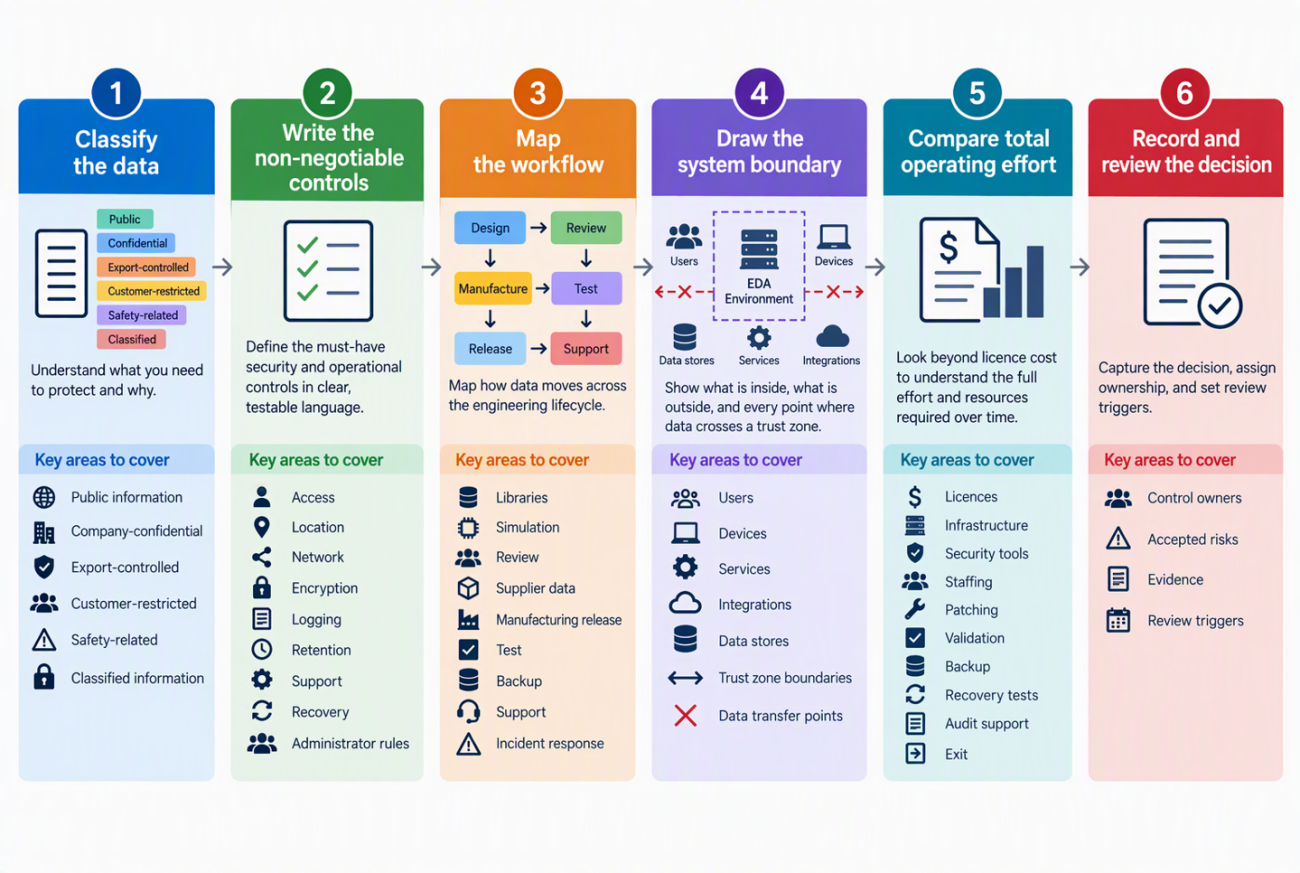
Figure 1: Six-Step Selection Method
The six steps can be used to select the appropriate Altium environment. Data classification helps determine whether a standard Altium workspace, Altium 365 GovCloud, customer-managed Enterprise Server, or isolated local setup is suitable. The control requirements then shape identity, permissions, logging, network access, administration, and support.
Workflow mapping should cover more than PCB editing. Teams should include requirements, component libraries, ECAD-MCAD work, design reviews, BOM management, PLM publishing, manufacturing release, external partners, and audit evidence. Altium capabilities such as managed workspaces, structured reviews, role-based access, event logs, component data, workflow-based publishing, and version-controlled releases can help keep those activities connected.
The final record should name the chosen deployment, control owners, accepted risks, and review triggers. It should also document which responsibilities sit with Altium, which sit with the organization, and which depend on connected identity, PLM, security, manufacturing, or supplier systems.
Questions for an EDA Security Review
- Where are design files, libraries, release packages, logs, and backups stored?
- Who can administer the service, from which locations, and under what approval?
- How are users provisioned, reviewed, and removed?
- What network paths, telemetry, licence checks, and support channels exist?
- How are data encrypted, logged, restored, exported, and deleted?
- How are external partners limited to the projects and actions they need?
- How quickly are critical security fixes applied and validated?
- What happens if the provider, data centre, local site, or isolated lab is unavailable?
- How can the organization leave the platform and verify data return or deletion?
Choose the Smallest Model That Closes the Real Risk
For Altium users, the goal is to choose the deployment and security controls that fit the real boundary rather than force every project into one model. Altium can provide managed workspaces, access controls, design histories, review records, release governance, local infrastructure, regulated cloud options, and offline licensing. The organization remains responsible for its system architecture, user behaviour, connected tools, transfer processes, and compliance decisions.
Cloud can be the right answer when managed services, current security controls, and distributed collaboration matter most. On-premises can be right when local administration and integration are essential. Air-gapped deployment can be right when a written requirement rejects external connectivity.
Altium supports each operating direction, but the strongest decision is still the one backed by a clear system boundary, control map, and operating plan.
Frequently Asked Questions
Is on-premises EDA safer than cloud EDA?
Not automatically. On-premises gives the customer more direct control, but the customer also owns patching, monitoring, backup, resilience, and administrator security. Cloud security depends on provider controls and customer configuration.
Does cloud EDA mean PCB design happens in a browser?
Not always. “Cloud” may describe data management, collaboration, compute, or the full application. Buyers should ask which functions run locally and which depend on the hosted service.
Can an on-premises system be air-gapped?
Yes. An air-gapped system is usually on dedicated local infrastructure, but most on-premises systems are connected. Air-gapped describes isolation, not location alone.
Which model is best for regulated industries?
There is no universal answer. Match the data and contract requirements to identity, network, encryption, logging, residency, support, recovery, and evidence controls.
Can one organization use more than one model?
Yes. Many organizations separate workloads by data class or program. The key is to control every interface and avoid copying sensitive data into a lower-trust zone.

About Author
Related Resources
Related Technical Documentation
Table of Contents
- Key Takeaways
- Three Deployment Models
- Cloud EDA: Managed Scale and Connected Work
- On-Premises EDA: Local Control with Local Responsibility
- Air-Gapped EDA: Strict Isolation With a High Operating Load
- Side-By-Side Decision View
- Compliance Should Shape the Model, Not Name It
- A Six-Step Selection Method
- Questions for an EDA Security Review
- Choose the Smallest Model That Closes the Real Risk
- Frequently Asked Questions
Solutions for Every Role and Team
- Discover and evaluate design options earlier
- Develop in one shared workspace
- Scale with control and compliance
- Connect every stage of hardware development
Learn More
Thank you, you are now subscribed to updates.