







Moving Beyond the Spreadsheet: The New Standard for Engineering Task Management

At a Glance
Replace disconnected spreadsheets with in-context task management. Discover how Altium Agile Teams and Jira integration accelerate hardware development.


Product development cycles are accelerating, and engineering teams must coordinate more work across more roles in less time. Every hardware organization wants to move faster, but as these teams grow, they often feel they must sacrifice project velocity to accommodate more complex operations. The real challenge lies in scaling that speed across distributed teams, increasingly complex electronic projects, and growing regulatory requirements. Organizations face a distinct paradox: they need to operate with the agility of a startup while maintaining the structured control and discipline of a large enterprise.
One of the most significant barriers to achieving this balance is how teams handle engineering task management. As projects multiply and collaboration crosses time zones, the pressure placed on legacy systems warps what used to be agile workflows into tangled, manual processes that take too much time to administer. When the management of tasks relies on disconnected tools and static documents, the crushing administrative overhead actively robs energy from creativity and innovation. To truly scale, engineering organizations must abandon the spreadsheet and adopt connected, in-context engineering task management that unites the entire multidisciplinary team.
Key Takeaways
- Managing engineering tasks across spreadsheets, emails, and disconnected ticketing systems creates manual administrative overhead, introduces errors, and drains engineering time.
- In-context task management, where comments and tasks are placed directly on the design artifacts, eliminates misunderstandings and dramatically accelerates the review cycle.
- Connecting your ECAD environment natively with Jira and enterprise PLM tools ensures automated data synchronization and provides complete traceability, eliminating manual reporting loops.
The Danger of Silos, Spreadsheets, and Disconnected Tools
Electronics product development processes grind through friction. This friction does not exist because engineers do not want to collaborate, but because the tools and environments they rely on were never built to support true co-creation.
In most organizations, especially small and mid-sized ones, hardware professionals work in deep functional silos. Electrical engineers live in their ECAD tools, mechanical teams operate in MCAD environments, software teams write code in separate IDEs, procurement handles sourcing in spreadsheets, and compliance teams work in entirely separate systems. Each discipline speaks its own language, uses its own tools, manages its own independent data, and operates on its own timeline.
Because these tools do not natively communicate, collaboration is usually forced through a patchwork of meetings, emails, shared network drives, and exported files. Consequently, coordination heavily depends on human effort. When engineering task management requires a person to manually export a list of design changes from a CAD tool, format it into a spreadsheet, email it to a mechanical engineer, and then log a ticket in a separate tracking system, alignment becomes a recurring administrative task rather than a given.
Most hardware teams still juggle these disconnected tools alongside file-based exchanges and ad-hoc workflows. Design reviews happen in isolation, Jira tickets drift completely out of sync with the actual design files, and component data lives in separate spreadsheets. The immediate result of this methodology is project delays, duplication of effort, and a lost trust in the underlying engineering data.
Spreadsheets and isolated ticketing systems fundamentally fail the modern hardware design process because they lack context. When an electrical engineer discovers a clearance issue or a thermal constraint on a printed circuit board, describing that highly spatial, complex problem in a text-heavy Jira ticket or an Excel cell is inherently inefficient. The mechanical engineer or layout designer reviewing that task must then open their own tools, find the correct version of the file, navigate to the specified coordinates or component, and attempt to interpret the original engineer's intent.
As teams scale, this complexity scales with them. Multiple designers attempting to edit the same board while tracking their tasks in a disconnected spreadsheet can easily introduce conflicts and require massive rework. Incomplete version control leads to outdated libraries, while manual approvals slow down releases and open up dangerous compliance gaps.
The industry data surrounding this inefficiency is stark. According to research from Bain & Company, many engineers in traditional firms devote barely half of their time to active design work. They lose a massive, significant number of hours simply to rework and administrative tasks. If your highly talented engineers are spending more time managing processes, chasing down status updates, and updating spreadsheets than they are creating actual electronics, your organization is suffering from the hidden costs of complexity.
The Shift to In-Context Task Management
To eliminate the friction of functional silos, teams must move toward a model of multidisciplinary co-creation. Altium Agile Teams modernizes electronics design and development by introducing multi-disciplinary collaboration that actively connects people, processes, and data; instead of separate tools stitched together with spreadsheets, Agile Teams provides a single, shared workspace where electrical, mechanical, software, and manufacturing engineers can co-create together.
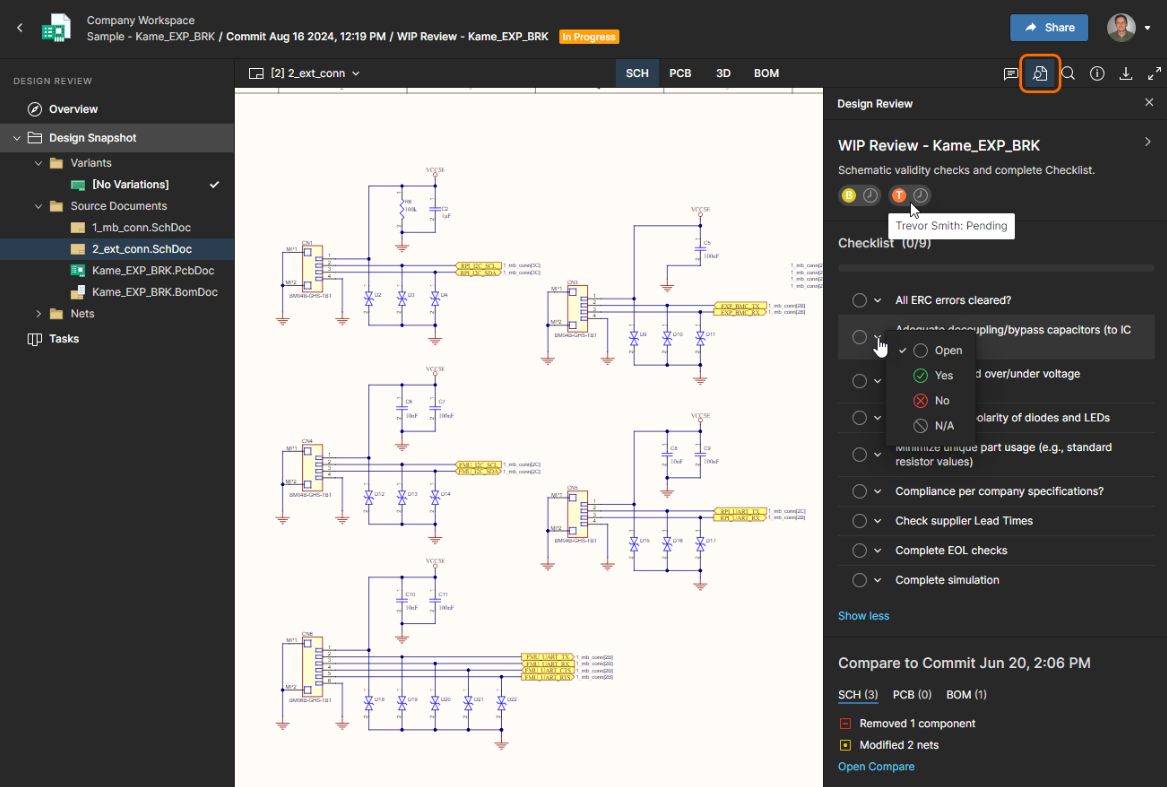
The foundation of this unified approach is in-context task management. Rather than forcing engineers to leave their design environment to log an issue, this innovative platform allows users to leave comments and generate tasks directly within the design documents themselves. Because this happens without any intermediate documents, the context is perfectly preserved.
During design reviews, stakeholders can provide in-browser commenting and execute structured sign-offs asynchronously and in a distributed manner. If an engineer spots an issue with component placement or trace routing, they can drop a comment directly on that specific artifact on the board. Feedback happens in real time, directly within the design environment, involving all necessary stakeholders. Changes are visible immediately across all disciplines.
This direct linkage between tasks and design artifacts leads to drastically fewer misunderstandings and much faster resolution times. When a task is generated exactly where the problem exists, coordination is built directly into the platform, live and direct. Managers gain full visibility and control through these structured workflows and streamlined, multidisciplinary design reviews. Furthermore, the system automatically maintains a complete audit trail history of all changes and actions in one centralized place, ensuring compliance and accountability without the need for manual tracking.
Why Jira and PLM Connectors Are Essential
While moving away from spreadsheets is the first step, true agile hardware development requires unhindered integration with the broader enterprise software ecosystem. Isolated engineering task management platforms, even powerful ones, will inevitably cause friction if they require manual data entry to stay updated. Therefore, integrating your design environment with established tracking and product lifecycle tools is essential.
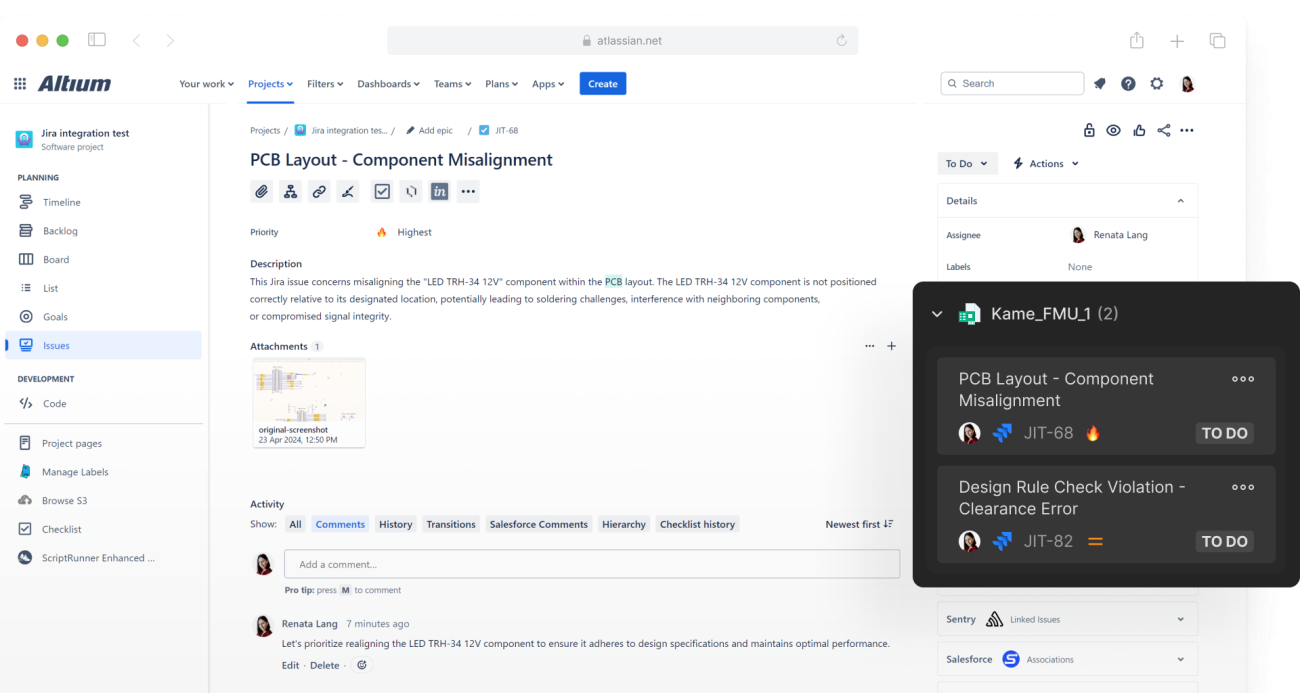
Altium Agile Teams allows organizations to integrate their ecosystem to connect directly to Jira and PLM tools such as Duro PLM or Arena PLM. By tightly coupling the electronic computer-aided design environment with these enterprise systems, you keep engineering and project data perfectly in sync across all tools.
When a Jira ticket is linked directly to a design artifact, the status of the project is always accurate. PLM and Jira integrations completely remove the manual steps and reporting loops that historically add time to product development and lead to critical errors. Every design change and approval is recorded, traceable, and secure. This creates a shared digital thread that weaves the work together, ensuring clear traceability from the initial concept all the way through to manufacturing release.
Unifying Your Engineering Ecosystem
Modern hardware product development moves too fast to rely on disconnected spreadsheets and siloed ticketing systems. As projects grow in complexity, the administrative burden of manually coordinating tasks across ECAD, MCAD, and procurement disciplines will inevitably stifle innovation and slow your time-to-market.
Altium Agile Teams flips this organizational complexity into a competitive advantage. By providing fast, structured, and flexible multi-disciplinary collaboration, it delivers control without the burdensome complexity that slows adoption or innovation. By linking tasks directly to design artifacts, streamlining communication, and natively integrating with essential tools like Jira and enterprise PLMs, organizations can finally leave the spreadsheet behind. Experience enterprise-level collaboration without the enterprise-level friction, and empower your engineering teams to work as one →
Frequently Asked Questions
Why are spreadsheets ineffective for managing electronics design tasks?
Spreadsheets lack spatial and design context. When a task or issue is logged in a spreadsheet, engineers must leave their tools, hunt down the correct file version, and manually interpret text-heavy descriptions to find the problem on the board. This manual coordination leads to delays, duplication of work, and an increased risk of errors.
How does Altium Agile Teams handle design reviews differently?
Altium Agile Teams replaces formal review meetings and file packaging with asynchronous, real-time collaboration. Stakeholders can leave comments and generate trackable tasks directly within the design documents in their browser. This ensures feedback is captured exactly where the issue exists, preserving critical engineering context.
Does Altium Agile Teams integrate with my existing project management tools?
Yes. Altium Agile Teams features turnkey integrations with standard ecosystem tools like Jira, as well as PLM systems such as Duro PLM and Arena PLM. This keeps engineering data automatically synced across platforms, removing the need for manual updates and ensuring total traceability.

About Author
Related Resources
Related Technical Documentation
Table of Contents
Solutions for Every Role and Team
- Discover and evaluate design options earlier
- Develop in one shared workspace
- Scale with control and compliance
- Connect every stage of hardware development
Learn More
Thank you, you are now subscribed to updates.