








5 Ways AI Requirements Management Is Transforming Hardware Product Development

At a Glance
Discover five ways AI is transforming requirements management in electrical engineering, from summarizing requirements documents to impact analysis.


Requirements are the primary text-based representation of the system being designed. Before a schematic is drawn or a line of code is written, the system exists as words: statements that describe behavior, constraints, interfaces, and verification criteria. As products grow in complexity, however, that textual description grows with them, until manually managing it becomes a challenge in its own right.
AI, and large language models in particular, are well-suited to this problem. This is the idea behind Agentic Requirements Engineering: using AI to structure, review, and refine large volumes of requirements, exactly where it excels, while engineers remain firmly responsible for intent, tradeoffs, and final decisions.
Here’s what it looks like in five core workflows.
Key Takeaways
- AI helps teams turn scattered requirements into structured, reviewable engineering data.
- AI can improve requirement quality by suggesting clearer, more specific, and more verifiable statements.
- AI supports review, traceability, and verification workflows. Engineers remain responsible for final decisions.
1. Extract Requirements Out of Static Documents
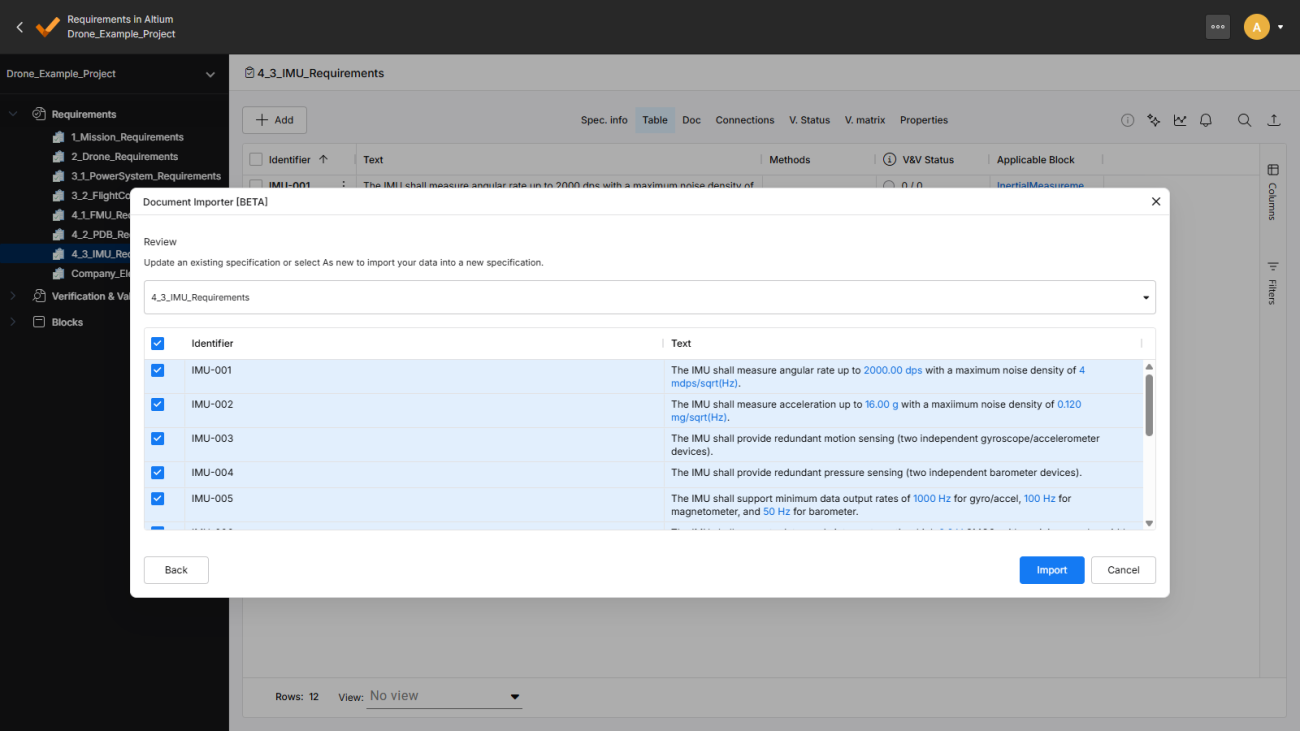
Many teams receive requirements in unstructured formats, and moving that content into a usable workspace has traditionally required manual copying, cleanup, and reformatting before teams can review, trace, or verify anything.
AI can handle much of that grunt work, identifying likely requirements and converting them into structured requirements in a shared workspace. Engineers spend less time reconstructing content from static files and more time on the requirements work that actually drives design decisions.
2. Break Down Requirements Into Verifiable Engineering Specs
High-level requirements often contain implied engineering details that become important downstream. A customer requirement may express the right intent but still leave too much ambiguity for design, review, or verification teams to work from.
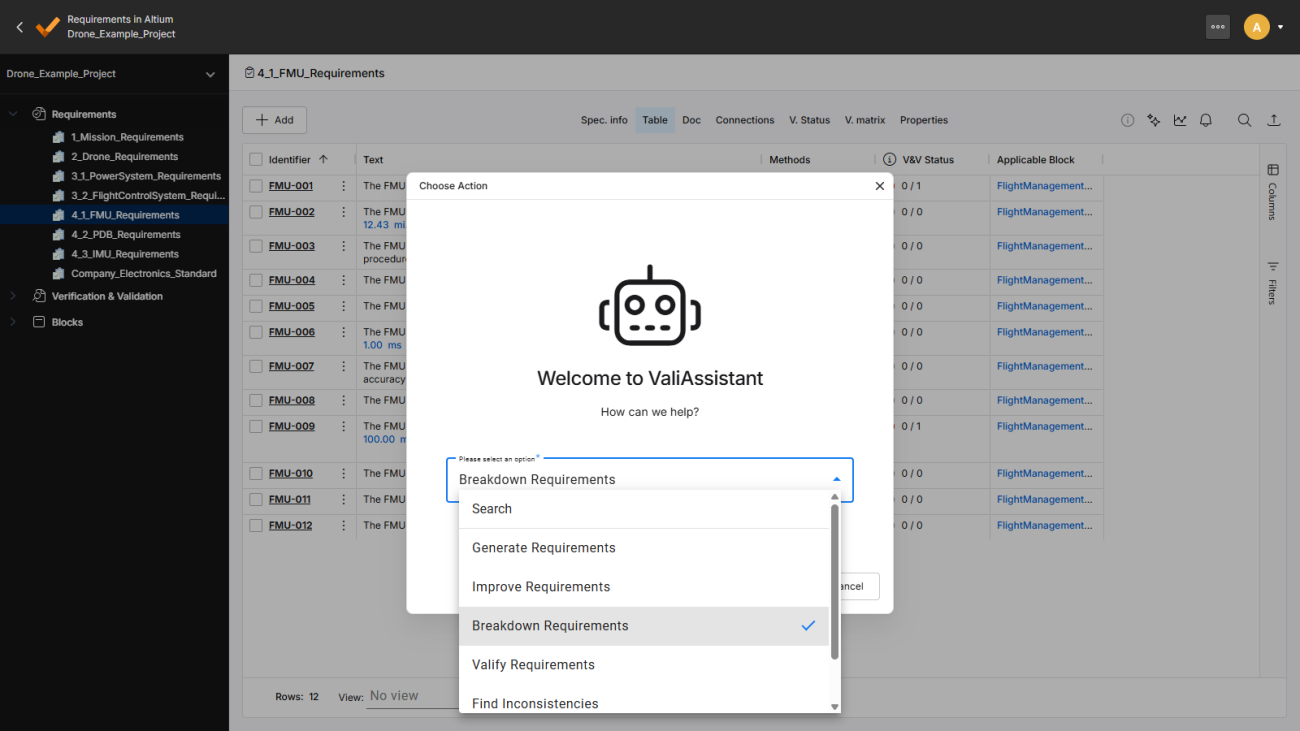
AI helps by suggesting derived requirements and breaking down broad statements into more specific, verifiable specs. Here are two examples:
Example: “The handheld unit shall operate reliably in outdoor service conditions.”
From this, AI can help derive measurable child requirements that are sufficiently specific to support a test procedure, such as:
- Operating temperature range
- Ingress protection
- Display readability in bright ambient light
- Drop survivability
Example: “The device shall support a full shift of field use.”
In this case, AI suggests child requirements for:
- Battery runtime
- Recharge time
- Low-battery warning threshold
- Performance at the end of discharge
3. Catch Duplicates, Conflicts, and Weak Wording
Even well-written requirements can conflict or overlap as a system grows in complexity.
AI can help teams pressure-test this by:
- Flagging duplicates: identifying requirements that express the same intent across sections or documents
- Surfacing conflicting statements: comparing system requirements against customer requirements and highlighting where the two have diverged
- Catching vague or unverifiable wording: recognizing language that would leave a test engineer without a clear pass/fail criterion
Weak wording is often the easiest place to see the value, as these next two examples demonstrate:
Example: “The board should not overheat during normal use.”
This leaves too much open to interpretation. What qualifies as normal use? What temperature counts as overheating? Where should that temperature be measured?
AI can suggest a stronger version, such as “The PCB surface temperature adjacent to U14 shall not exceed 85 °C after 30 minutes of operation at maximum rated load in 40 °C ambient air,” which gives the team something specific to review, discuss, modify, and verify.
Example: “The system shall start quickly.”
This captures the intent, but it doesn't define success. AI will suggest a verifiable version, such as “The system shall reach operational readiness within 10 seconds of power-on under nominal supply conditions,” which provides a much stronger basis for design and test.
4. Strengthen Verification Planning
Once requirements are structured and reviewed, teams need to plan verification and prepare for the reality that things will change. This includes thinking through how each requirement will be validated, what evidence will be needed, and which linked requirements or verification items may be affected by updates.
AI can support this work by:
- Suggesting verification methods
- Drafting testing procedures
- Identifying downstream effects of change
5. Translate Requirements While Preserving Engineering Intent
For many hardware teams, requirements work crosses language boundaries. Global product teams, suppliers, manufacturing partners, and regional compliance stakeholders may all need access to the same requirements, and even small translation differences can create design risk.
AI can support multilingual requirements development in several practical ways:
- Drafting translations across multiple languages: giving teams a consistent starting point that human reviewers can refine rather than produce from scratch
- Flagging phrases that don’t translate cleanly: recognizing idiomatic or domain-specific language that may not carry its meaning across languages
- Highlighting where translation could shift intent or weaken verifiability: catching cases where the translated version no longer maps cleanly to a testable condition
Example: A requirement such as “The system shall reach operational readiness within 10 seconds of power-on under nominal supply conditions” needs more than a loose translation. Its timing, condition, and engineering intent all need to remain intact.
Engineers still need to review translations, especially for nuanced technical language, but AI gives them a big head start, helps preserve consistency across versions, and reduces the burden of work for multilingual requirements.
Best Practice: Work with Requirements in a Shared Workspace
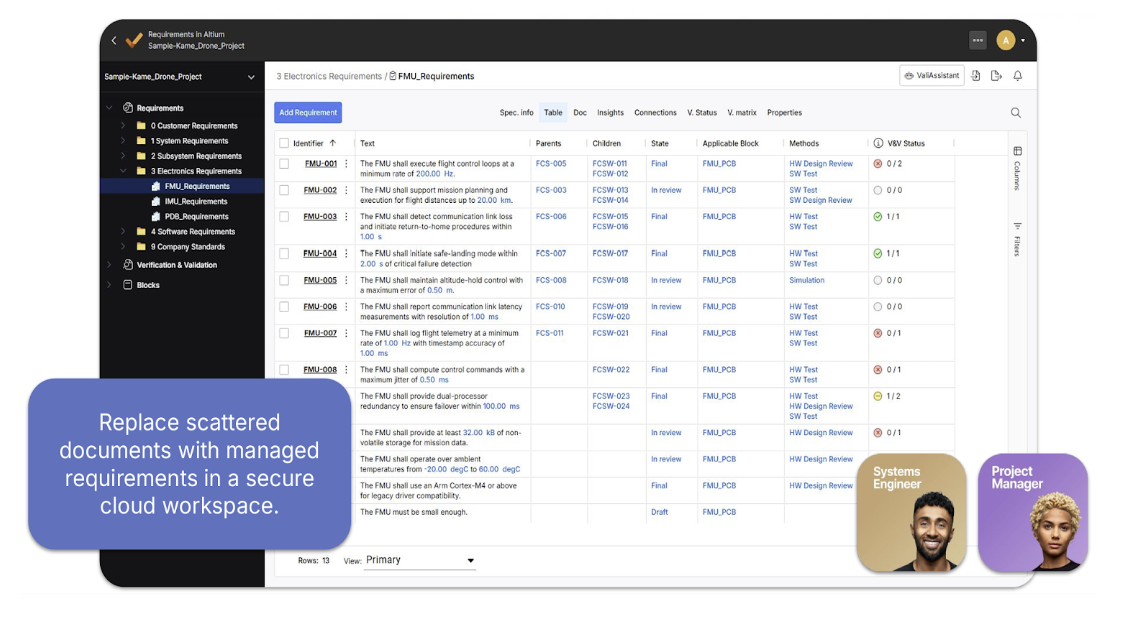
AI works best inside a shared, structured environment, that requirements management software provides, where requirements, traceability, and verification are connected. Teams that embed AI throughout the workflow, from document import to verification planning, spend less time managing scattered content and more time engineering.
Better requirements improve design alignment, review speed, and verification readiness. Altium Requirements Portal provides teams with a shared workspace to import, structure, and manage requirements with AI assistance alongside their design and verification work.

About Author
Related Resources
Related Technical Documentation
Table of Contents
- Key Takeaways
- 1. Extract Requirements Out of Static Documents
- 2. Break Down Requirements Into Verifiable Engineering Specs
- 3. Catch Duplicates, Conflicts, and Weak Wording
- 4. Strengthen Verification Planning
- 5. Translate Requirements While Preserving Engineering Intent
- Best Practice: Work with Requirements in a Shared Workspace
Better Requirements
Less Busywork
Build better hardware with AI agents that live and act in your requirements tool.
Learn More
Thank you, you are now subscribed to updates.