









Common Requirements Management Pitfalls (and How to Avoid Them)

At a Glance
This article explores common pitfalls in requirements management and offers practical insights on how to avoid costly missteps in product development. It highlights the implications of vague requirements, the challenges of siloed tools, and the dangers of scope creep, illustrating how these issues can lead to delays, miscommunication, and increased costs.


As products become more interconnected and development cycles accelerate, the cost of poor requirements management becomes harder to absorb. Unclear requirements can drive costly rework, delay schedules, increase sourcing risks, and create products that pass verification testing yet still fail to meet customer needs. Understanding the most common pitfalls, and the practices mature systems engineering teams use to avoid them, can help organizations reduce risk while cutting development time.
Key Takeaways
- Ambiguity in requirements drives costly misalignment. Clear, quantitative, and testable requirements prevent rework and miscommunication.
- Siloed tools and disconnected artifacts make it hard to track the impact of requirement changes. Automated, end-to-end traceability is essential for managing changes reliably.
- Scope creep (gold-plating) adds cost without real value. Adding “nice-to-have” features inflates complexity, verification effort, and cost while often not improving the core product outcome.
1. Vague Requirements Create Expensive Guesswork
"Low power." "High reliability." "Fast response time."
These phrases commonly appear in requirements documents, yet they can mean different things to different engineers. When requirements rely on qualitative language without defined units, ranges, or verification methods, interpretation gaps form early and propagate across subsystems. The result is divergence that often only becomes visible at integration, when teams discover they were working toward different assumptions.
The Mars Climate Orbiter is the classic example. A mismatch between engineering units (English vs. metric) was not caught during interface verification, sending the spacecraft ~170 km below planned entry altitude and costing $327 million. The root issue wasn't engineering capability, but how interface requirements were specified, interpreted, and validated across systems.
At the practitioner level, the pattern is less dramatic but structurally identical. A requirement such as “the sensor shall be low power” is not inherently wrong; it is not verifiable. It leaves too much room for interpretation. A requirement such as “the sensor shall consume no more than 1 W during active operation and 0.01 W in standby mode, measured under defined operating conditions” removes ambiguity by introducing measurable targets and test conditions.
Two firmware teams on the same sensor node interpret "low power" independently. One designs for ~800 mW; the other budgets ~200 mW. Both designs locally satisfy the requirement, but integration exposes a mismatch in system-level assumptions.
The issue is not that one team is wrong; it is that the requirement allowed multiple valid interpretations without forcing convergence.
The Fix: Write quantitative, testable requirements with explicit units, operating conditions, and verification methods. Pair this with cross-functional flow-down reviews so subsystem teams explicitly demonstrate how they interpret and satisfy parent requirements before detailed design begins. |
2. Siloed Tools Break Traceability
Traceability isn’t an issue. Until it is — usually discovered at the worst possible moment: during a late-cycle audit, a customer review, or when a test fails and no one can quickly answer which requirement it was supposed to verify.
Disconnected systems (requirements in a spreadsheet, design decisions in a Wiki, tests in a separate tool, code in version control with no explicit links) turn change management into a manual reconciliation exercise. When a requirement changes mid-cycle (and it will), engineers must hunt across systems to identify every downstream artifact it touches. Some get missed. The result is "zombie" test cases: verification procedures still running against requirements that were modified months ago, or that no longer exist at all. Outdated documentation, obsolete test procedures, and design assumptions that outlive their original requirements accumulate quietly until something breaks.
Modern engineering environments address this by maintaining live links between requirements, design artifacts, test plans, software revisions, and verification evidence. For example, with the Altium Requirements Portal, teams can establish this end-to-end traceability, connecting requirements to downstream design and verification activities. When a requirement changes, teams can quickly assess the impact across the development lifecycle and ensure affected artifacts are reviewed and updated.
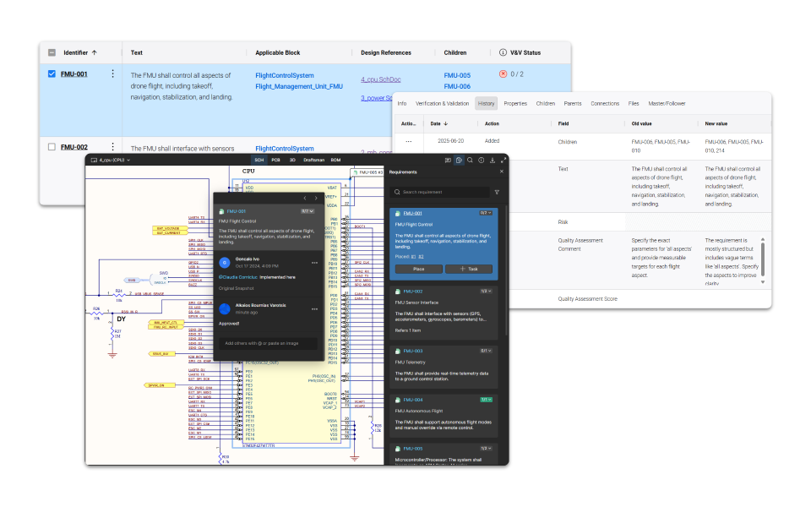
In practice, this means engineers can immediately identify which subsystems, test cases, or design documents need attention when a requirement changes, allowing teams to respond earlier and with greater confidence.
The Fix: Establish automated traceability between requirements, design artifacts, verification activities, and change records. Flag any verification artifact without a live requirement link as a process defect, and incorporate impact analysis into the standard change workflow; not as an audit exercise, but as a daily engineering tool. |
3. “Gold-Plating” Inflates Scope Without Adding Value
Gold-plating elevates nice-to-have features into mandatory requirements. Each looks justified in isolation. Collectively, they bloat cost and verification effort without advancing the mission.
The problem compounds because gold-plated requirements are invisible once they are written. They look exactly like legitimate functionality. They generate the same design work, testing burden, and documentation requirements as genuinely necessary features. And because they were added by someone with legitimate standing (an engineer who saw a genuine edge case) they rarely get challenged.
Rigorous organizations avoid this by maintaining an unbroken line of sight between engineering tasks and high-level objectives. Every requirement must justify its existence by supporting a parent customer need, operational objective, regulatory obligation, or system-level performance target.
The Fix: Require every requirement to explicitly trace back to a business, regulatory, or mission objective. Separate exploratory trade studies from requirements baselines, evaluating a potential enhancement does not justify putting it in the specification. The key question is never whether a feature can be implemented; it is whether its absence would cause the product to fail. |
While gold-plating adds unnecessary functionality, over-specification adds unnecessary constraints. Engineering teams naturally add margin to reduce risk, but problems arise when highly conservative assumptions become permanently embedded throughout the requirements baseline without evaluating their downstream impact.
A common example is specifying high-reliability, extended-temperature components for controlled commercial environments. Technically superior, but it cascades hidden costs: specialized testing, longer lead times, higher unit prices, and defense-grade verification rigor.
For platform-based or iterative development programs, this damage compounds quickly. Repeating verification activities for unchanged requirements on an established platform baseline is pure overhead. It adds a schedule burden while providing zero new information.
The Fix: Deploy a risk-based verification strategy. Match the verification rigor and testing class to the actual operational risk of each requirement, rather than applying blanket scrutiny. Preserve and reuse verification evidence for stable, legacy platform capabilities, and focus active validation efforts strictly on new functionality or mission-specific changes. |
5. Requirements Developed Without Manufacturing and Supply Chain Input Create Downstream Risk
Engineering teams naturally write specifications within their own zone of expertise: performance requirements driven by simulation, interfaces shaped by architecture, and environmental constraints informed by the use case. What is frequently missing is the early cross-functional input that determines whether those specs can actually be built, sourced, and scaled.
Specifications that look flawless on a screen can create severe downstream friction. Tight tolerances may be achievable in prototype quantities but impossible in volume manufacturing. Similarly, components selected blindly from reference designs often introduce single-source dependencies, long-term obsolescence risks, or severe lead-time exposure. By the time manufacturing or supply chain teams surface these issues, the requirements are baselined, the design is frozen, and resolving them costs far more than it would have at the requirements stage.
Mitigating this risk requires treating supplier depth, manufacturability, and sourcing constraints as active engineering inputs rather than post-design logistics.
The Fix: Involve procurement and manufacturing engineers during initial requirements development, not just at the final design review. Integrate Design-for-Manufacturability (DFM) guidelines and Approved Vendor List (AVL) data directly into the engineering workflow. This ensures component lifecycle status and supply chain risks are visible to teams before specifications become fixed. |
Conclusion
The single thread connecting all five pitfalls is disconnection – between teams, between tools, and between the specification and the reality it is supposed to describe.
- Vague language creates gaps between engineers.
- Siloed tools create gaps between artifacts.
- Missing operations input creates gaps between design and production.
- Skipped validation creates gaps between the product and the customer.
Requirements management is not a documentation exercise but the connective tissue of product development. Teams that treat it as a live, integrated workflow rather than a front-loaded compliance activity build faster, with greater confidence, and at a lower cost.
Platforms like the Altium Requirements Portal bridge critical information gaps, transforming requirements from static documents into a live, traceable workflow throughout the product lifecycle.
Common Questions
What makes a requirement “good” in systems engineering?
A good requirement is clear, measurable, and testable. It includes defined units, conditions, and acceptance criteria, so different teams interpret it the same way. Strong requirements also link to a higher-level objective (customer need, business goal, or regulatory constraint), ensuring they drive meaningful outcomes, not just technical activity.
Why is traceability important in requirements management?
Traceability connects requirements to design, code, tests, and verification results, making change management predictable. When a requirement changes, traceability allows teams to instantly see downstream impact, avoid outdated tests (“zombie” artifacts), and prevent integration failures caused by misaligned assumptions.
What is the difference between verification and validation?
Verification asks: Did we build the product correctly according to the specification?
Validation asks: Did we build the right product to meet real user needs?
Both are essential. A system can pass all verification tests and still fail if the original requirements were incomplete or misaligned with real-world use.
How can teams avoid scope creep and over-specification?
Avoiding scope creep requires ensuring every requirement traces back to a business or mission objective. To prevent over-specification, teams should adopt a risk-based approach, applying stricter requirements only where necessary. Regular cross-functional reviews (engineering, manufacturing, supply chain) help identify unnecessary complexity early, before it becomes costly to fix.

About Author
Related Resources
Related Technical Documentation
Table of Contents
- Key Takeaways
- 1. Vague Requirements Create Expensive Guesswork
- 2. Siloed Tools Break Traceability
- 3. “Gold-Plating” Inflates Scope Without Adding Value
- 4. Over-Specification Can Become a Hidden Cost Driver
- 5. Requirements Developed Without Manufacturing and Supply Chain Input Create Downstream Risk
- Conclusion
- Common Questions
Better Requirements
Less Busywork
Build better hardware with AI agents that live and act in your requirements tool.
Learn More
Thank you, you are now subscribed to updates.