










How Lunar New Year Disrupts Electronics Manufacturing and PCB Supply Chains

At a Glance
The Lunar New Year is celebrated in China and other countries, leading to delays in electronics manufacturing. These can be predicted and accommodated if you plan to produce in China.


If you work in electronics, Lunar New Year is not just a date on the calendar but one of the most predictable and unforgiving stress tests in the global electronics supply chain.
Many teams still say “Chinese New Year,” but Lunar New Year is the better planning term. The holiday follows a lunar calendar; China officially calls it the Spring Festival, and the disruption is not limited to one country. Electronics supply chains now span China, Vietnam, Malaysia, Singapore, Thailand, Indonesia, and other Asian hubs, so the impact spreads across a regional network rather than a single factory base.
What Happens Before Lunar New Year
Electronics manufacturing relies on a multi-tier ecosystem of PCB fabrication, laminates, resins, copper foil, semiconductors, connectors, passives, cables, specialist chemicals, and logistics capacity. Manufacturing has diversified across Asia, but exposure has not gone away. In practice, the holiday creates a coordinated regional capacity dip, which is why planning now has to happen supplier by supplier, lane by lane, and tier by tier.
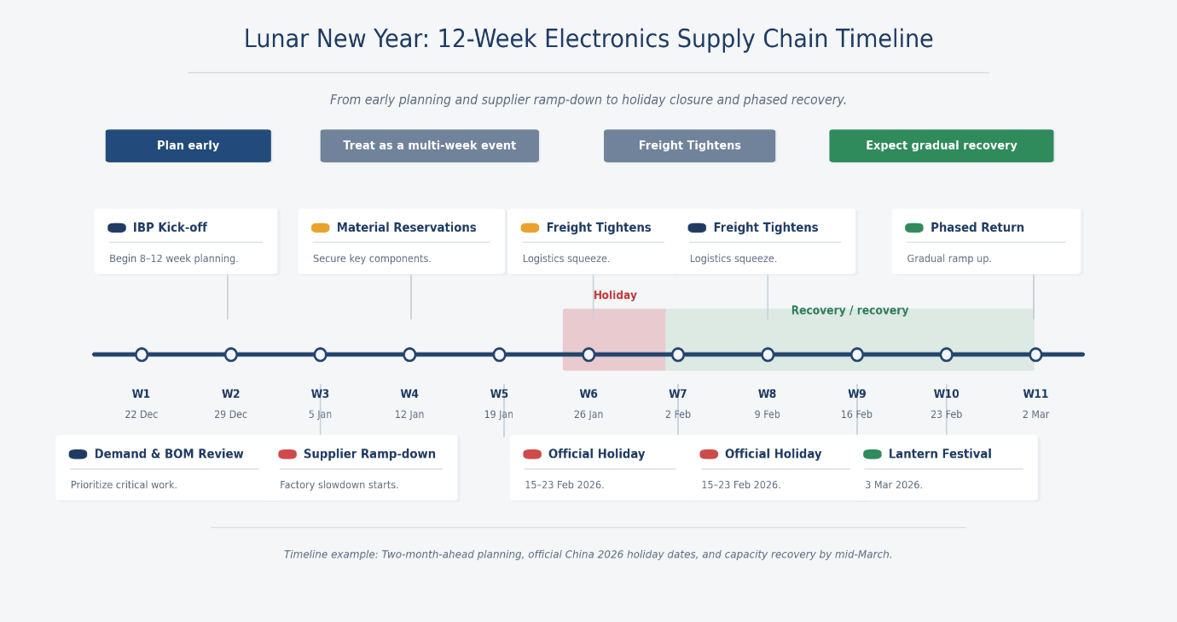
Lunar New Year moves every year because it follows the lunar calendar. In 2026, Lunar New Year Day fell on 17 February 2026, while China’s official Spring Festival holiday ran from 15 February to 23 February 2026, with adjusted working days on 14 February and 28 February.
The first signal is usually order compression. Buyers pull demand forward, suppliers try to lock material, and freight bookings tighten. The available production and shipping window starts shrinking long before the holiday officially begins. Supply Chain Brain notes many manufacturers begin winding down one to two weeks ahead of the break, while MIT advises planning at least two months ahead when China-facing demand and supply pressures are involved.
The second signal is hardening supplier behavior. Some suppliers stop taking new orders. Others accept only confirmed demand already in the queue. Smaller PCB and PCBA suppliers will continue to take orders, but they may not disclose the true order lead time until after the start of the Lunar New Year.
The third signal is freight strain. Even if production finishes on time, logistics may not. Port congestion, carrier adjustments, and tighter air capacity can all delay finished boards and assemblies. For large orders, freight has its own schedule and constraints.
Shutdowns vs. Slowdowns
Some sites will fully shut down during Lunar New Year, and, as noted above, they will warn customers in advance. However, not all companies shut down completely; a factory may still be open, but upstream materials may be late, QA approvals may take longer, engineering support may thin out, and substitute options may narrow. In that scenario, the supplier looks “open” while the network behind it is not operating normally. Some companies will inform customers of order delays, while others will not.
How Buyers Should Plan Ahead for Lunar New Year
The first rule is simple: plan for supplier cut-off dates, not public holiday dates. If you use the public holiday as your trigger, you are probably already too late.
The second rule is to segment demand. Separate work into:
- Must-ship
- Can-slip
- High-risk
That gives you a cleaner way to protect customer commitments, avoid unnecessary pre-holiday panic, and focus leadership attention on the builds that really matter.
The third rule is to protect the long tail of materials. The real constraint may not be the fabrication slot. It may be the specialist laminate, the foil, the finish chemistry, or the connector that quietly drives the entire schedule. Strong planning requires BOM visibility across tiers, not just a list of direct suppliers. Running your BOM through Octopart BOM Tool before the pre-holiday window closes is a straightforward way to surface which parts are already thinning across authorized distributors and which ones have credible alternates you could qualify while there is still time.
The fourth rule is to design freight as part of the sourcing plan. If your plan depends on the last three shipping days before closure, it is not really a plan. It is a gamble.
For electronics teams, that means starting the Lunar New Year planning cycle 8 to 12 weeks ahead and answering a short list of clear questions:
- Which customer demand is fixed?
- Which materials are constrained?
- Which suppliers have confirmed cut-off dates?
- Which SKUs need buffer stock?
- Which builds can move to alternate sites or parts?
- What will restart look like by supplier and commodity?
That is how a predictable disruption becomes a managed seasonal event instead of an annual surprise.
A Final Thought
The teams that still treat Lunar New Year as a one-week China shutdown are planning for the wrong problem. This is a multi-country, multi-tier, multi-week supply chain event that starts before the holiday, distorts inbound capacity and freight, and continues to shape yield, backlog, and availability after reopening. The best electronics teams plan for it early, visibly, and cross-functionally. Everyone else ends up paying for the same lesson again next year.
Frequently Asked Questions
Why does the Lunar New Year affect electronics manufacturing so much?
Because electronics supply chains are concentrated across Asian manufacturing hubs that reduce labor availability, production capacity, and logistics throughput around the same time. The impact extends well beyond final assembly to include PCB materials, semiconductors, connectors, passives, and freight.
Is the Lunar New Year only a China issue?
No. It affects multiple hubs across Asia, including Vietnam, Malaysia, Singapore, Thailand, and Indonesia. For electronics companies, the disruption is regional, not just Chinese.
When should buyers start planning for Lunar New Year?
A good rule is 8 to 12 weeks ahead, with at least two months of visibility on demand, materials, cut-off dates, and freight.

About Author
Related Resources
Related Technical Documentation
Table of Contents
Solutions for Every Role and Team
- Discover and evaluate design options earlier
- Develop in one shared workspace
- Scale with control and compliance
- Connect every stage of hardware development
Learn More
Thank you, you are now subscribed to updates.