











Standards for High-Reliability Passive Components

At a Glance
Learn how standards define high-reliability passive components. Understand AEC-Q200, MIL-PRF, and space frameworks to choose components for demanding designs.


High reliability used to be a concern reserved for defense, aerospace, and a narrow band of industrial work. EV powertrains, LEO satellite payloads, surgical robotics, and grid-edge infrastructure are now pushing more electronics into harsher environments and longer service lives. The passive components in these systems operate under conditions much closer to military and space environments than to commercial ones.
Major manufacturers are responding to this trend. On April 8, 2026, Murata announced mass production of seven AEC-Q200-qualified automotive MLCCs, offering what the company describes as the largest capacitance available for their rated voltage and size, targeting ADAS, autonomous-driving, and automotive power-line applications. A week later, on April 13, KYOCERA AVX announced an expansion of its MIL-PRF-32535 BME NP0 MLCC qualifications, adding new case sizes and capacitance values to the Defense Logistics Agency (DLA) Qualified Products Database.
In today’s high-reliability designs, capacitors, resistors, and inductors directly affect power integrity, timing stability, sensing accuracy, EMI control, and long-term robustness. A 1% drift in a precision resistor is a calibration headache in a commercial product and a recall-grade failure in an implantable device. A ceramic capacitor that loses 40% of its effective capacitance under DC bias works fine in a desktop power supply and starves the filter network in an automotive ADAS module. In each case, a standards-qualified passive component that appears acceptable in a broad catalog search can still be the wrong choice if its operating behavior doesn't fit the design.
Key Takeaways
- High-reliability passive components are defined by qualification, screening, derating, and controlled use conditions.
- Those criteria differ depending on which standards govern them. AEC-Q200, MIL-PRF, and space-focused frameworks each serve distinct reliability goals and are built for different operating environments.
- Once the framework is matched to the application, electrical behavior, mechanical robustness, derating, and engineering judgment determine the final call.
- Octopart’s search and filtering tools help engineers use standards-based criteria to identify high-reliability passive components that fit design requirements.
High Reliability Starts With the Standards Framework
High-reliability passive selection is governed by three component-level standards systems, plus medical device-level quality and safety frameworks.
Automotive
AEC-Q200 is the Automotive Electronics Council’s baseline qualification document for auto-grade passive components. Revision E, released in 2023, expanded categories to include niobium capacitors, supercapacitors, fuses, and trimmer potentiometers, and added ESD testing requirements for quartz crystals. AEC-Q200 also defines family-specific test methods, including board-flex, surge, flame-retardance, and HBM ESD tests.
Military and Defense
MIL-PRF performance specifications, maintained by the DLA, remain central in many defense programs. Family-specific documents, such as MIL-PRF-55681 for established-reliability ceramic capacitors and MIL-PRF-55342 for fixed-film chip resistors, define failure rate levels (FRLs) designated M, P, R, and S, ranging from 1% down to 0.001% allowable failures per 1,000 hours. MIL-PRF-55342 also includes a T-level (space-grade) designation that mandates additional testing and inspection beyond the basic FRL requirements.
Space
NASA’s EEE-INST-002 has long governed parts selection, screening, qualification, and derating for Goddard Space Flight Center space-flight projects, while NASA-STD-8739.11 is the newer agency-level framework that builds on that baseline with four assurance levels and device-specific sections. The European equivalent, ECSS-Q-ST-60C Rev.4, differentiates among Class 1, Class 2, and Class 3 components as trade-offs between assurance and risk. Both frameworks add space-specific expectations for screening, derating, traceability, lot acceptance, and risk classification.

Medical
Medical electronics often utilize automotive, industrial, or military-grade parts, with traceability and risk-control requirements flowing down from ISO 13485 and IEC 60601 at the device level rather than from a component-specific passive standard.
Engineers increasingly encounter overlap between these systems, especially when considering automotive-grade parts for ruggedized, defense, or space-adjacent applications.
Standards Set the Floor. Applications Set the Bar
Qualification reveals how a component performs under controlled stress tests. Real-world behavior in a specific design is a different question, and the answer varies by component type: MLCCs, tantalum capacitors, resistors, and inductors each carry their own application risks.
Multilayer Ceramic Capacitors (MLCCs)
MLCCs experience a loss of effective capacitance under DC bias, and this loss is particularly severe in Class II dielectrics such as X7R and X5R. A 10 µF X7R MLCC operated at rated voltage can deliver less than half its nameplate capacitance in circuit, and TDK’s published data show some operating conditions push the drop closer to 80%.
Tantalum Capacitors
Tantalum capacitors can fail short under surge current at power-up, particularly in low-impedance circuits with large inrush. Sustained ripple current also degrades the dielectric over time. MIL-PRF-55365 defines surge-current screening options at specific temperature points, but no qualification test fully replicates the surge profile of a real circuit at the end of life. NASA’s capacitor reliability tutorial gives updated guidance on surge-current limits and ripple-current life testing.
Resistors
Resistors drift under sustained power loading and thermal cycling. Thin-film parts hold tolerance and temperature coefficient of resistance (TCR) far better than thick-film parts over thousands of hours at rated power, which is why precision instrumentation, sensor front-ends, and medical signal conditioning often require thin-film parts qualified to MIL-PRF-55342. Thick-film parts tolerate higher pulse energy and are common in power and protection roles.
Inductors
Inductors saturate when the transient current exceeds the core’s rated limit, and the saturation point depends on temperature and DC bias. A part that meets AEC-Q200 stress requirements can still saturate prematurely if its peak operating current sits close to the rated rollover point. NASA’s magnetics tutorial anchors evaluation around temperature rise and the mission environment, both of which are easy to underestimate based on inductance values alone.
What Engineers Should Check Before Selecting Parts
Once the framework and product-family risks are clear, perform these five checks to pressure-test part candidates before locking your BOM.
- Qualification verification: Confirm the governing qualification standard is met before designating a part as a high-reliability candidate.
- Derating policy: Define derating early for voltage, temperature, ripple current, power, and current loading. Use authoritative derating tables, such as those in NASA EEE-INST-002, rather than supplier marketing curves.
- Lifecycle and supplier discipline: Review lifecycle status, traceability, PCN practices, and supplier documentation.
- Sourcing and counterfeit assurance: Confirm authorized distribution, lot-acceptance expectations, chain-of-custody requirements, and whether AS6171-based counterfeit detection is needed.
- Assembly sensitivity: Check solder profile compatibility, moisture sensitivity level, and mechanical handling requirements.
How To Find Standards-Compliant Passive Components
Octopart can help you find the right high-reliability passives for your application with this search workflow:
1. Start the Search with Family and Standard
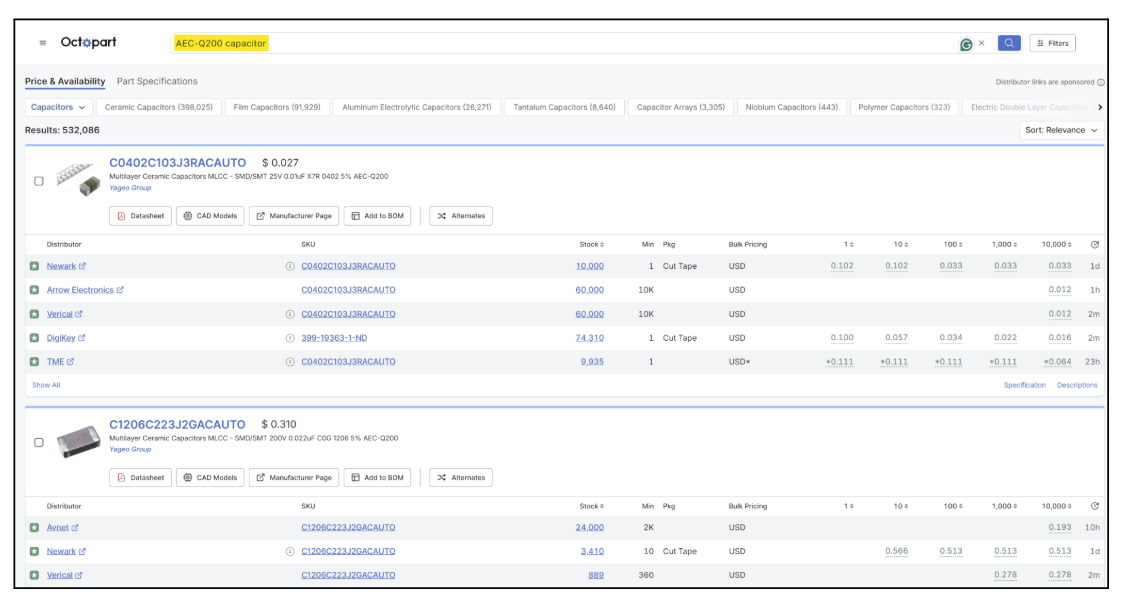
Pick the required passive family: resistors, capacitors, inductors, or transformers. Perform a search that combines the family name with the standard in the search query, such as "AEC-Q200 capacitor" or "MIL-PRF-55342 resistor." The results page lists each candidate with its manufacturer, distributor coverage, and pricing.
2. Filter the Results Page
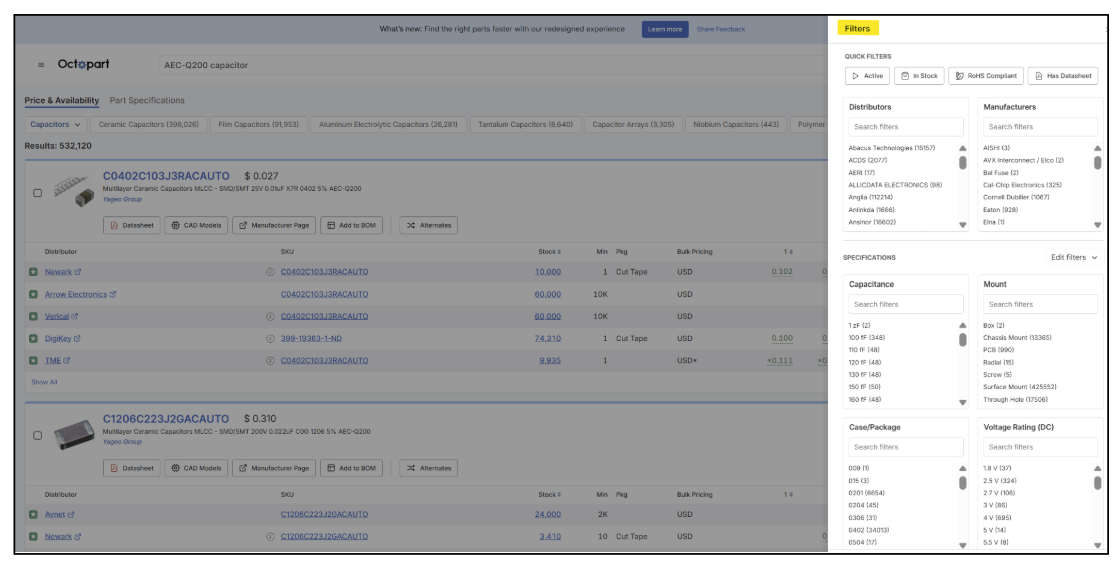
Toggle Filters to narrow results by package, parametric range, manufacturer, lifecycle status, and compliance attributes, surfacing qualified candidates without opening each part page.
3. Review Consolidated Specs View
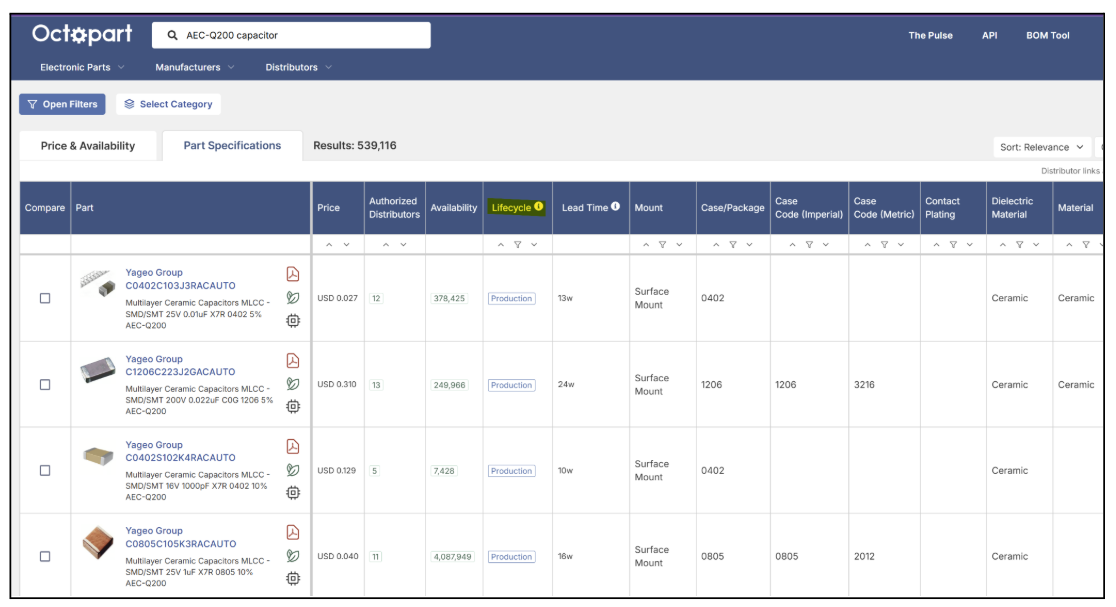
Switching to Parts Specifications View surfaces additional fields, including lifecycle status. Once the candidate list is narrowed (see the following example), the next step is verifying revision compliance.
4. Confirm the Revision
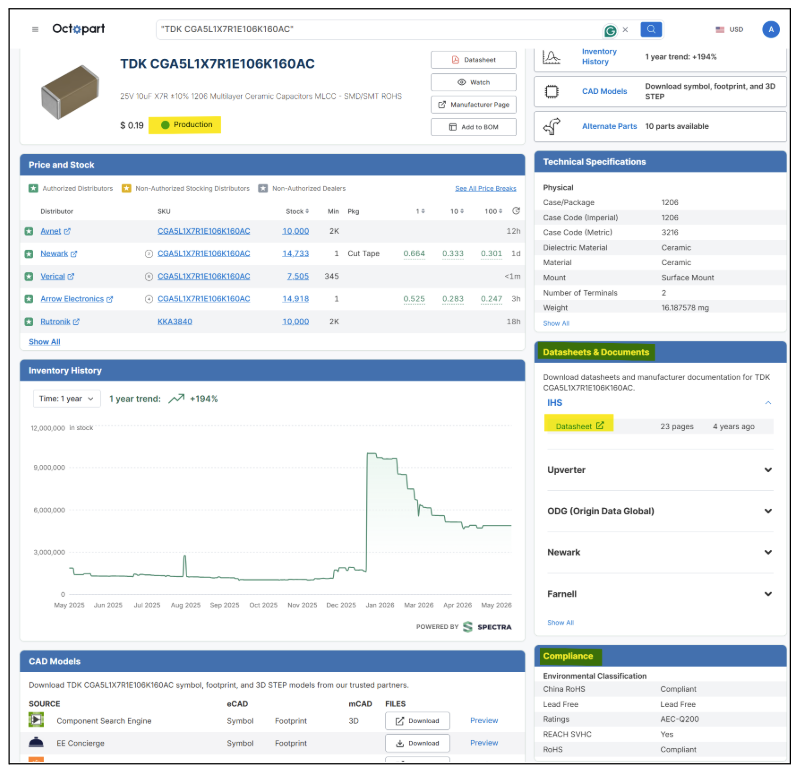
Open each candidate’s part page on Octopart, where available datasheets and documentation usually state the qualification revision. Cross-check that revision against the current one published by the issuing authority. Revision mismatches between specification and procurement are a recurring source of late-stage rework.
Example: Narrowing Results to a Usable Shortlist
Consider an industrial sensor application calling for an AEC-Q200 Grade 1 ceramic capacitor.
Define the Design Parameters
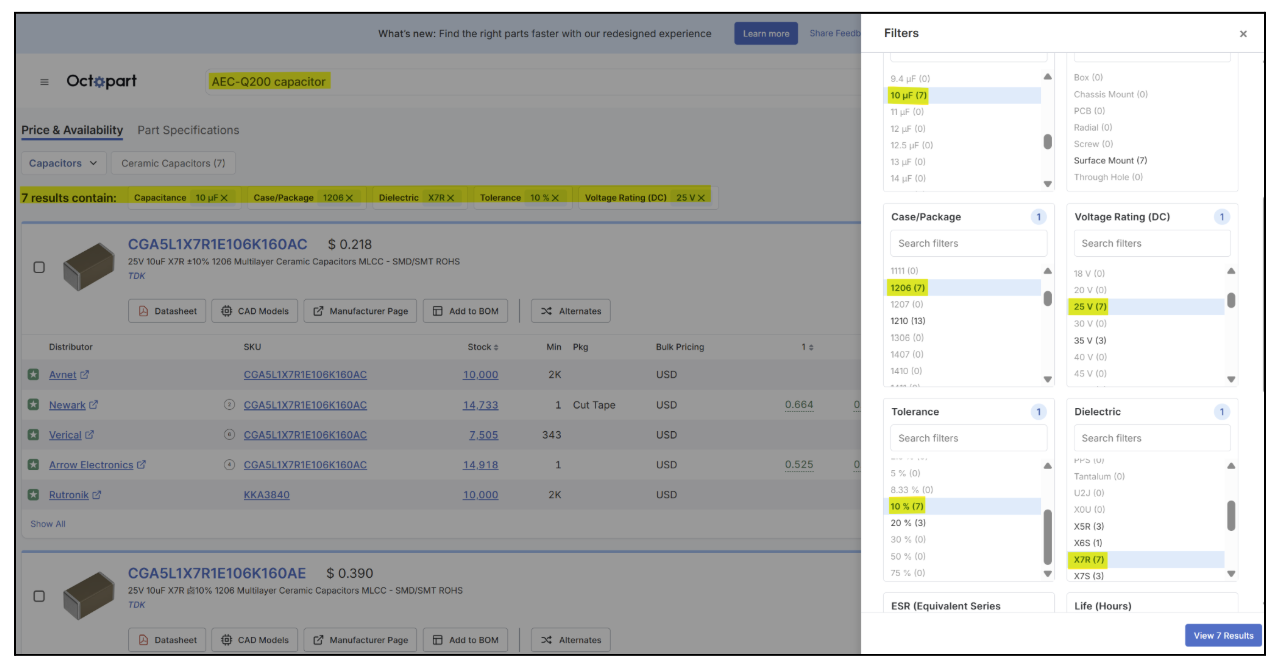
The application requires a 10 µF, 25 V, X7R, 10% tolerance, 1206 ceramic capacitor qualified to AEC-Q200 Grade 1 (–40 °C to +125 °C).
Apply Octopart Filters
After starting the search with “AEC-Q200 capacitor” (as above), filter the capacitor results page by dielectric (X7R), voltage (25 V), capacitance (10 µF), tolerance (10%), and package (1206). See Screenshot 5. When combined with the AEC-Q200 search term, the parametric filters narrow the results to candidates that match both the standards baseline and the design spec.
Evaluate Each Candidate’s Part Page
Refine your shortlist by opening each part page to review compliance information, available documentation, and relevant part data in one place. Then, cross-check any qualification or revision claims against the manufacturer's datasheet and the issuing standard.
Standards Provide Structure. Part Selection Still Requires Judgment
Qualification frameworks define how a passive performs under controlled test conditions. Selecting the right part for a specific design requires another layer of review. Standards qualification narrows the field, and the final decision depends on application fit, risk tolerance, and supply confidence.

About Author
Related Resources
Related Technical Documentation
Table of Contents
- Key Takeaways
- High Reliability Starts With the Standards Framework
- Standards Set the Floor. Applications Set the Bar
- What Engineers Should Check Before Selecting Parts
- How To Find Standards-Compliant Passive Components
- Example: Narrowing Results to a Usable Shortlist
- Standards Provide Structure. Part Selection Still Requires Judgment
Solutions for Every Role and Team
- Discover and evaluate design options earlier
- Develop in one shared workspace
- Scale with control and compliance
- Connect every stage of hardware development
Learn More
Thank you, you are now subscribed to updates.