







What Makes Aerospace Connectors Different

At a Glance
Discover what makes aerospace connectors different from commercial parts. Explore material risks, mounting methods, and mechanical locking requirements.


Designing hardware for space is an entirely different discipline from traditional electronics engineering. It is unforgiving, and you are not building a board to sit on a desk. Instead, you are building a system that must survive violent acoustic shocks, extreme G-forces, and the cold vacuum of space. In these extreme environments, the connectors you choose are often the weakest link in your system. The stakes are astronomically high, as a single loose pin or cracked solder joint can ruin an expensive mission, which is why connector selection matters.
Key Takeaways
- Connectors are often the weakest link in aerospace systems that must withstand extreme G-forces, acoustic shocks, and the vacuum of space.
- Friction-fit commercial connectors back out under vibration; aerospace components require physical locking, like threaded couplings or bayonet locks.
- Pure tin and cadmium pose severe risks in space environments due to the growth of conductive tin whiskers and toxic outgassing, respectively.
- Through-hole technology is preferred over surface-mount devices because it transfers mechanical loads directly to the board rather than to the surface pad.
- You do not necessarily need parts explicitly marked as space-grade; commercial off-the-shelf parts are often acceptable if they meet strict mechanical and material requirements.
The Fundamental Divide: Commercial vs. Aerospace
Before the heavy details, here is a quick reference to the fundamental differences between standard commercial connectors and those built for aerospace. Standard commercial parts prioritize speed, affordability, and compactness, whereas spacecraft components prioritize absolute physical resilience and specialized material compositions.
Feature | Standard Commercial | Aerospace & Spacecraft |
Board Mounting | SMD (faster, space-saving) | THT (physically stronger under stress) |
Surface Finish | Pure tin | Gold (completely tin-free) |
Body Material | Plastics, basic alloys | Advanced composite materials or specialized finishes (cadmium-free) |
Fixation | Friction fit | Threaded, bayonet, physical keying |
Now, here is what you need to know about the specific mechanical factors impacting aerospace connector selection.
Mechanical Fixation: Screws, Locking, and Keying
The launch and operational phases of an aerospace vehicle's lifecycle introduce immense physical stress. Specifically, aerospace vehicles experience intense random vibration loads and mechanical shocks over their operational lives. Under these punishing conditions, standard friction-fit connectors easily back out due to vibrations.
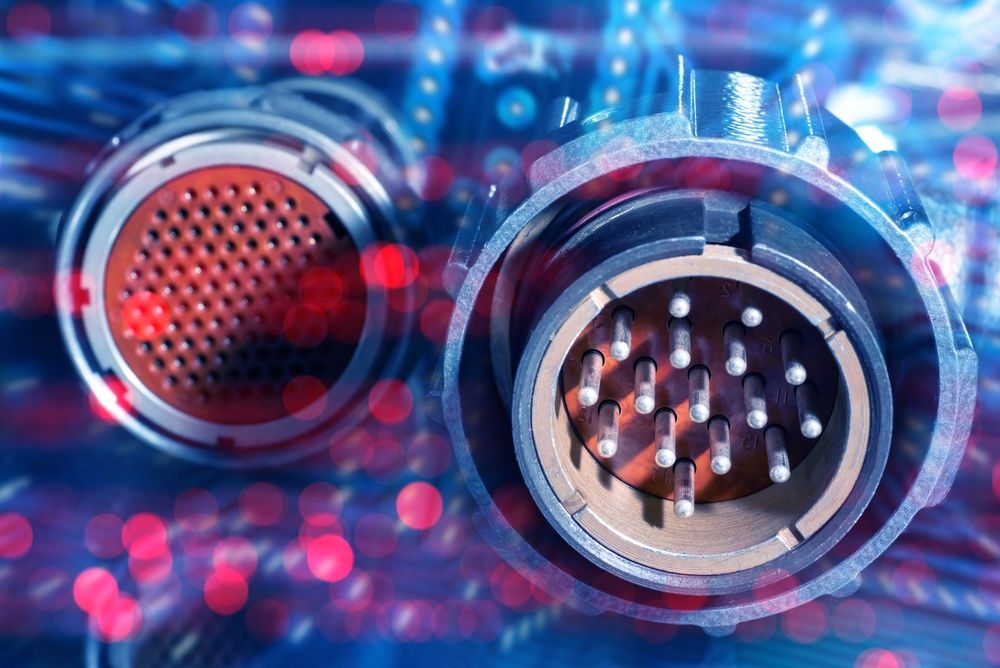
To get around this, aerospace engineers must rely on definitive mechanical retention. Physical locking mechanisms like screw mounts, threaded couplings, and bayonet locks keep the connections firmly attached despite the acoustic and vibrational chaos of launch.
Beyond securing the connector in place, the geometry of the connector shell itself is vital. Keying physically prevents technicians from forcing a plug into the wrong socket or inserting it upside down. This seemingly mechanical feature can prevent total system failures caused by a simple loose wire or a cross-connected circuit.
Surface Finishes: The Danger of Pure Tin
The surface finish is just as important as the underlying metal. In standard consumer electronics, pure tin plating is inexpensive and widely used on commercial printed circuit boards.
But when pure tin is stressed in a vacuum, it can grow metal filaments called tin whiskers. These microscopic hairs sprout from the plating and fill gaps between pins. Once they bridge the gap between adjacent conductors, they create electrical shorts that can destroy critical hardware. The thickness of the coating also plays a role in this dangerous phenomenon; for example, studies show that tin whiskers grow even longer on thicker tin coatings (e.g., 2.3 μm) than on thinner ones.
To stop this hardware-destroying issue, aerospace connectors use gold surface finishes to remain completely tin-free. While standard aerospace connectors typically use a nickel underplate beneath the gold for durability, engineers will occasionally specify specialized nickel-free underplates for deep-space probes that require strictly non-magnetic components.
Galaxy IV
While the danger of microscopic metal filaments might sound like a purely theoretical engineering concern, its real-world consequences have crippled international infrastructure before. Here’s the case of Galaxy IV:
- The mission: Launched in 1993, Galaxy IV was a $250 million commercial communications satellite. From its geostationary orbit, it handlednearly 90% of all pager traffic in North America, alongside major television and radio broadcast signals.
- The incident: On May 19, 1998, the satellite suddenly lost its ability to maintain attitude control and began to spin uncontrollably in space. In an instant, over 40 million pagers went completely dead across the continent, and several broadcast networks were knocked offline.
- The culprit: Engineers traced the catastrophic anomaly to a failure in the spacecraft's primary and redundant control processors. The root cause was tin whiskers. Microscopic filaments had sprouted from pure tin-plated relays within the control electronics, which bridged a gap between terminals and triggered a fatal electrical short circuit.
- The aftermath: With its processors shorted and its thruster fuel quickly depleted from spinning, Galaxy IV could not be recovered and was declared a total loss. The multi-million-dollar incident became one of the most famous catalysts for the aerospace industry's strict policies against pure tin plating.
Base Materials: Moving Away from Cadmium
The structural body of the connector is another area where standard practices have had to evolve significantly. For a long time, cadmium plating was the standard for aluminum aerospace connectors. It stops corrosion and acts as a solid lubricant for threads.
So here's what changed that standard: global health regulations recognized cadmium as highly toxic and carcinogenic. Beyond the severe terrestrial health hazards, cadmium presents a unique functional hazard in space: it outgasses in the vacuum, leaving harmful deposits on sensitive optical lenses and sensors.
Finding a substitute is difficult because cadmium works very well for rust prevention. However, to meet modern aerospace briefs, engineers need to find advanced composite materials or specialized finishes that are cadmium-free to guarantee safety without compromising structural strength.
Mounting Methods: SMD vs. Through-Hole
How a connector attaches to the printed circuit board dictates how much physical stress that connection can withstand before failing. Surface mount devices, including discrete semiconductors, sit flat on the copper pads and save space. This makes them incredibly popular in standard commercial applications where miniaturization is the goal.
However, when printed circuit boards operate in harsh conditions with high vibration or acceleration, through-hole technology is often heavily preferred. Instead of merely resting on the surface, THT pins go entirely through the board and are soldered on the opposite side.
This gives itsuperior durability: the mechanical load from a heavy connector transfers to the fiberglass board itself rather than just pulling on the surface solder joint, preventing the pads from tearing off. By utilizing the structural integrity of the entire fiberglass substrate, THT connections effectively anchor the component against intense G-forces.
Incidental Aerospace Suitability
Procuring components for space missions can be a massive logistical and financial hurdle, but there are viable workarounds. Here's the thing: you do not always have to buy a part explicitly marked as space-grade to use it in space.
Many standard commercial off-the-shelf connectors are acceptable for spacecraft as long as they meet the strict mechanical requirements. The engineering focus must remain on the material and mechanical realities rather than the marketing label. If a standard industrial connector is entirely tin- and cadmium-free and passes the required thermal derating tests, it is generally safe to fly.
To find these suitable components, engineers use platforms like Octopart to access this kind of technical data and filter components by material. The platform serves as a trusted source of truth for part attributes and lifecycle information across the industry. Databases with strict material filtering can help you find affordable alternatives that still meet aerospace constraints.
Frequently Asked Questions
How does atomic oxygen in Low Earth Orbit affect connector materials over time?
While the vacuum of deep space presents challenges like outgassing, Low Earth Orbit (LEO) introduces atomic oxygen (AO). AO is highly reactive and can severely erode certain plastics, polymers, and exposed metals on connectors. To mitigate this, engineers must often specify materials with high AO resistance or use specialized protective conformal coatings.
What role does thermal cycling play in connector mating cycles in space?
Spacecraft experience extreme temperature fluctuations, shifting from blistering heat in direct sunlight to freezing cold in Earth's shadow. This drastic thermal cycling causes the different materials in a connector (like the plastic housing and metal pins) to expand and contract at different rates. Over time, this can degrade the mating force, loosen the connection, or induce micro-cracks in the solder joints.
Are fiber optic connectors starting to replace traditional copper in aerospace applications?
Yes, fiber optics is becoming increasingly common in modern aerospace designs. Fiber-optic connectors offer massive bandwidth advantages and are entirely immune to electromagnetic interference (EMI), which is a significant concern in the radiation-heavy environment of space. That being said, they do introduce new mechanical challenges, as fiber alignment is highly sensitive to the intense vibrations of launch.

About Author
Related Resources
Related Technical Documentation
Table of Contents
- Key Takeaways
- The Fundamental Divide: Commercial vs. Aerospace
- Mechanical Fixation: Screws, Locking, and Keying
- Surface Finishes: The Danger of Pure Tin
- Galaxy IV
- Base Materials: Moving Away from Cadmium
- Mounting Methods: SMD vs. Through-Hole
- Incidental Aerospace Suitability
- Frequently Asked Questions
- How does atomic oxygen in Low Earth Orbit affect connector materials over time?
- What role does thermal cycling play in connector mating cycles in space?
- Are fiber optic connectors starting to replace traditional copper in aerospace applications?
Solutions for Every Role and Team
- Discover and evaluate design options earlier
- Develop in one shared workspace
- Scale with control and compliance
- Connect every stage of hardware development
Learn More
Thank you, you are now subscribed to updates.