



Introducing Agentic Requirements Engineering

At a Glance
Agentic Requirements Engineering is here: AI that acts on your requirements tool. Less busywork, more alignment, faster iterations. Now in Requirements Portal.


We're introducing a new way for engineers to work in Requirements Portal, through AI agents that act on your project data. |
Our new Agentic Requirements Engineering capabilities remove unnecessary friction when working with requirements, closing the gap between the mental model in your head and the shared model your whole team works from.
The benefit? Less busywork, more team alignment, fewer mistakes, and faster iterations.
Watch the video below to see it in action.
Key Takeaways
- AI agents act directly on your requirements data so that you spend less time on admin.
- Requirements stop being static documents and become a living, shared model.
- Available today in Requirements Portal - included with every Altium Develop and Agile Teams subscription.
Why Don't More Engineers Work with Requirements?
Every engineer knows that good requirements matter during product development:
- They are the shared mental model that keeps the team aligned.
- They enable everyone involved to understand the problem so they can reach the best solution.
- Hardware design, software development, and verification all trace back to requirements.
In other words, requirements sit at the core of the entire hardware development process. Get the specification right, and the whole team iterates faster and builds better products.
The best engineers treat requirements as a shared mental model that evolves with their product. |
Yet in practice, many engineering teams want to be more requirements-driven but the friction introduced by the tools available to them get in the way:
At one end of the spectrum, there are documents and notes. Easy to start, but they break down quickly as complexity grows: scattered, disconnected, and impossible to trace across a project.
At the other end, there are dedicated requirements management systems. Powerful in theory, but built for documentation and compliance, not engineering. They feel like administration platforms: heavy, form-driven, and disconnected from the actual engineering workflow.
Neither option makes it easy for engineers to manage requirements as their projects evolve. So requirements get written once and forgotten or passed around informally through meeting notes and spreadsheets.
That's why we built Agentic AI into Requirements Portal - to remove the friction that keeps engineers from working with requirements.
Enter Agentic Requirements Engineering
Agentic Requirements Engineering brings you AI agents that act directly on your requirements data - answering questions with full context, proposing changes, and running continuous quality checks.
Requirements Portal now ships with four new capabilities:
Engineering Assistant
Ask questions, describe what you want to change, see a preview in the UI, review and apply. Approve every AI action before you commit.
AI-Assisted Importer
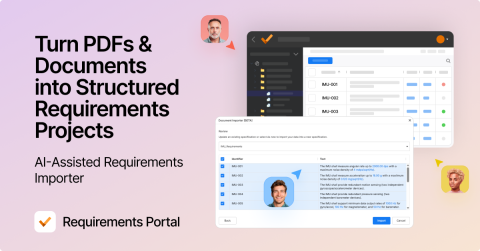
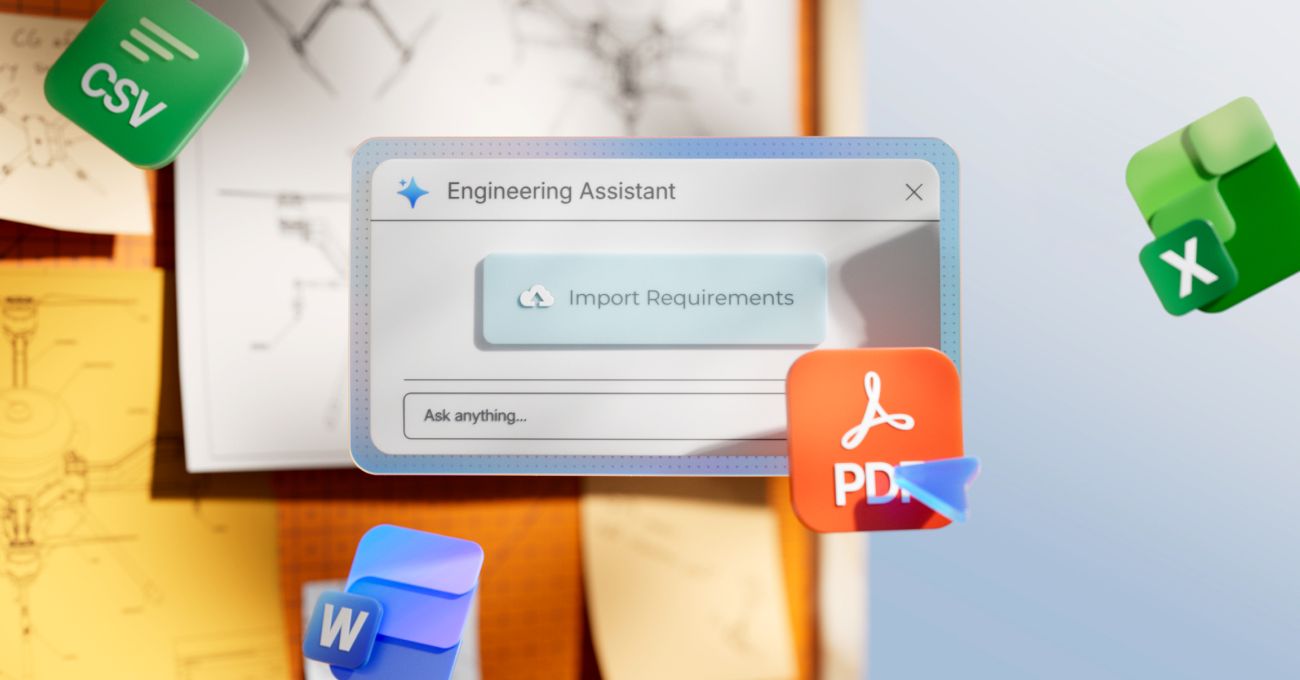
Import requirements from anywhere: spreadsheets, PDFs, documents, or notes. AI converts them into structured, well-formatted requirements.
AI Skills
Turn your processes into instructions that AI agents can reuse across projects. Share them with your team to standardize your workflows.
Background Agents
Let AI run continuously in the background, scanning your requirements and surfacing risks, traceability issues, and coverage gaps for you to review. (Coming soon.)
No change happens without your approval. The AI handles the busywork. You make the engineering decisions. |
Agentic Workflow Examples
Let's follow a real project - a quad-drone with onboard AI for defect detection - to see how Agentic Requirements Engineering fits into the work.
Turning Scattered Inputs into Structured Requirements
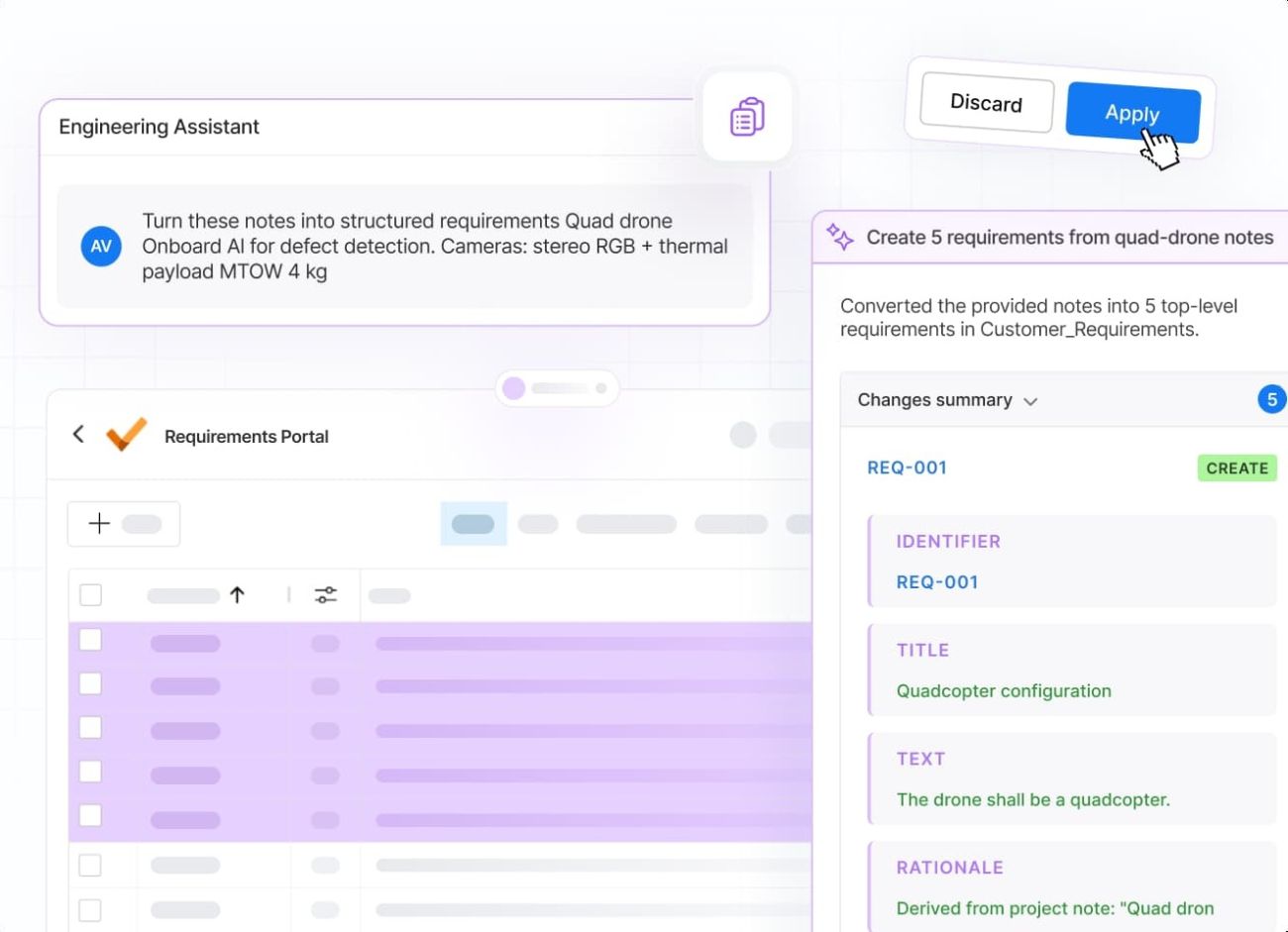
Every new project starts with scattered inputs. Requirements rarely arrive fully formed: they come as customer emails, meeting notes, PDFs with standards, and spreadsheets from previous projects.
The project lead uses the AI-Assisted Importer to pull requirements from the spreadsheet that the customer provided, then opens the Engineering Assistant and types: "Turn these notes from the customer meeting into requirements."
Structured requirements come back, each with an identifier, title, text, rationale, and type, ready to review and apply. The whole team has a shared starting point before the first design decision is made.
Try it yourself: Paste this prompt into the Engineering Assistant: “Turn these notes into structured requirements: Quad drone, Onboard AI for defect detection, Cameras: stereo RGB + thermal payload, MTOW 4 kg”.
Understanding a New Specification Fast
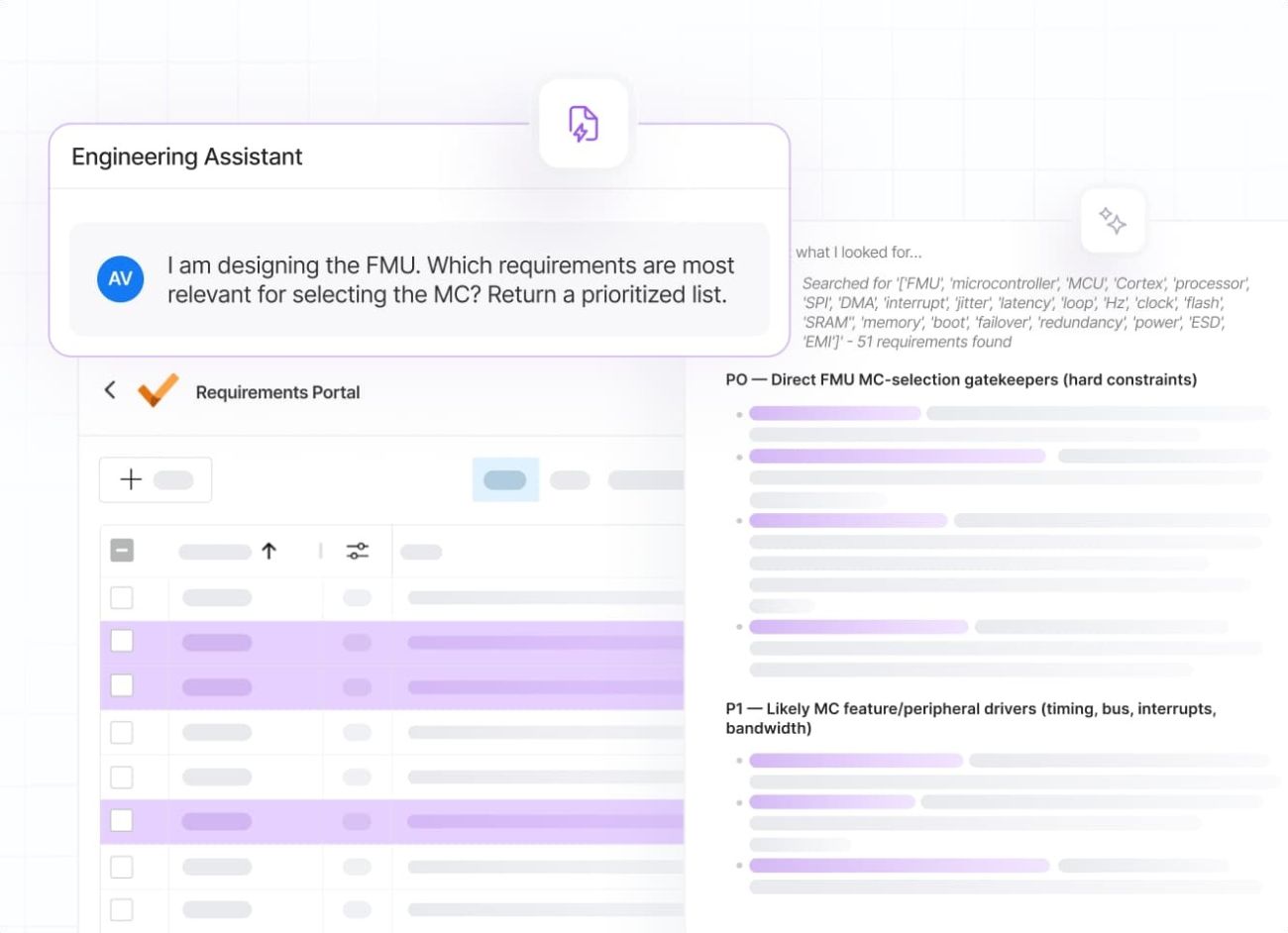
Later in the project, an electronics engineer joins the team. Instead of reading through 120 requirements to find what's relevant to their board design, they ask directly:
- “Which requirements are most relevant for selecting the MC?”
- “What are the power budget constraints?”
- “Are there any EMC or ESD requirements?"
Each answer is grounded in the full project data so that the engineer gets to what's relevant in minutes.
Try it yourself: Open the sample Drone_Example_Project, and paste this prompt into the Engineering Assistant: “I am designing the FMU. Which requirements are most relevant for selecting the MC? Return a prioritized list.”
Assessing the Impact of a Change
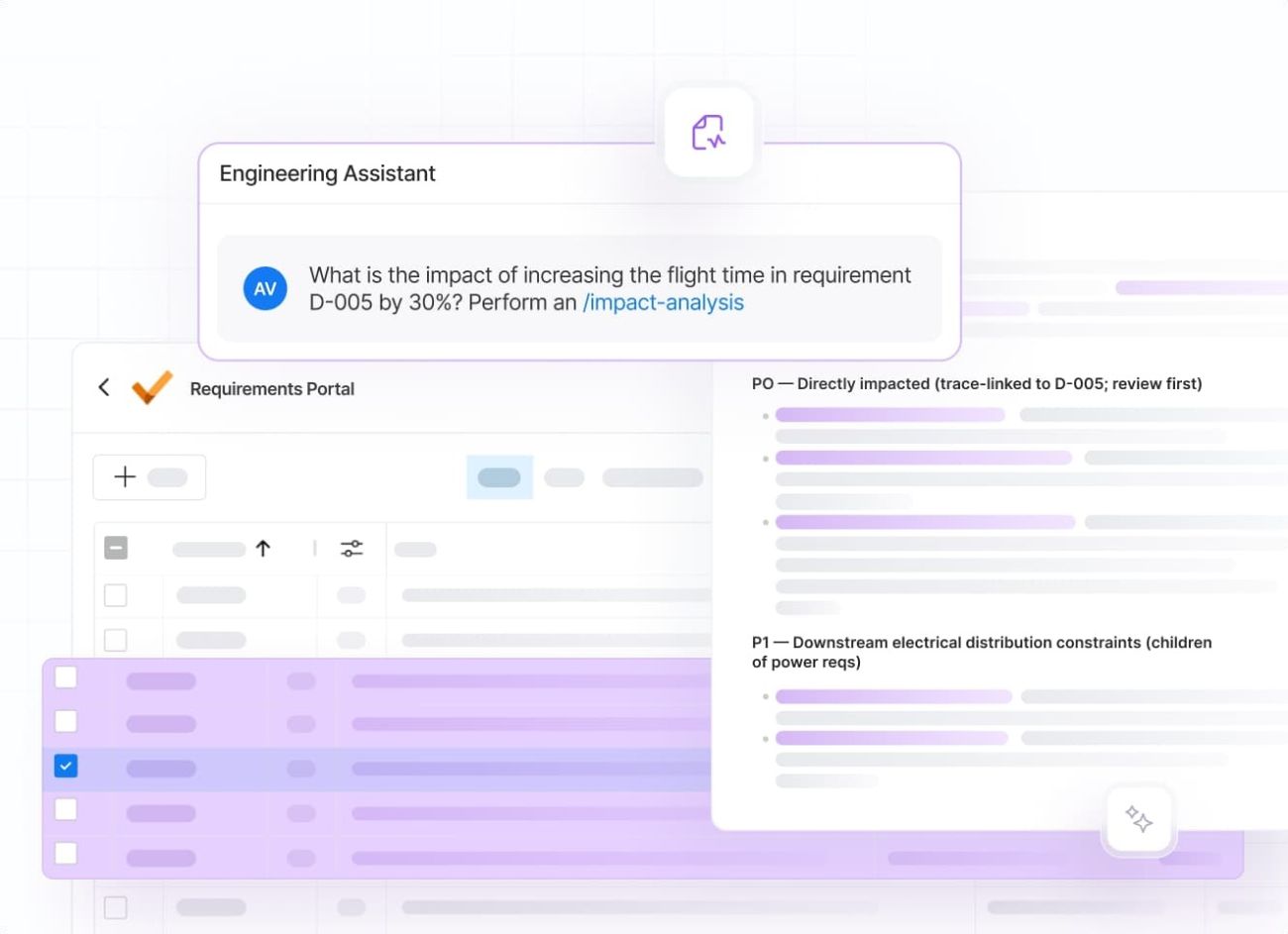
Mid-project, the customer requests a 30% increase in flight time. It sounds simple. It isn't.
The engineer asks: "What is the impact of increasing flight time by 30%? Identify all requirements that need review. Return a prioritized list."
Directly impacted requirements surface first, downstream power and electrical constraints next - each with a clear explanation of what needs to change. What would have taken hours of manual tracing takes minutes.
In hardware, every overlooked dependency carries a high cost. Catching it before it's built in is the difference between a revision and a respin. |
Try it yourself: Open the sample Drone_Example_Project, and paste this prompt into the Engineering Assistant: “What is the impact of increasing the flight time in requirement D-005 by 30%? Identify all requirements that would need to be reviewed or revised as a result. Return a structured, prioritized list. Be concise and actionable.”
How Teams Get Started
This is how we see teams adopting Agentic Requirements Engineering - starting simple and expanding as the tool becomes part of how they work.
Start: Capture and Share Requirements
Create a new project and bring your requirements in:
- Use the AI-Assisted Importer to pull customer requirements from a PDF or spreadsheet.
- Then use the Engineering Assistant to refine and break them down.
When you're ready, share the project with your team. Your colleagues can use the same AI tools to understand what's relevant to their work, ask questions, provide feedback - then start building.
Scale: Build Your Processes
While the Engineering Assistant gives you a direct way to interact with your requirements, AI Skills let you encode your team's processes into reusable instructions - so that the way you write requirements, run checks, and plan verification becomes repeatable and consistent across every project.
Each skill encodes a process that's specific to your team - your templates, your vocabulary, your standards. For example, define custom skills to:
- Draft test cases for each requirement based on your team's capabilities and templates.
- Write requirements using your framework of choice and your company's vocabulary.
- Run traceability checks that ensure each requirement is correctly linked to its dependencies, verification activities, and design items.
Automate: Always-On Proactive Checks
Background Agents continuously monitor your requirements and surface issues proactively - so that you spend less time inside the documentation and more time designing. Set them to run on a schedule or trigger automatically when a requirement changes.
That's because no engineer has time to manually trace every linked requirement, design item, and verification activity every time something changes. Background Agents replace that work with always-on checks that catch mistakes before they spread.
Less Busywork. More Alignment. Faster Iterations.
Requirements touch everyone on the team but not everyone in the same way. That's because each role has a different relationship with them.
- Requirements Owners capture structured requirements fast and keep their team aligned. Administrative work is delegated to AI agents so that engineers can spend more time making real engineering decisions and less time maintaining documents.
- Implementation Engineers chat directly with their requirements to get accurate answers in plain language - relevant to their discipline and grounded in full project context. Less time chasing context, more time building.
- Technical Leadership gains continuous visibility into requirements health, verification coverage gaps, and compliance risk. Issues surface proactively as early signals - not later in reports.
Requirements stop being static documents and become a living, shared model that the whole team shapes and evolves. |
Built by the Team That Brought AI to Requirements Engineering First
The team behind Agentic Requirements Engineering brought AI to requirements engineering for the first time in 2023. Originally Valispace, they joined Altium through acquisition and became Requirements Portal.
That early start matters. The key insights behind this release come from years of building, shipping, and iterating with real engineering teams: engineers want proposals they can review, not autonomous changes; chat alone isn't enough; AI must act on your project data, not just answer questions about it.
Why Now?
AI tools are starting to do genuinely useful work in hardware development workflows. But AI is only as good as the context it works from — and requirements are that context. Good requirements don't just help your team stay aligned. They're the foundation that makes AI-assisted design, verification, and testing possible. Get them right, and every AI tool downstream works better.
That's why now is the right time to take requirements seriously and that’s why we built this.
Read the option piece from the product lead →
Get Started with Agentic Requirements Engineering
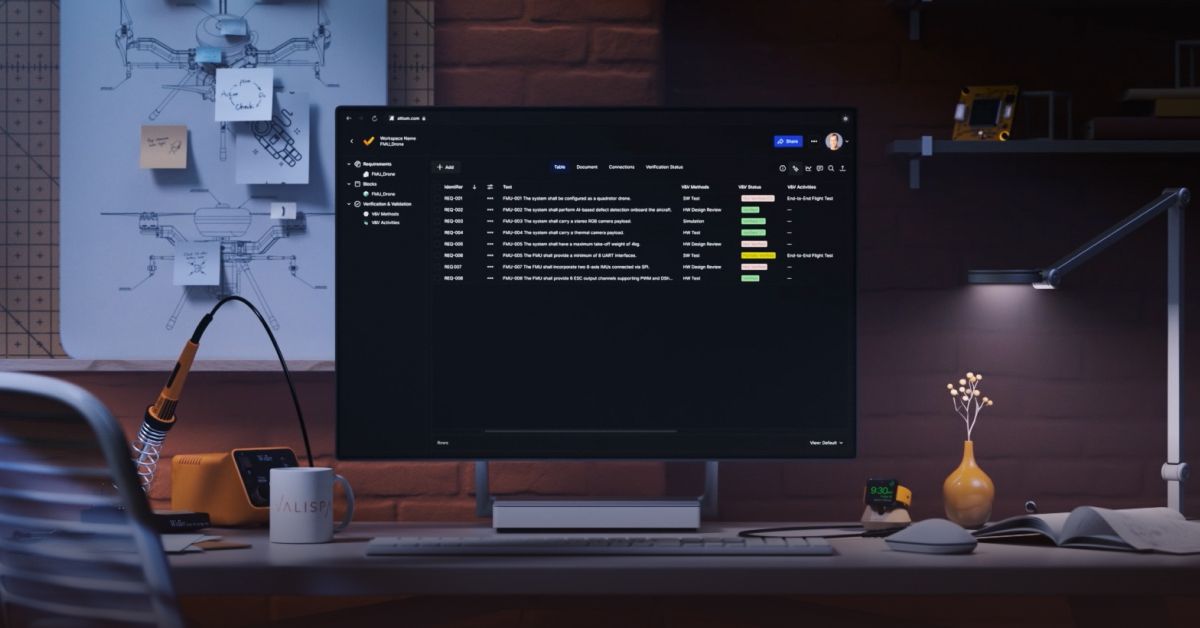
Agentic Requirements Engineering is available today in Requirements Portal.
- If you're already on Altium Develop or Agile Teams, Requirements Portal is included in your subscription — request access directly from your cloud workspace.
- If you want to test the tool in a clean environment, start a free 30-day evaluation. No credit card required.
Once you're in, you'll find sample data ready to explore so you can see the agents in action before using it in your own projects.
FAQ
Can AI be trusted with engineering requirements?
That's exactly the point. AI agents in Requirements Portal never commit a change without your explicit approval. Every suggestion is previewed in the UI - you review it side by side with the original, edit if needed, and apply. The AI proposes. The engineer decides.
How is this different from adding AI chat to a requirements tool?
Most tools bolt a chat window onto an existing interface and call it AI. Agentic Requirements Engineering goes further - AI acts directly on your project data and proposes structured changes in the UI for you to review. Our AI agents are specifically built to work with technical requirements, so the output is precise, structured, and tied to your project.
Our team doesn't do formal requirements engineering. Is this for us?
Yes, and no prior experience with formal requirements engineering is needed to get started. Most engineering teams know requirements matter - but avoid formal workflows because traditional tools assume specialist knowledge and rigid processes. Agentic Requirements Engineering works the way engineers already think, so you can capture intent fast without becoming a requirements expert.
How do I get started with Agentic Requirements Engineering?
Agentic Requirements Engineering is available in Requirements Portal today. If your company already uses Altium products, it's included in your Altium Develop and Agile Teams subscription - no new vendor, no procurement cycle. Start a free 30-day evaluation at the link below.

About Author
Related Resources
Related Technical Documentation
Table of Contents
- Key Takeaways
- Why Don't More Engineers Work with Requirements?
- Enter Agentic Requirements Engineering
- Agentic Workflow Examples
- How Teams Get Started
- Less Busywork. More Alignment. Faster Iterations.
- Built by the Team That Brought AI to Requirements Engineering First
- Get Started with Agentic Requirements Engineering
- FAQ
Better Requirements
Less Busywork
Build better hardware with AI agents that live and act in your requirements tool.
Learn More
Thank you, you are now subscribed to updates.