







Shenzhen Shifts Gears: China’s Electronics Hub Reinvents Itself Amid Trade Turbulence

At a Glance
Explore how Shenzhen evolves into an AI-driven hardware hub amid tariffs, reshaping supply chains, manufacturing yields, and BOM sourcing strategies worldwide.


Shenzhen, long regarded as the “World’s Factory”—a place where low-cost labor and massive scale yielded any component imaginable at a cost the rest of the world couldn’t touch—has leveled up. Despite 2025–2026 trade curbs and the recent change to U.S. Section 122 tariffs, the city is closing the technological gap to become the “Silicon Valley of Hardware.” For Octopart users planning BOMs under this new tariff environment, this pivot means reassessing Shenzhen not as a risk, but as an AI-powered partner.
Driven by giants like Huawei, DJI, and BYD, the city is turning from simple volume manufacturing to high-value, AI-integrated innovation. As the primary testing ground for China’s 15th Five-Year Plan, Shenzhen is pioneering an "agentic" industrial economy that prioritizes technical autonomy and domestic "Industrial Mother Machines" over simple labor automation.
What is unfolding in Shenzhen is a radical, state-sponsored metamorphosis.
Key Takeaways
- Shenzhen is transforming from a low‑cost manufacturing hub into an AI‑driven hardware innovation center. The city is no longer defined by labor arbitrage but by the deep integration of AI into manufacturing, R&D, and supply chains. Backed by state policy and major firms, Shenzhen is positioning itself as the global “Silicon Valley of Hardware.”
- AI‑integrated manufacturing is delivering step‑change gains in yield, cost stability, and speed. Agentic AI, digital employees, and real‑time optimization are pushing first‑pass yields beyond 98%, reducing rework and insulating supply chains from price volatility and capacity shocks.
- Real‑time linkage between component markets and factory floors is Shenzhen’s structural advantage. The digital and physical integration of Huaqiangbei and Bao’an enables live inventory visibility, rapid logistics, and synchronized production planning, capabilities that many global manufacturing hubs still lack.
- For procurement and engineering teams, Shenzhen is shifting from a contingency option to a strategic anchor. Rather than serving as a last‑minute backup for prototyping or ECNs, Shenzhen is becoming a primary operating environment for high‑mix, fast‑turn, AI‑instrumented manufacturing, requiring teams to rethink BOM segmentation and sourcing strategies.
The $50 Billion Engine: A 2030 Economic Roadmap
Shenzhen is no longer just speculating on AI. It’s institutionalizing it. According to the city’s latest economic data, Shenzhen is already home to over 2,800 AI firms that generated an output of 360 billion yuan ($51.5 billion) in 2024. From AI developers like fxis.ai and Malong Technologies to Yimian Data’s analytics platforms, this ecosystem now feeds directly into PCB workflows.
This scale provides the foundation for the city’s newly unveiled 2026–2030 Economic Roadmap. The plan mandates "AI ubiquity," aiming to integrate AI into every home and business in the city by 2030. This strategy positions Shenzhen as the national testbed for China’s broader AI goals, shifting the focus from pure research to real-world deployment at scale.
For global supply chains, this means Shenzhen is moving beyond building the world's gadgets to becoming the primary laboratory for autonomous vehicles, humanoid robotics, and "agentic" urban infrastructure.
The "AI Plus" Transformation: Re-Engineering the Factory Floor
At the core of Shenzhen’s industrial shift is the “AI+” Advanced Manufacturing Action Plan (2026–2027), reinforced by the national “AI + Manufacturing” Special Action Plan (2026-2028). Together, these initiatives collapse the divide between hardware production and software intelligence, embedding AI directly into manufacturing workflows.
Institutional backing is what gives the transformation both its speed and its staying power.
Shenzhen’s designation as China’s National AI Application Pilot Base grants the city preferential access to national AI infrastructure funding, regulatory flexibility to deploy untested automation technologies, and direct integration into central government procurement pipelines.
In effect, Shenzhen operates as the country’s proving ground for AI-driven manufacturing, with successful models scaled nationally.

Getting It Right the First Time: Digital Employees and Autonomous Yields
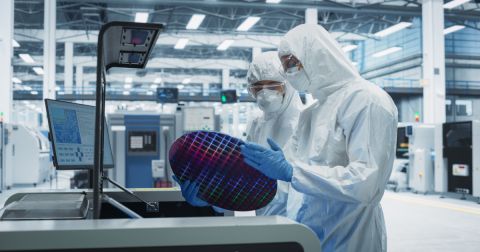
Under the “AI + Manufacturing” Special Action Plan (2026-2028), fabrication clusters across Shenzhen have deployed over 100 AI scenarios. These ‘digital employees’ utilize agentic AI to drive first-pass yields toward a 98%+ benchmark, pushing beyond the 90–95% range commonly cited as ‘good to excellent’ in complex electronics manufacturing, where yield variability often reflects fragmented supplier networks rather than process limitations.
Achieving this level of precision doesn’t just impact quality, but stabilizes cost. By reducing defect‑driven rework and scrap, the supply chain is insulated from the capacity shocks and price spikes that typically follow yield losses.
Shenzhen gains a further competitive edge as the digital infrastructure now linking Huaqiangbei's component markets directly to Bao'an's factory floors enables real-time supply chain traceability and R&D cycle acceleration shift from targets to operational standards. While many U.S. supply chains still rely on batch-level tracking across siloed ERP and MES systems, Shenzhen's model synchronizes component availability, production scheduling, and quality data in real time. And for suppliers outside this ecosystem, that gap is becoming increasingly difficult to close.
The Bao'an-Huaqiangbei Link: The Digital Nerve
The most critical infrastructure update is the connection between Huaqiangbei's raw material markets and the Bao'an District's high-tech fab clusters.
While Huaqiangbei remains the world’s most recognizable “face” for electronic components, it has evolved from a physical bazaar into a high-speed digital interface. That shift is powered by two specialized zones working in tandem: Huaqiangbei (Futian District), the “Sourcing Brain” and densest spot market for components, and Bao’an, the “Manufacturing Muscle” home to advanced PCB fabrication clusters and “dark factories.”
- The Physical Link: Since 2025, Shenzhen has opened over 300 dedicated low-altitude drone logistics routes. In practice, this means critical components can bypass urban traffic entirely, flying from a vendor’s stall in Huaqiangbei to a production line in Bao’an in as little as 30 minutes.
- The Digital Link: Under the 2026 AI Plus initiative, the city uses 5G-Advanced (5.5G) networks to enable "Passive IoT" tracking. This allows factory schedulers in Bao’an to view live inventory levels across markets, enabling real-time responses to supply chain shocks.
- The Sourcing Edge: For Octopart users, this means that a price fluctuation in a Huaqiangbei stall is reflected in the production planning of a 4-layer PCB in Bao'an almost instantly. This tightly synchronized ecosystem allows Shenzhen to absorb supply chain shocks that would stall hubs in Mexico or Vietnam for weeks.
Sector Focus: Beyond Consumer Electronics
As a hedge against consumer market volatility, Shenzhen is aggressively moving into high-reliability sectors powered by agentic quality control.
- Aerospace & Robotics: The city is leveraging its dense ecosystem of sensor manufacturers to dominate the emerging "low-altitude economy" and humanoid robotics sectors.
- Industrial Mother Machines: Shenzhen is focusing on the domestic production of high-end CNC machines and precision tools ("manufacturing the manufacturers"). This ensures the city can build its own production lines independent of Western tool imports, safeguarding industrial sovereignty.
- New Energy Vehicles (NEVs): The “BYD (Build Your Dreams) effect” has created a localized power electronics supply chain unmatched globally.
Geopolitics vs. Partnerships: Defying the Blacklist
Despite political headwinds, the ITES Shenzhen 2026 ecosystem demonstrates that global Tier-1 suppliers continue to integrate with the city's manufacturing DNA.
Firmware as a Borderless Asset
Firms are navigating rules of origin by shifting final assembly to third-party countries (e.g., Malaysia or Mexico) while keeping core R&D and “AI Plus” infrastructure in Shenzhen. Increasingly, the differentiating value of these products sits not in the hardware itself, but in the firmware developed and maintained on it.
As a result, even when hardware is assembled elsewhere to meet tariff requirements, the underlying intelligence (and much of the product’s performance) remains tied to Shenzhen. This makes traditional hardware tariffs less effective at capturing where the real value is created.
The "Co-Creation" Model
Japanese and European firms are using local AI-driven simulation to shrink R&D cycles from months to weeks. By embedding in the local ecosystem, these firms maintain their speed-to-market, utilizing Shenzhen’s high-density supply chains to remain competitive in a fragmented global landscape.
Early Results: The Numbers Behind the Transformation
The transformation is already showing measurable impact.
- According to 36Kr, Shenzhen's AI industry output grew 22.6% year-over-year to reach 368.5 billion yuan ($51.5 billion) in 2024, with core AI technologies surging 45.7%, demonstrating rapid commercial adoption beyond pilot programs.
- The city's robotics sector (a key beneficiary of AI-driven quality control) grew 12.58% to 201.2 billion yuan in 2024, with 74,032 enterprises now operating in the cluster.
- While Shenzhen-specific cycle time data is limited, industry-wide benchmarks suggest the scale of operational improvement. Electronics assembly operations deploying AI-driven optimization report 43% shorter cycle times—gains consistent with the city's push toward integrated hardware-software workflows between component markets and production floors.
Rewriting the Shenzhen Playbook for Procurement
For a decade, Shenzhen sat in most playbooks as the place you went for fast prototypes, last‑minute ECNs, and opportunistic spot buys. Procurement teams treated the city like an external buffer: when a design change landed late, or a regional hub slipped on capacity, you pushed a Gerber or sourcing request into Shenzhen and relied on sheer ecosystem density to absorb the chaos. Speed was the product; deeper integration was optional.
By 2026, that relationship is flipping from transactional to structural. Instead of a backup valve for emergencies, Shenzhen is becoming the primary operating environment for AI‑instrumented manufacturing and supply chains. For procurement pros, the question is no longer just “Can Shenzhen bail us out?” but “Which parts of our category strategy should anchor there because of its AI stack—and which should deliberately sit elsewhere?”
Practically, that means segmenting your BOM and supplier base:
- Anchor Shenzhen for: high‑mix, fast‑turn assemblies, SKUs where yield volatility and traceability risk are high, and programs that benefit from tight coupling between design, fabs, and component markets.
- Push diversification for: commodity parts where tariffs and compliance overhead outweigh AI‑driven efficiency, or programs constrained by data sovereignty and security requirements.
If you used to tap Shenzhen only for rush protos and fire drills, 2026 is the moment to rewrite that playbook. The city is no longer just a pressure‑release valve, but it’s becoming the reference architecture for how agentic manufacturing and procurement will operate.
Sourcing in the Age of "AI Plus"
Shenzhen’s advantage is no longer just labor costs but also the integration speed among component availability, AI-driven production planning, and localized tooling.
For engineers and sourcing leaders, the 2030 mandate for AI in every home and business signals a massive shift in demand for components. The question is no longer “Should we exit China?” but rather, “Which layers of our BOM truly benefit from Shenzhen’s ecosystem, and which do not?” To remain competitive, sourcing strategies must now account for Shenzhen’s AI-integrated hardware ecosystem and its growing domestic supply independence.

About Author
Related Resources
Related Technical Documentation
Table of Contents
- Key Takeaways
- The $50 Billion Engine: A 2030 Economic Roadmap
- The "AI Plus" Transformation: Re-Engineering the Factory Floor
- Getting It Right the First Time: Digital Employees and Autonomous Yields
- The Bao'an-Huaqiangbei Link: The Digital Nerve
- Sector Focus: Beyond Consumer Electronics
- Geopolitics vs. Partnerships: Defying the Blacklist
- Firmware as a Borderless Asset
- The "Co-Creation" Model
- Early Results: The Numbers Behind the Transformation
- Rewriting the Shenzhen Playbook for Procurement
- Sourcing in the Age of "AI Plus"
Solutions for Every Role and Team
- Discover and evaluate design options earlier
- Develop in one shared workspace
- Scale with control and compliance
- Connect every stage of hardware development
Learn More
Thank you, you are now subscribed to updates.