









Why Procurement Can't Capture Volume Discounts When Engineering BOMs Live in Silos

At a Glance
This article discusses the challenges faced by procurement teams when managing multiple engineering bills of materials (BOMs) that are siloed in separate spreadsheets or folders. It highlights how these disconnections can obscure opportunities for volume discounts on components like capacitors or semiconductors.


On paper, volume pricing is straightforward. The more components you buy, the better the price you’ll get. But in reality, you might be buying the same capacitor, connector, or semiconductor separately for each project, without realizing that combining these requirements could help you secure better pricing.
Each engineering team often manages its own bill of materials (BOM) in separate spreadsheets or project folders. This makes it harder for procurement teams to see the combined demand for the same components across different projects.
Altium Agile Teams helps procurement teams identify these opportunities by bringing BOMs from different projects into a connected workspace. Teams can identify common components across different projects, track design changes, and view pricing, availability, lifecycle status, and compliance information all in one place.
Key Takeaways
- Disconnected engineering BOMs can hide consolidated component demand, causing procurement teams to miss volume discount opportunities.
- Limited visibility into pricing, stock availability, and future production demand can make it harder to plan purchases and negotiate better supplier pricing.
- Altium Agile Teams connects engineering and procurement through shared BOM data, helping teams track component changes, evaluate alternates, and consolidate requirements.
The Volume Discount Opportunity Hiding in Engineering BOMs
Electronics manufacturers often work on several products at the same time, from NPIs and design revisions to ongoing production programs.
Each project typically has its own bill of materials (BOM), making it difficult for procurement to identify common components and get a clear picture of total demand.
Imagine a manufacturer working on three different electronic projects, all of which use the same 10 µF MLCC. However, each project records its requirements in a separate BOM. The first project needs 20,000 units, the second requires 35,000, while the third needs another 45,000.
Without a consolidated view across these BOMs, procurement may see three separate requirements rather than a combined demand of 100,000 capacitors. Buyers may negotiate for each project separately, leaving volume discounts on the table.
Why Consolidating Demand Across BOMs Isn't Always Simple
Identifying common components across projects sounds simple on paper, but it becomes more complicated when procurement starts working with real engineering data. Several everyday challenges can make it difficult.
1. Different BOM Formats and Part Descriptions
Every team uses a different BOM format. One exports from CAD, another maintains an Excel file, and a third reuses an old template. By the time those files reach procurement, column headers don't match, units are inconsistent, and the exact same part might be described three different ways.

For example, a single capacitor might show up as a standard MPN in one BOM, an internal part number in another, and a free-text description in a third. Even though all three entries refer to the exact same component, procurement can easily miss the match.
A 2024 literature review by Poon et al. in Frontiers of Computer Science, covering 35.5 years of research, found that 94% of business spreadsheets contain errors. When engineering data is managed manually across disconnected files, those hidden discrepancies quietly limit purchasing leverage long before buyers ever see the final numbers.

2. Revision Changes Make Demand Consolidation Difficult
BOMs are living engineering documents. Components get replaced, parts can become obsolete, electrical requirements may shift, and engineering teams implement engineering change orders (ECOs).
When those revisions are tracked through spreadsheets or email attachments, without a connected PDM or PLM system, buyers are left guessing which version is actually the latest approved one. As a result, buyers may combine outdated quantities or miss opportunities to consolidate actual demand.
3. Limited Visibility into Upcoming Production Demand
Even when BOMs are accurate, they do not provide a consolidated view of future purchasing requirements.
A component used across several BOMs may not need to be purchased immediately. Some requirements may be scheduled months apart, while on-hand stock and open POs may already cover half of the near-term requirement.
Without a single, consolidated view of production schedules, existing stock, open POs, and supplier lead times, buyers struggle to identify opportunities to negotiate volume discounts.
How Altium Agile Teams Helps Capture Volume Discounts
The solution is not to ask teams to spend more hours comparing spreadsheets. Instead, they need a shared, reliable view of component data that engineering and procurement can work from throughout product development.
With Altium Agile Teams, the BOM becomes more than just a document passed from engineering to procurement. By connecting Altium Designer, Altium 365, and Octopart in a connected platform, teams can review component data, check supply chain information, track design and BOM revisions, and spot common components across projects.
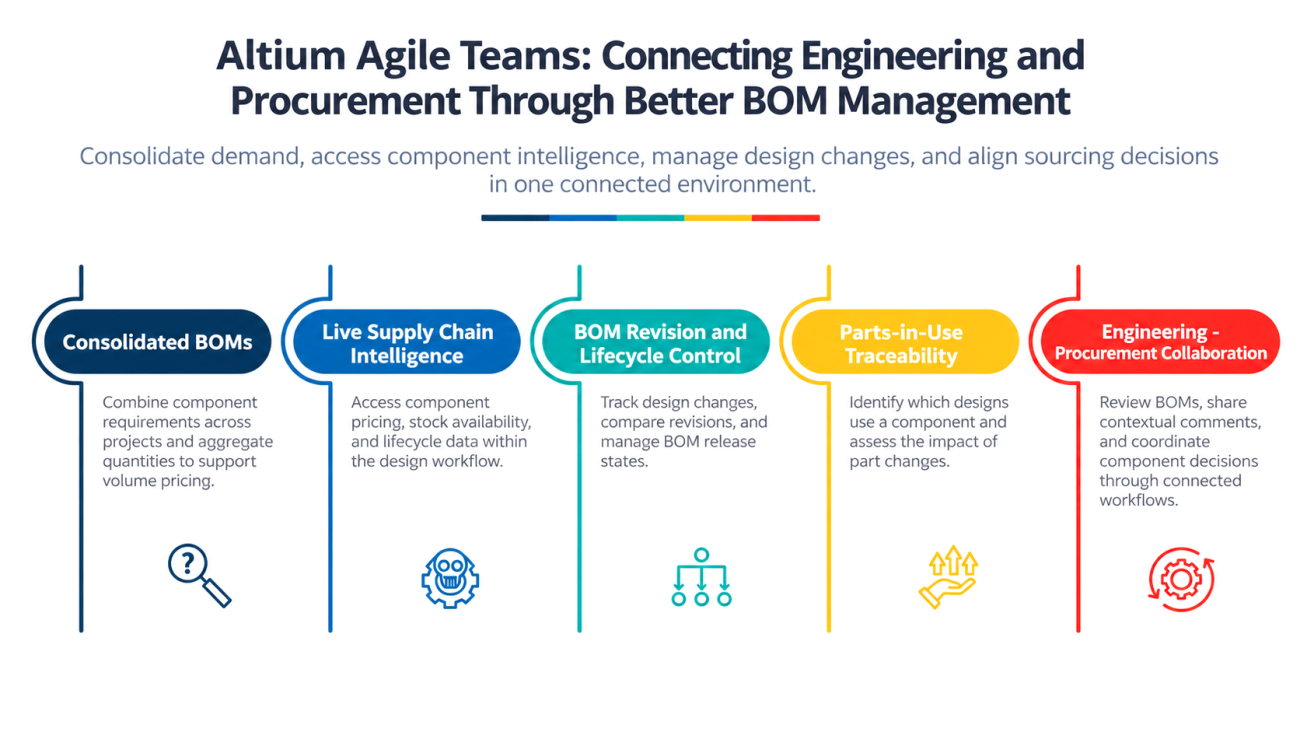
A few Altium Agile Teams capabilities are especially useful in addressing these challenges.
1. Centralized BOM Management and Component Visibility Across Projects
Altium Agile Teams includes a consolidated BOM feature that combines component requirements from multiple engineering BOMs, automatically matches identical parts, and calculates cumulative quantities, reducing the need to manually combine BOMs in spreadsheets.
With centralized component data in Altium Agile Teams, procurement teams can approach suppliers with larger quantities, negotiate better unit prices, and potentially capture volume discounts before placing orders.
2. Integrated Supply Chain Intelligence for Up-to-Date Component Visibility
One of the biggest wins for procurement is seeing up-to-date pricing and stock levels right inside the design workflow before a BOM is locked.
Altium Agile Teams pulls component intelligence directly from sources like Octopart, and from SiliconExpert and Z2Data as optional extensions, helping teams review pricing, stock availability, manufacturer specifications, and lifecycle information side by side while evaluating parts.
This visibility lets teams compare price breaks, flag NRND or obsolete parts before they cause respins, and qualify cost-effective alternates during the design stage to support BOM cost reduction.
3. BOM Revision History and Lifecycle Control
When a BOM has hundreds of line items across multiple projects and variants, tracking down every component change history manually can be time-consuming. Procurement needs to know which requirements are current and approved before consolidating demand or negotiating volume discounts.
With Altium Agile Teams, teams can compare BOM versions, review changes between design releases, and manage BOM releases through defined lifecycle stages.
When an engineer replaces a part or updates a BOM, teams can review the changes and verify the affected quantities before including them in purchasing forecasts, ensuring volume commitments are always based on approved, up-to-date BOMs.
4. Where-Used Traceability and Alternate Part Identification
Altium Agile Teams' BOM Portal provides instant where-used traceability for linked Workspace components, along with lifecycle monitoring and suggested alternates.
For example, if a commonly used voltage regulator goes under allocation, procurement can identify affected designs in seconds and check the potential impact rather than reviewing each project independently. Engineering can validate technically suitable alternates, while procurement compares their availability, lead times, and pricing.
This visibility can also help teams standardize components across products. When the same component meets the technical requirements, using it in multiple products can make sourcing easier and bring purchasing volumes together.
5. Shared Reviews and Structured Collaboration
Volume purchasing usually involves several teams. Engineering needs to approve the component, Procurement reviews pricing and BOM cost estimates, and planning teams check whether the ETDs and supply match production needs.
Altium Agile Teams helps keep these discussions connected instead of spreading them across email threads.
Through browser-based design reviews, contextual comments, and structured signoffs, teams can use the connected BOM Portal and BOM CoDesign features to review component requirements, flag sourcing risks, suggest suitable alternates, and track BOM changes while the design is still being developed.
This gives engineering and procurement a chance to make technical and commercial decisions before purchase orders are placed.
A Purchasing Scenario: Saving $6,000 Through Volume Discounts
Take our earlier example of 100,000 capacitors split across three product programs (20,000, 35,000, and 45,000 units).
Suppose a supplier quotes $0.50 per unit for smaller, separate orders, but offers the price to $0.44 per unit for a confirmed 100,000 order:
Purchasing scenario | Quantity | Unit price | Total cost |
Separate purchases (3 isolated orders) | 20k + 35k + 45k | $0.50 | $50,000 |
Consolidated purchase (1 combined order) | 100,000 | $0.44 | $44,000 |
Potential gross savings |
| $0.06 / unit | $6,000 |
That $6,000 saving comes from just one passive component. The savings could increase further when teams consider lower PO processing costs, fewer freight shipments, and better volume pricing on other components shared across projects.
Final Takeaway
Capturing volume discounts is not just about negotiating better prices with suppliers. It starts with understanding total component demand across projects, identifying opportunities to consolidate purchase orders, and ensuring that purchasing decisions are based on the latest BOM revision.
Altium Agile Teams helps address these challenges by connecting engineering and procurement onto a platform, where teams can consolidate component demand, improve BOM visibility, and make smarter sourcing decisions.

About Author
Related Resources
Related Technical Documentation
Table of Contents
Speed at Scale. Structured Repeatability. Secure Flexibility.
- Start up fast with out‑of‑the‑box workflows
- Collaborate using ECAD‑MCAD codesign tools
- Manage BOMs with live supply chain part data
- Manage access and security as teams scale
Contact Us
Thank you, you are now subscribed to updates.