Skip to main content
Mobile menu
Discover
Develop
Agile
Resources & Support
Free Altium 365 Tools
Gerber Compare
Online PCB Viewer
Resources & Support
Learning Hub
Support Center
Documentation
Webinars
Altium Community
Forum
Bug Crunch
Ideas
Education
Student Lab
Educator Center
Altium Education Curriculum
Search Open
Search
Search Close
Sign In
Main menu
Home
PCB Design
Collaboration
Component Creation
Data Management
Design Outputs
ECAD/MCAD
HDI Design
High Speed Design
Multi-Board
PCB Layout
PCB Routing
PCB Supply Chain
Power Integrity
RF Design
Rigid Flex
Schematic Capture
Signal Integrity
Simulation
Software
Develop
Discover
Agile
Altium 365
Altium Designer
Education
Programs
Altium Academy
Engineering News
Guide Books
Newsletters
Podcasts
Projects
Training Courses
Webinars
Whitepapers
Agile Development and Testing: The Role of Simulations
Simulations can help you avoid repeated prototyping and testing Design, build, test; whether you are a hardware designer or a software engineer, you’ll go through multiple iterations when developing complex systems. The build and test portions are the moment of truth—when you find out whether your hard work will pay off. An important part of design, build, and test iterations concerns narrowly defining test cases and functionality requirements
Read Article
Length Matching for High-speed Signals: Trombone, Accordion, and Sawtooth Tuning
Once upon a time, length matching guidelines for high-speed signals required a designer with enough skill to remain productive when manually applying different trace-length turning schemes. With today's advanced interactive routing features in modern PCB design tools, designers no longer need to manually draw out length tuning structures in a PCB layout. The remaining choice for a designer is deciding which length-matching scheme to use: trombone
Read Article
Never Cross a Ground Plane Gap in High Speed PCB Design
I often browse electronics and PCB forums, and I see the same question asked over and over: Why shouldn’t I route a trace over a split in my ground plane? This question gets asked by everyone from makers to professional designers who are just dipping their toes into high speed PCB design. For the professional signal integrity engineer, the answer should be obvious. Whether you’re a long-time PCB layout engineer or a casual designer, it helps to
Read Article
Tools for Transient Signal Analysis in Circuit Design
You can perform transient signal analysis with any of these circuits with the right simulator. I still remember my first differential equations class. One of the first topics that was discussed was damped oscillator circuits and transient signal response, which arises in many different physical systems. A transient response in an interconnect and on power rails in your PCB is a source of bit errors, timing jitter, and other signal integrity
Read Article
Modular Layout and Design vs. Hardware Cloning
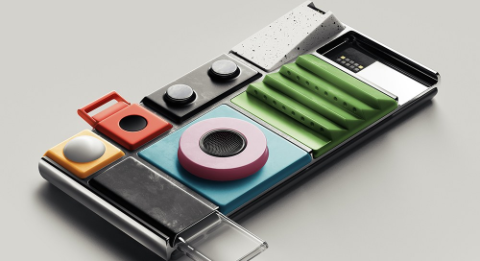
Modular layout for Lapka’s Project Ara From enterprise software to signal processing, modular design is now the norm for many advanced product design and analysis tasks. Modular hardware design leverages several independent modules to create a unique, customizable system. In the hardware ecosystem, a modular design for an embedded board involves laying out modules with their own well-defined connections and functions. This typically starts with a
Read Article
Beyond the Drawing Board: A Lesson Learned in Flex Design
Several recent blogs have been discussing “war stories” about flex and rigid-flex and the lessons learned when problem-solving and ultimately resolving the issue. We all have them. Flex is part art, part science, and even with the best of intentions and great attention to detail, there are occasionally “surprises” in performance. Most often they seem to defy logic until we stumble on the solution, and then of course everything is crystal clear in
Read Article
The Modular Single Board Computer Design Process
Modular design is a design process that has been gaining momentum over the last decade, especially in the world of embedded computing. A good example is in single board computers, sensor boards for data streaming, and some evaluation boards. This design approach breaks down a generic system into several independent parts (modules) that can be linked together to increase the functionality of a device. They are independent in the sense that a
Read Article
A First Look at Altium Designer 20
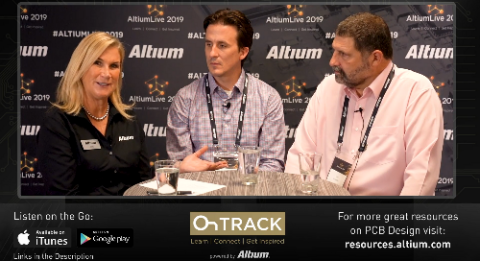
November marks the launch of Altium Designer 20, and we thought you’d be like to hear from a couple of Altium veteran “insiders” about what you can expect to see in this latest release. Lawrence Romine, VP of Corporate Marketing and Ben Jordan, Technical Marketing Director, Corporate (both engineers) share what their favorite new features are and which ones they think will have the most impact on your day-to-day designs. Judy Warner: Lawrence
Read Article
Max Seeley and Carl Schattke on AltiumLive 2019
Max Seeley of 3M and Carl Schattke from a well-known electrical vehicle manufacturer join us at AltiumLive Europe, and shares how tech conferences can add value to one's career as PCB Designer.
Read Article
Mike Konrad on Design for Reliability
Mike Konrad delivers an expert view on the necessity of cleaning boards at assembly, and revisits subjects such as low-residue flux as it pertains to Design for Reliability.
Read Article
Pagination
First page
« First
Previous page
‹ Previous
…
Page
206
Page
207
Page
208
Page
209
Current page
210
Page
211
Page
212
Page
213
Page
214
…
Page
220
Page
230
Page
240
Page
250
Page
260
Page
270
Page
280
Page
290
Page
300
Page
310
Page
410
Next page
Next ›
Last page
Last »
Subscribe to