Skip to main content
Mobile menu
Discover
Develop
Agile
Resources & Support
Free Altium 365 Tools
Gerber Compare
Online PCB Viewer
Resources & Support
Learning Hub
Support Center
Documentation
Webinars
Altium Community
Forum
Bug Crunch
Ideas
Education
Student Lab
Educator Center
Altium Education Curriculum
Search Open
Search
Search Close
Sign In
Main menu
Home
PCB Design
Collaboration
Component Creation
Data Management
Design Outputs
ECAD/MCAD
HDI Design
High Speed Design
Multi-Board
PCB Layout
PCB Routing
PCB Supply Chain
Power Integrity
RF Design
Rigid Flex
Schematic Capture
Signal Integrity
Simulation
Software
Develop
Discover
Agile
Altium 365
Altium Designer
Education
Programs
Altium Academy
Engineering News
Guide Books
Newsletters
Podcasts
Projects
Training Courses
Webinars
Whitepapers
OnTrack Newsletter: Altium Designer 20 Sneak Peek, Impedance Measurement, Food for Thought - November 2019
OnTrack Newsletter Nov. 2019 Vol. 3 No. 6 A First Look Inside Altium Designer 20 November marks the launch of Altium Designer 20, and we thought you’d be like to hear from a couple of Altium veteran “insiders” about what you can expect to see in this latest release. Lawrence Romine, VP of Corporate Marketing and Ben Jordan, Technical Marketing Director, Corporate (both engineers) share what their favorite new features are and which ones they
Read Article
Follow Your Multilayer Ground Return Path to Prevent EMI
Following the path back to ground can quickly become complex in a complicated multilayer PCB. When your PCB has a small layer count (e.g., a 4-layer board with two plane layers), it becomes rather easy to determine the return path and deliberately design it to prevent EMI. The situation becomes more complicated when you’re working with higher layer counts. Multiple plane layers and conductors can form the ground return path, even if the conductor
Read Article
Driving Small DC Motors With Altium Designer
In this article, we’re going to run through the actual implementation of a driver IC from schematic creation to PCB layout. You will find this project on GitHub, released under an open-source license if you simply want to grab it to copy and paste into your own design. Part Selection I have two small, high-speed motors that I want to drive, which will draw about 1 amp each under load, and I’ll need to run off a 30 volt power source in an
Read Article
Problems in Multiboard BOM Generation? Unified Design Tools Can Help
Your next multiboard system design is likely complicated enough. You’ve got to worry about multiple layouts, multiple schematics, signal integrity within and between boards, mechanical form and function, and EMI/EMC. With all these design aspects to worry about, documenting every aspect of your board can be a time suck. With so many new products being built from multiboard systems, you shouldn’t have to choose between multiboard system designer
Read Article
Signal Distortion in Your PCB: Sources and Solutions
Length matching for high-speed signals is all about synchronization... Signal distortion often gets a passing mention in many discussions on signal integrity and circuit analysis. As more networking products start running at higher speeds and use complicated modulation schemes, you’ll find that signal distortion becomes a serious problem that contributes to bit error rates. Distortion sources are cited as one of the primary bottlenecks preventing
Read Article
Electronics System-Level Circuit Engineering Design in Altium Designer
Electronics system level design lets you focus on functionality and abstraction The day-to-day life of a PCB layout engineer is all about translating schematics into a real, manufacturable PCB. Before this can happen, designs begin at an abstract level that focuses on designing functionality. As the overall design process progresses, design requirements are made more granular, reaching the signal processing level and, eventually, the component
Read Article
How to Create an Amplifier Simulation in Altium Designer
There are a variety of performance simulations you can run in Altium Designer. Read and understand the role of simulation and learn how to create and run an amplifier simulation in your schematic.
Read Article
How to Choose an RGB LED Screen Panel for Your Next Upverter Project
Billboards are just one application for RGB LED panels I remember the days where I would drive down the highway and see workers placing new graphics on billboards dotting the roadside. Now you hardly see this because so many billboards have gone digital. You can thank RGB LED panel display tiles for this, which allows multiple advertisements to share the same space and allows for some interesting animated advertisements. RGB LED panel displays
Read Article
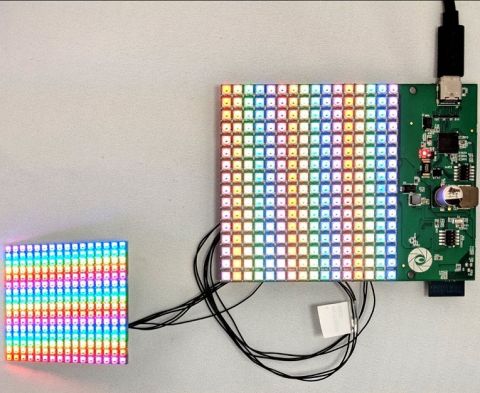
How to Add an RGB Matrix Display to Your Board in Upverter
Micro RGB Matrix Tile connected to the WiFi RGB LED Matrix board. When it comes to custom display applications, you may not need to go the route of including a large-scale LED or LCD display screen. For specialized or artistic lighting applications, you can benefit from a system that provides selectable color mixing and distribution across your lighting module. This is where an RGB matrix display is an ideal choice for your next lighting
Read Article
Calculating your PCB Complexity & First Pass Yields
There are four things I know about PCB yields—mathematically! PCB yields are not normally distributed. They are what is called GAMMA Distributed. Defects that produce low yields may be systemic and repeatable, others may be just random—but you can test for this. You can predict yields if you take the time to collect the data. Yields are such wonderful things! I wonder why we don’t write about them more. They are the dividing phenomena that often
Read Article
Pagination
First page
« First
Previous page
‹ Previous
…
Page
204
Page
205
Page
206
Page
207
Current page
208
Page
209
Page
210
Page
211
Page
212
…
Page
220
Page
230
Page
240
Page
250
Page
260
Page
270
Page
280
Page
290
Page
300
Page
310
Page
410
Next page
Next ›
Last page
Last »
Subscribe to