Skip to main content
Mobile menu
Discover
Develop
Agile
Resources & Support
Free Altium 365 Tools
Gerber Compare
Online PCB Viewer
Resources & Support
Learning Hub
Support Center
Documentation
Webinars
Altium Community
Forum
Bug Crunch
Ideas
Education
Student Lab
Educator Center
Altium Education Curriculum
Search Open
Search
Search Close
Sign In
Main menu
Home
PCB Design
Collaboration
Component Creation
Data Management
Design Outputs
ECAD/MCAD
HDI Design
High Speed Design
Multi-Board
PCB Layout
PCB Routing
PCB Supply Chain
Power Integrity
RF Design
Rigid Flex
Schematic Capture
Signal Integrity
Simulation
Software
Develop
Discover
Agile
Altium 365
Altium Designer
Education
Programs
Altium Academy
Engineering News
Guide Books
Newsletters
Podcasts
Projects
Training Courses
Webinars
Whitepapers
Design Planning with Differential Pair Routing Software and Directive Symbols
If the components on your PCB are like the organs in your body, then your trace routing between components are like blood vessels. What looks like a complex tangle of copper connections is actually a meticulously designed system that uses well-understood design rules. Your PCB design software can help you maximize your productivity while routing and prevent errors using directive designations. Great PCB design software doesn’t just let you set
Read Article
CAD Layout Software for Modern PCB Design and Modern PCB Designers
Back in the day, PCB designers drew schematics by hand. Instead of guiding a mouse, technicians used red and blue pencils to carefully draw pads and traces on vellum parchment paper. Their tools included a triangle, a T-square, and templates. Forget a thorough design process involving CAD tools, full team collaboration, differentiated schematic diagrams and circuit board designs - one was lucky enough to have a steady hand. After completing a
Read Article
Auto-Interactive Routing to Overcome Obstacles and Other Polygons
There’s no doubt about it, routing traces on a printed circuit board by hand can be a lot of fun. It’s an engaging challenge to make the routing as neat, tight, and correct as possible to give you the shortest routes with the best signal integrity. Once you are done you can take a lot of pride in knowing that your measured lines are perfect, you differential pairs are spot on, and everything looks great. The only problem is that level of manual
Read Article
Dispel Confusion with Global Editing: Poor DxDesigner Usability Causes Confusion
The world has turned the corner from linear to organic. The need for global editing within versatile environments continues to grow. It used to be I could keep one file in my office drawer to collect bills for the month. When I got paid, it was a simple matter to list the bills, add them up, and write the checks. These days, bill paying goes much quicker on the computer. But I’ve had to adapt to different steps on each utility website and
Read Article
Analog Meets Digital: How Converters Can Make or Break Signal Performance
We are born into a world of purely analog signals. The sound of a stream running through a mountain meadow, the brown color of dirt, that screaming baby next to you; all of these ‘signals’ are of an analog nature. Yet, we grow up and seem to spend most of our time attempting to turn these signals into a reproducible ‘digital’ copy so we can perceive them through a digital device. Analog and digital signal performance is necessary to keep in mind
Read Article
What Are the Advantages of Using Templates for PCB Design?
The domestication of horses, inventing the wheel and developing the combustion engine are tremendous milestones that we laud for enabling us to get around more efficiently and explore new places. Although, this is true another creation that deserves at least as much credit for giving most of us the confidence to branch out from our familiar surroundings is the map. The knowledge that someone before us has traversed a path gives us confidence in
Read Article
PCB Design Testing
The most successful PCB designs a result from practice, but for your PCB to function as intended, you also need to test your design. By testing the electronic components of your board before manufacturing you can be sure that it will perform as you intended with your design. Schematic simulation does not guarantee the functionality, reliability or even manufacturability of your design. Applying good design for manufacturing (DFM) practices will
Read Article
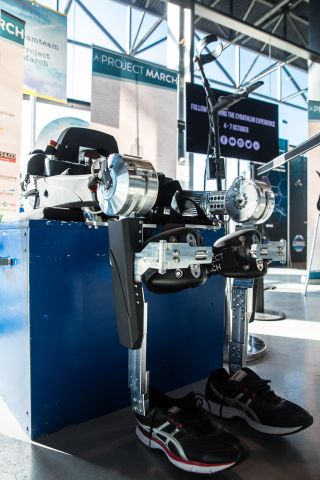
Competitive Exoskeleton by Project March from the Delft Technical University Dream Team
Judy Warner: Robbert, please tell us about your major at Delft Technical University and your role at Project March. Robbert de Lange: I’m studying civil engineering and my role on the Project March team is Acquisition and PR. Presently, I have taken off a full year of studies to focus full-time on Project March. Warner: What motivated you to take a full year off of your studies to invest in Project March? De Lange: Beyond all the academic
Read Article
Mary Elizabeth McCulloch Developed Voz Box and Project Vive
Judy Warner: It’s so nice to talk with you, Mary Elizabeth! Please share your background, education and what inspired you to choose engineering as a vocation. Mary Elizabeth McCulloch: I was always good at science and math and I graduated from Penn State University with a biomedical degree in 2016. Both of my parents were very inspirational in my choice to pursue engineering. My Dad studied physics in college and is now an engineer who
Read Article
Flex and Material Sets with Chris Hunrath
The rise in flex applications across all industries means opportunity for material suppliers to innovate and meet demand. Learn about flex material sets from material science expert Chris Hunrath.
Read Article
Pagination
First page
« First
Previous page
‹ Previous
…
Page
280
Page
281
Page
282
Page
283
Current page
284
Page
285
Page
286
Page
287
Page
288
…
Page
290
Page
300
Page
310
Page
320
Page
330
Page
340
Page
350
Page
360
Page
370
Page
380
Next page
Next ›
Last page
Last »
Subscribe to