





Bitter Lessons in Requirements: Samsung Galaxy Note 7

At a Glance
Learn how the Galaxy Note 7 shows that a second supplier's part must pass the same safety tests as the first.


In hardware development, when a part from one supplier fails, teams often switch to a second supplier for the same part. It seems like a quick fix because both parts are built to the same specification.
The Samsung Galaxy Note 7 case shows why the second supplier's part must pass the same safety tests before it goes into the product. When the Note 7's batteries caught fire, Samsung replaced the phones with ones using batteries from its second supplier. Then the replacements caught fire as well.
The Note 7 went on sale on August 19, 2016. Samsung announced a global recall on September 2 and stopped production on October 11, 53 days after launch.
In this article, we take a closer look at the origins of the Note 7 battery failures and the transferable lessons engineers can apply to their projects.
Key Takeaways
- Test a second supplier's part against your safety requirements before it goes into the product.
- Keep the test evidence for each supplier, so you know which parts have passed.
- Write clearances, such as the space a battery needs to swell, as numbers in your requirements.
What Happened with the Samsung Galaxy Note 7
The Galaxy Note 7 was Samsung's large-screen flagship phone. Samsung sold about 3.06 million units, each using lithium-ion pouch cells from two established suppliers: Samsung SDI for the original units and ATL for the replacements.
- August 2, 2016: Samsung unveiled the Note 7.
- August 19, 2016: The phone went on sale. First reports of fires followed in late August.
- September 2, 2016: Samsung halted sales and announced a global replacement program for about 2.5 million phones after 35 reported cases.
- September 15, 2016: The US CPSC issued a formal recall of about 1 million units.
- October 5, 2016: A replacement unit smoked on a Southwest aircraft in Louisville, and the plane was evacuated before takeoff.
- October 11, 2016: Samsung permanently stopped production, a day after halting sales and exchanges worldwide.
- October 13, 2016: The CPSC expanded the recall to about 1.9 million US units, including replacements.
- October 14, 2016: A US Department of Transportation emergency order banned the Note 7 on US flights. Samsung estimated the operating profit impact at about $5.3 billion.
- January 23, 2017: Samsung announced the root cause after an investigation by about 700 researchers and engineers, with more than 96% of units recovered.
Both batteries failed due to an internal short between the positive and negative electrodes, triggering thermal runaway. Samsung's infographic identifies the main cause in battery A as a deflected negative electrode in the upper-right corner, with the electrode tip in the curve rather than the flat area. In battery B, high welding burrs on the positive electrode penetrated the insulation tape and separator, and some cells had no insulation tape at all.
One outside analysis adds a packaging perspective. An Instrumental teardown of one unit measured a 5.2 mm battery in a 5.2 mm pocket. In other words, the pocket had zero clearance, which contradicts a rule of thumb that pockets need approximately 10% of the battery's thickness. Samsung's official finding doesn't include this.
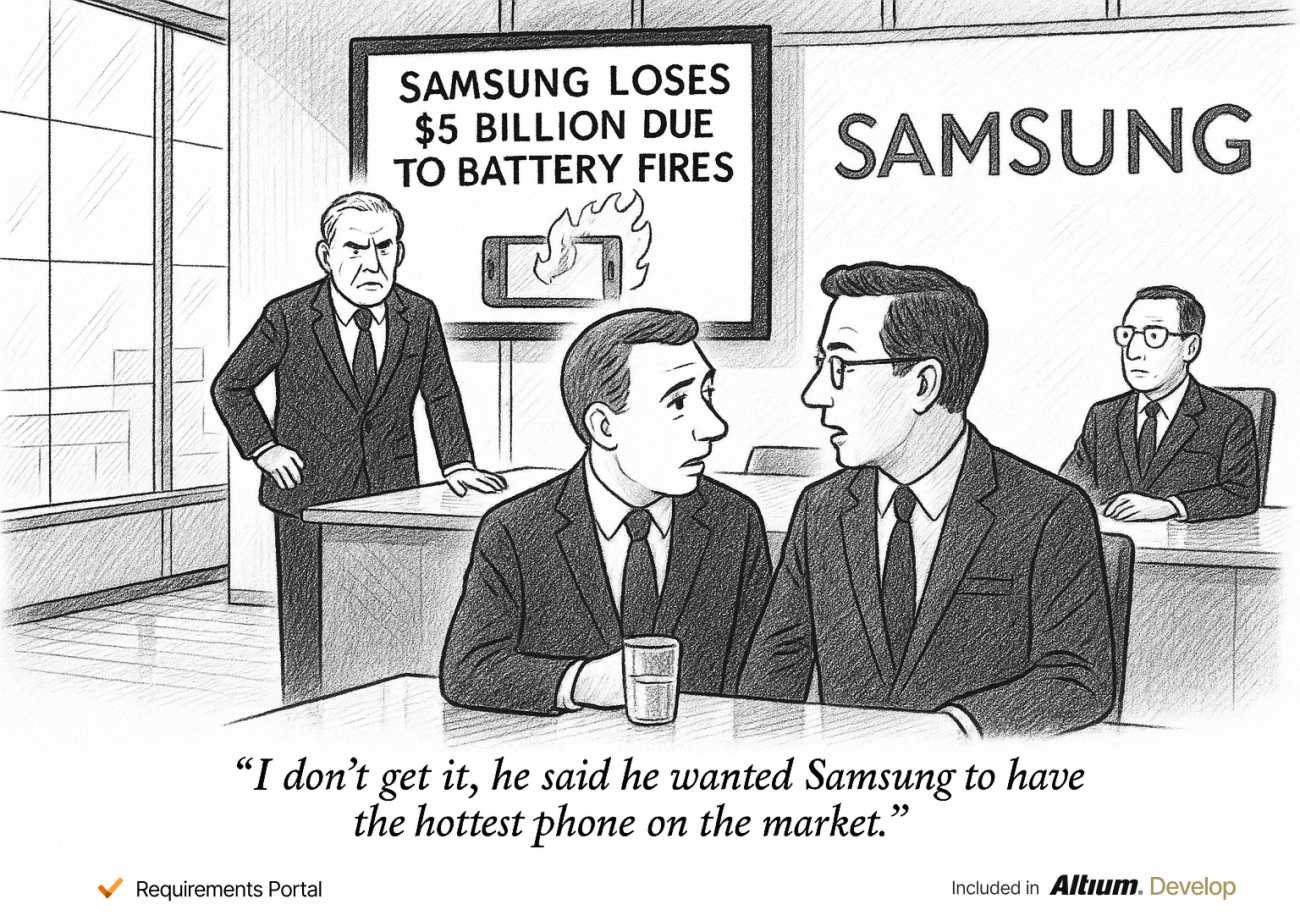
The illustration shows that a replacement part deserves the same safety tests as the original before it goes into the product.
Every decision likely seemed reasonable at the time. SDI and ATL were established suppliers. The first failures pointed to one supplier, so moving production to the other was a logical fix, and the recall was swift.
Viewed through a requirements engineering lens, the replacement cells came from a different production line, but they reached the field without verification strong enough to catch a different defect. Samsung's mobile chief put it plainly that "the overall responsibility falls to us for failing to verify its safety and quality." Contributing factors included volume and time pressure on the supplier switch, and, in one outside reading, a tight design margin.
Lessons Learned from the Samsung Galaxy Note 7 Case
Most hardware teams don't ship millions of phones in a few weeks, but they second-source parts all the time. A connector swapped for a pin-compatible one, a regulator changed during a shortage, or a battery pack from a new vendor: each looks like the same part on the BOM.
Verify Per Supplier
Best practice: Link every safety requirement to its test evidence for each approved supplier.
A requirement such as "no internal short under rated swell" is verified only for the samples you tested. Record which supplier and which revision each test covered. When you add a second source, the requirement appears unverified for that source until it has its own evidence. The Note 7 replacement cells came from a different production line, and a different defect got through.
Treat Changes as New Designs
Best practice: Treat every part or supplier change as a new design that reopens its linked verification.
A change request should list the requirements the part affects and reset their status. That turns "same datasheet" into a list of tests to rerun. After the recall, Samsung added an eight-point battery safety check, including X-ray, disassembly, and accelerated usage tests. That's the kind of verification that catches a defect the first fix missed.
State the Margin
Best practice: Write mechanical clearance as a requirement with a number, and verify it on measured parts.
A requirement stating "the battery cell shall fit the pocket" isn't testable. Instead, a requirement specifying a clearance of "at least 10% of the cell's thickness" is both clear and testable. Measure production samples, not just CAD nominals, and record the value against the requirement.
Which Replacement Part Did You Only Verify Once?
The same gap appears on any board with a second-source part. Every replacement part is a new design that must be reverified. Ask your team:
- Does each safety requirement specify the supplier and revision it was verified against?
- When a part changes, which requirements reopen, and who is notified?
- Are mechanical margins stated numerically and checked on measured parts?
- Could a replacement part ship before its tests are complete?
How to Avoid This Bitter Lesson
A connected requirements workflow links each requirement to its design data and test evidence, so a part change shows which requirements must be reverified.
With Requirements Portal, teams keep requirements, their verification status, and their links to designs and V&V activities in one shared place. When a team adds a second supplier or changes a component, the links show which requirements the change affects, so the owner knows which tests to rerun.
More Bitter Lessons in Requirements
If you want more lessons from real hardware cases, these articles cover other requirements management failures and what you can learn from them:
- Ariane 5 Flight 501 explains why requirements, software, and tests reused from an earlier project need a second look before you rely on them.
- S-80 Submarine Program shows how a design change can break a constraint that no one was reviewing, and how linking constraints to design decisions shows what a change affects.
- Unit Conversion Failures covers how a number with an unclear unit or source can mislead a team, and why every value needs its unit, its source, and an owner for each handoff.
- SNCF & Renfe Trains shows why critical requirement values need a traceable source and an early check against the real constraint, and why every raised concern needs an owner.
Frequently Asked Questions
What Caused the Samsung Galaxy Note 7 Fires?
Internal short circuits in the lithium-ion battery cells led to thermal runaway. Samsung identified two defects: a deflected negative electrode in the original SDI cells and high welding burrs and missing insulation tape in the replacement ATL cells.
Why Did the Replacement Note 7 Phones Also Catch Fire?
The replacement units used cells from a second supplier, and those cells had a different defect. The switch addressed the first defect, but the new cells weren't sufficiently verified to catch the second.
How Much Did the Galaxy Note 7 Recall Cost Samsung?
Samsung estimated the operating profit impact at about $5.3 billion. It sold about 3.06 million units and recovered more than 96% of them by January 2017.

About Author
Related Resources
Related Technical Documentation
Table of Contents
Better Requirements
Less Busywork
Build better hardware with AI agents that live and act in your requirements tool.
Learn More
Thank you, you are now subscribed to updates.