Mobile menu
  • Solutions
    • Octopart Discover Go beyond part search to discover viable solutions, evaluate tradeoffs, and make better decisions earlier
    • Altium Develop Design advanced PCBs in Altium Designer, working independently or connecting reviewers, sourcing data, and release coordination when needed
    • Altium Agile Teams Bring structure to multidisciplinary electronics development and collaboration without sacrificing speed
    • Altium Agile Enterprise Connect context from intent through release with an intelligent, governed, extensible platform
  • Resources & Support
    Free Altium 365 Tools
    • Gerber Compare
    • Online PCB Viewer
    Resources & Support
    • Learning Hub
    • Support Center
    • Documentation
    • Webinars
    Altium Community
    • Forum
    • Bug Crunch
    • Ideas
  • Education & Training
    • Student Lab Free access to professional PCB design software, training, and learning resources for students
    • Educator Center A comprehensive education platform providing curriculum, software, training, and classroom resources for educators
    • Altium Education Curriculum Free college- and university-level PCB design curriculum designed to prepare students for real-world engineering careers
    • Altium Professional Training Flexible on-demand and instructor-led training courses that help engineers build and advance their PCB design skills
  • Search Open
    Search Close
Sign In
Webinars

Main menu

  • Home
  • PCB Design
    • Collaboration
    • Component Creation
    • Data Management
    • Design Outputs
    • ECAD/MCAD
    • HDI Design
    • High Speed Design
    • Multi-Board
    • PCB Layout
    • PCB Routing
    • PCB Supply Chain
    • Power Integrity
    • RF Design
    • Rigid Flex
    • Schematic Capture
    • Signal Integrity
    • Simulation
  • Software
    • Develop
    • Discover
    • Agile
    • Altium 365
    • Altium Designer
  • Education
    • Programs
    • Altium Academy
    • Engineering News
    • Guide Books
    • Newsletters
    • Podcasts
    • Projects
    • Training Courses
    • Webinars
    • Whitepapers
Learning Hub Webinars Securing Your Electronics Development Workspace

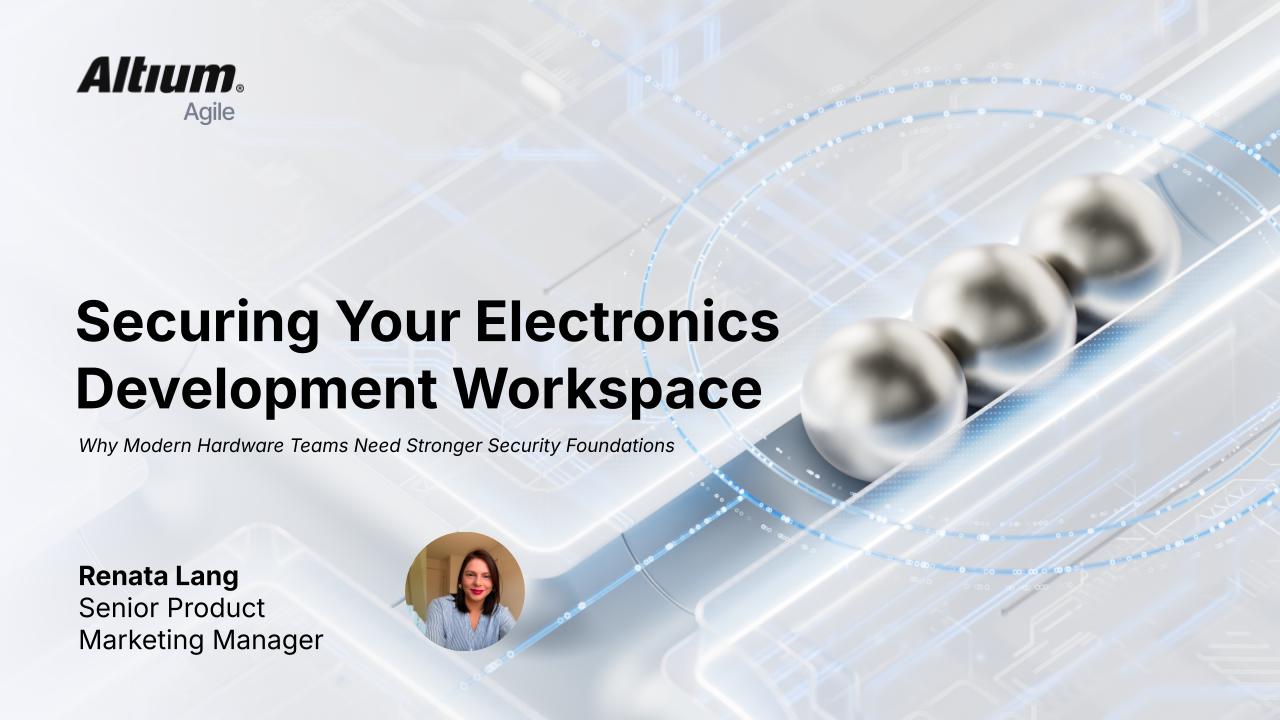
Securing Your Electronics Development Workspace

Modern electronics development has become part of the software supply‑chain attack surface. Sensitive design data now lives across tools, devices, and personal workspaces—creating blind spots for both engineering and IT security teams. 

This session shows how securing your electronics development workspace with Altium Agile gives development teams the speed they need while giving security teams the control they require.

What You'll Learn

  • Securing a Hardware Development Workspace — A practical model for securing modern electronics development environments, built around the core pillars of workspace security: identity, access, process governance, and data protection.
  • How Altium Agile Enforces Security — A clear walkthrough of the platform’s security architecture, including SSO, MFA, SCIM provisioning, GovCloud, Trust Center, access control, IP whitelisting, event logging, SIEM integration, and more—showing how security is applied across people, process, and data.
  • Why Altium Agile Serves Both Engineering and IT Security — How engineering teams gain speed and simplicity while IT teams gain auditability, governance, and compliance‑ready controls.
  • Trust Center — A centralized place to view, verify, and understand the platform’s security posture and compliance commitments.

Why Attend?

  • A complete view of today’s hardware security risks — Why electronics development has become a software supply‑chain problem and how attackers exploit fragmented tools, personal workspaces, and weak identity controls.
  • A practical security blueprint — The identity, access, monitoring, and compliance capabilities required to secure an electronics development workspace.
  • A deep dive into Altium Security Tools — SSO, MFA, SCIM, workspace segmentation, IP whitelisting, event logs, SIEM integration, and GovCloud, and more.
  • A unified story for both teams — How development teams get speed and simplicity while IT security teams get control, visibility, and compliance.

Who Should Attend?

  • Engineering managers and hardware development leads
  • IT security, governance, and compliance teams
  • Organizations handling sensitive, export‑controlled, or regulated design data
  • Teams moving from fragmented tools to a secure, centralized electronics development platform

Reserve Your Spot

See how Altium Agile helps you build speed, structure, and security into every stage of your electronics development process. Learn how to protect sensitive design data, strengthen governance, and give both engineering and IT teams the tools they need to work confidently in a secure, well‑managed workspace.

Space is limited—secure your spot today and take the next step in connected electronics design.
 

IT Security Webinar

Registration has recently closed. Check back soon for on-demand webinar.

Related Resources

00:45:05 What's New in Requirements Portal Discover the latest additions to Altium’s Requirements Portal — including a brand-new AI-assisted importer that turns unstructured documents into structured requirements with ease.
Watch Video
01:00:30 Introducing the Requirements & Systems Portal Watch our webinar to learn about the application of the Altium 365 suite. Requirements & Systems Portal will help align engineering teams to get to market quicker Watch Video
00:21:26 Integrating Requirements into Your PCB Design Workflow Join our webinar where you will learn about integrated requirements tools who can help you eliminate late-stage design changes, AI support through system requirements and integration of design requirements directly in PCB Design. Don't miss it, register now! Watch Video
00:22:36 From Design to First Assembly: Complete Your BOM & Plan Your Build Discover how BOM Portal and Assembly Assistant take you from a released design to prototype-ready in minutes, not days. Watch Video
00:34:19 How BOM Portal supports R&D and Procurement with DFM & DFC analysis throughout the entire product lifecycle Explore how shared BOM projects help R&D and procurement teams collaborate more effectively. Watch Video
37:15 Altium Designer: Key Benefits of ActiveBOM Webinar What is ActiveBOM? ActiveBOM is an editor in Altium Designer that sits alongside, in importance, with the schematic and PCB editors. You can think of ActiveBOM as an alternative (table-based) way to view and interact with your design. The schematic provides the logical representation of the design and the PCB provides the physical representation. ActiveBOM supplements these two domains with focus on selection, sourcing and cost of the items Watch Video
ECAD Engineering Management Beyond Design Connecting Requirements, Development, and PLM in One Enterprise Workflow Multiple Dates and Times September 2, 2026 10:00 AM Register
00:38:06 Altium Agile Teams - Solution Overview Get an overview of this new Electronic Product Development Platform. Watch Video
00:33:05 Your Design Data Has Zero Defense See how Altium Agile builds speed, structure, and security into every stage of electronics development. Watch Video
00:52:37 Holistic Engineering Management in Electronic Design See how engineering leaders gain the visibility and control to deliver on time, with less risk
Watch Video

Related Technical Documentation

Altium 365 Platform Interface Altium 365 Platform Interface

Depending on your relationship with Altium, the services offered on the Altium Platform will be experienced from within Altium Designer and through the platform's browser-based interface. This page takes a look at the latter and provides an overview of what you'll see when you register an Altium Account and sign in to the Altium Platform Interface. For the latest information on the security,…

Read Documentation
Exploring the Browser-based Interface Exploring the Browser-based Interface

In addition to connecting to a Workspace through Altium Designer – interfacing to it through the Explorer panel and Components panel (for direct interaction with the components therein) – you also connect to it through a dedicated browser interface, with access to management interfaces for the various services available as part of the Workspace. In fact, with some of these services, your only…

Read Documentation
PLM Integration PLM Integration

The composite design solution of Altium Designer and an Altium 365 Workspace offers configurable PLM Integration with support available for Windchill®, Arena®, Oracle® Agile™, Aras Innovator®, and Siemens Teamcenter® (with additional setup). The PLM integration setup is performed through the Altium 365 Workspace browser interface, which provides an automated interface for easily configuring the…

Read Documentation
Custom Prompts Custom Prompts

The ValiAssistant's Custom Prompts feature allows administrators to create and manage alternative prompts for default actions within Requirements Portal. This feature enhances ValiAssistant's flexibility by providing an ability to override default prompts with custom ones tailored to their specific needs. Managing Alternative Prompts Administrators can create custom prompts on the Settings –…

Read Documentation
Quality Assessment Quality Assessment

The ValiAssistant's Quality Assessment feature analyzes the selected Requirements' texts based on a set of INCOSE rules and provides the user with a Quality Score and a Quality Comment on how to improve the Requirements if the score is low. This information is written into two specific columns which can be enabled on the Requirements tables called Quality Assessment Comment and Quality Assessment…

Read Documentation
Find Inconsistencies Find Inconsistencies

The ValiAssistant's Find Inconsistencies feature takes a set of requirements, analyzes the requirement text, and identifies inconsistencies or duplications between requirements. This feature automates the process of revising the consistency between requirements, saving time and eliminating the risk of human error from this tedious process. The Find Inconsistencies feature can be accessed from…

Read Documentation
Valify Requirements Valify Requirements

The Valify feature analyzes the requirements text in search for quantifiable properties to convert them to Valis. This aims to facilitate the parameterization of requirements by automatically creating new Valis that can be then used for multiple purposes, reducing the effort and error probability associated with this manual parameterization work. After accessing the Valify Requirements feature…

Read Documentation
Breakdown Requirements Breakdown Requirements

The ValiAssistant's Breakdown Requirements feature takes selected high-level requirement(s) and derives lower-level requirements from them using AI. In Requirements Portal, the terminology for high- and low-level requirements are parent and child requirements, respectively. This feature accelerates the requirement breakdown process by enabling you to quickly generate lower-level requirements that…

Read Documentation
Improve Requirements Improve Requirements

The ValiAssistant's Improve Requirements takes selected requirement(s), analyzes their text, and suggests improvements. Additionally, these suggestions can be edited in the process before finalizing their creation. This feature automates the process of revising the quality of requirements, saving time and eliminating the risk of human error from this tedious process. After accessing the Improve…

Read Documentation
Generate Requirements Generate Requirements

The ValiAssistant's Generate Requirements feature generates a set of requirements from a provided description of your project or stakeholder requirements. These requirements can then be adjusted before deciding whether to finalize their creation in your project or whether to discard them. This feature accelerates the creation and ideation process by enabling you to generate requirements quickly…

Read Documentation

Securing Your Electronics Development Workspace

Created: February 20, 2026
At a Glance
See how Altium Agile helps you build speed, structure, and security into every stage of your electronics development process.
Go Deeper with AI:
ChatGPT Perplexity Claude Google Grok
1 video
  • Hosted by Renata Lang - Senior Product Marketing Manager
    00:35:20 • Mar 4, 2026
    Hosted by Renata Lang - Senior Product Marketing Manager
    00:35:20 • Mar 4, 2026

    See how Altium Agile helps you build speed, structure, and security into every stage of your electronics development process.

Product: Altium Agile Teams Agile Webinars Electrical Engineers Manufacturing Outputs and Compliance

Modern electronics development has become part of the software supply‑chain attack surface. Sensitive design data now lives across tools, devices, and personal workspaces—creating blind spots for both engineering and IT security teams. 

This session shows how securing your electronics development workspace with Altium Agile gives development teams the speed they need while giving security teams the control they require.

What You'll Learn

  • Securing a Hardware Development Workspace — A practical model for securing modern electronics development environments, built around the core pillars of workspace security: identity, access, process governance, and data protection.
  • How Altium Agile Enforces Security — A clear walkthrough of the platform’s security architecture, including SSO, MFA, SCIM provisioning, GovCloud, Trust Center, access control, IP whitelisting, event logging, SIEM integration, and more—showing how security is applied across people, process, and data.
  • Why Altium Agile Serves Both Engineering and IT Security — How engineering teams gain speed and simplicity while IT teams gain auditability, governance, and compliance‑ready controls.
  • Trust Center — A centralized place to view, verify, and understand the platform’s security posture and compliance commitments.

Why Attend?

  • A complete view of today’s hardware security risks — Why electronics development has become a software supply‑chain problem and how attackers exploit fragmented tools, personal workspaces, and weak identity controls.
  • A practical security blueprint — The identity, access, monitoring, and compliance capabilities required to secure an electronics development workspace.
  • A deep dive into Altium Security Tools — SSO, MFA, SCIM, workspace segmentation, IP whitelisting, event logs, SIEM integration, and GovCloud, and more.
  • A unified story for both teams — How development teams get speed and simplicity while IT security teams get control, visibility, and compliance.

Who Should Attend?

  • Engineering managers and hardware development leads
  • IT security, governance, and compliance teams
  • Organizations handling sensitive, export‑controlled, or regulated design data
  • Teams moving from fragmented tools to a secure, centralized electronics development platform

Author

Author

Renata is a Senior Product Marketing Manager at Altium, leading go‑to‑market strategy for secure, enterprise‑scale electronics development and contributing to Altium 365 GovCloud and broader security initiatives. With over 20 years of experience across hardware, software, and electronics, she helps organizations translate complex engineering and security capabilities into practical, scalable solutions.

She holds a degree in Electrical Engineering from the University of São Paulo and an MBA from ESPM in São Paulo, Brazil, and previously held roles at Siemens and Sony working on industrial software, robotics, and advanced technology programs.

More content by Renata Lang

Related Resources

00:45:05 What's New in Requirements Portal Discover the latest additions to Altium’s Requirements Portal — including a brand-new AI-assisted importer that turns unstructured documents into structured requirements with ease.
Watch Video
01:00:30 Introducing the Requirements & Systems Portal Watch our webinar to learn about the application of the Altium 365 suite. Requirements & Systems Portal will help align engineering teams to get to market quicker Watch Video
00:21:26 Integrating Requirements into Your PCB Design Workflow Join our webinar where you will learn about integrated requirements tools who can help you eliminate late-stage design changes, AI support through system requirements and integration of design requirements directly in PCB Design. Don't miss it, register now! Watch Video
00:22:36 From Design to First Assembly: Complete Your BOM & Plan Your Build Discover how BOM Portal and Assembly Assistant take you from a released design to prototype-ready in minutes, not days. Watch Video
00:34:19 How BOM Portal supports R&D and Procurement with DFM & DFC analysis throughout the entire product lifecycle Explore how shared BOM projects help R&D and procurement teams collaborate more effectively. Watch Video
37:15 Altium Designer: Key Benefits of ActiveBOM Webinar What is ActiveBOM? ActiveBOM is an editor in Altium Designer that sits alongside, in importance, with the schematic and PCB editors. You can think of ActiveBOM as an alternative (table-based) way to view and interact with your design. The schematic provides the logical representation of the design and the PCB provides the physical representation. ActiveBOM supplements these two domains with focus on selection, sourcing and cost of the items Watch Video
ECAD Engineering Management Beyond Design Connecting Requirements, Development, and PLM in One Enterprise Workflow Multiple Dates and Times September 2, 2026 10:00 AM Register
00:38:06 Altium Agile Teams - Solution Overview Get an overview of this new Electronic Product Development Platform. Watch Video
00:33:05 Your Design Data Has Zero Defense See how Altium Agile builds speed, structure, and security into every stage of electronics development. Watch Video
00:52:37 Holistic Engineering Management in Electronic Design See how engineering leaders gain the visibility and control to deliver on time, with less risk
Watch Video

Related Technical Documentation

Altium 365 Platform Interface Altium 365 Platform Interface

Depending on your relationship with Altium, the services offered on the Altium Platform will be experienced from within Altium Designer and through the platform's browser-based interface. This page takes a look at the latter and provides an overview of what you'll see when you register an Altium Account and sign in to the Altium Platform Interface. For the latest information on the security,…

Read Documentation
Exploring the Browser-based Interface Exploring the Browser-based Interface

In addition to connecting to a Workspace through Altium Designer – interfacing to it through the Explorer panel and Components panel (for direct interaction with the components therein) – you also connect to it through a dedicated browser interface, with access to management interfaces for the various services available as part of the Workspace. In fact, with some of these services, your only…

Read Documentation
PLM Integration PLM Integration

The composite design solution of Altium Designer and an Altium 365 Workspace offers configurable PLM Integration with support available for Windchill®, Arena®, Oracle® Agile™, Aras Innovator®, and Siemens Teamcenter® (with additional setup). The PLM integration setup is performed through the Altium 365 Workspace browser interface, which provides an automated interface for easily configuring the…

Read Documentation
Custom Prompts Custom Prompts

The ValiAssistant's Custom Prompts feature allows administrators to create and manage alternative prompts for default actions within Requirements Portal. This feature enhances ValiAssistant's flexibility by providing an ability to override default prompts with custom ones tailored to their specific needs. Managing Alternative Prompts Administrators can create custom prompts on the Settings –…

Read Documentation
Quality Assessment Quality Assessment

The ValiAssistant's Quality Assessment feature analyzes the selected Requirements' texts based on a set of INCOSE rules and provides the user with a Quality Score and a Quality Comment on how to improve the Requirements if the score is low. This information is written into two specific columns which can be enabled on the Requirements tables called Quality Assessment Comment and Quality Assessment…

Read Documentation
Find Inconsistencies Find Inconsistencies

The ValiAssistant's Find Inconsistencies feature takes a set of requirements, analyzes the requirement text, and identifies inconsistencies or duplications between requirements. This feature automates the process of revising the consistency between requirements, saving time and eliminating the risk of human error from this tedious process. The Find Inconsistencies feature can be accessed from…

Read Documentation
Valify Requirements Valify Requirements

The Valify feature analyzes the requirements text in search for quantifiable properties to convert them to Valis. This aims to facilitate the parameterization of requirements by automatically creating new Valis that can be then used for multiple purposes, reducing the effort and error probability associated with this manual parameterization work. After accessing the Valify Requirements feature…

Read Documentation
Breakdown Requirements Breakdown Requirements

The ValiAssistant's Breakdown Requirements feature takes selected high-level requirement(s) and derives lower-level requirements from them using AI. In Requirements Portal, the terminology for high- and low-level requirements are parent and child requirements, respectively. This feature accelerates the requirement breakdown process by enabling you to quickly generate lower-level requirements that…

Read Documentation
Improve Requirements Improve Requirements

The ValiAssistant's Improve Requirements takes selected requirement(s), analyzes their text, and suggests improvements. Additionally, these suggestions can be edited in the process before finalizing their creation. This feature automates the process of revising the quality of requirements, saving time and eliminating the risk of human error from this tedious process. After accessing the Improve…

Read Documentation
Generate Requirements Generate Requirements

The ValiAssistant's Generate Requirements feature generates a set of requirements from a provided description of your project or stakeholder requirements. These requirements can then be adjusted before deciding whether to finalize their creation in your project or whether to discard them. This feature accelerates the creation and ideation process by enabling you to generate requirements quickly…

Read Documentation
Back to Home
Altium logo

Solutions for Every Role and Team

  • Discover and evaluate design options earlier
  • Develop in one shared workspace
  • Scale with control and compliance
  • Connect every stage of hardware development

Learn More

Altium Agile Teams
Speed at Scale. Structured Repeatability. Secure Flexibility.

 A unified platform for advanced multidisciplinary collaboration

Learn More
Platform-based Solutions
  • Octopart Discover
  • Altium Develop
  • Altium Agile Teams
  • Altium Agile Enterprise
Tools
  • Altium Designer
  • Octopart
Platform
  • Altium 365
Company
  • Our Customers
  • Trust Center
  • Newsroom
Software Capabilities
  • PCB Layout and Design
  • Requirements Management
  • Electronics Data Management
  • IT Security
  • Electronics Manufacturing
  • Electronics Supply Chain
  • Engineering Management
Resources & Support
  • Status
  • Downloads
  • Learning Hub
  • Support Center
  • Bug Crunch
  • Forum
  • Documentation
  • Ideas
  • Education
  • Professional Training / Certification
  • Webinars
  • Beta Program
Education
  • Student Lab
  • Educator Center
  • Altium Education Curriculum
Careers
  • Career at Altium
  • Copyrights & Trademark
  • Privacy policy
  • Cookie policy
  • Terms of Service
  • Legal
© 2026 Altium LLC.