








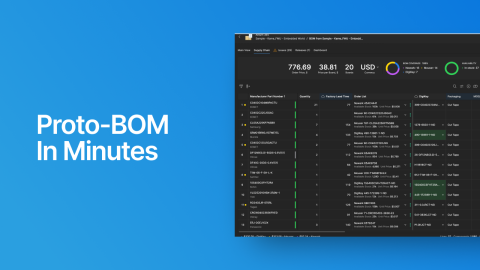



Comparing BOM Tools: What Makes Octopart Stand Out?

At a Glance
Compare BOM management tools based on component data coverage, freshness, lifecycle intelligence, pricing, availability, compliance, and sourcing visibility. Learn how distributor tools, component aggregators, enterprise platforms, and Octopart differ in the data and risk insights they provide.


In the search for an efficient Bill of Materials (BOM) management solution, the market is crowded. A quick search reveals dozens of "free" tools, all promising to streamline your workflow. But these tools are not created equal. The most critical difference isn't the user interface or the import features. It's the data underneath.
Choosing a BOM tool with a static, cached, or incomplete database is one of the most significant unforced errors an engineering team can make. It provides a false sense of security that leads to real-world, high-cost disasters.
The risks are not abstract. In 2023 alone, industry data shows that over 470,000 electronic components reached their End-of-Life (EOL). If your BOM tool isn't using up-to-date lifecycle data, it will happily give you a "green light" on a part that is already obsolete, guaranteeing a costly redesign before your product even hits production.
When that happens, the costs are catastrophic. Depending on product complexity, a single PCB re-spin forced by an unavailable or obsolete component can range from $20,000 to nearly $2 million. Add to this the incalculable cost of lost market opportunity from a six-week delay, and the "free" tool suddenly becomes the most expensive piece of software in your stack. Relying on a tool with outdated or siloed data is a massive gamble that no modern engineering team can afford to take.
BOM management tools help engineering and procurement teams evaluate component availability, pricing, lifecycle status, compliance, technical specifications, and sourcing risk across a bill of materials. When comparing BOM tools, teams should look beyond basic file import and part matching to evaluate data coverage, freshness, lifecycle intelligence, multi-source availability, alternate-part discovery, and collaboration capabilities. The quality of the underlying component data ultimately determines how effectively a BOM tool can identify sourcing and obsolescence risk.
From "Part Checking" to "Market Intelligence"
The goal is to move component risk analysis earlier in the design process, shifting from reactive part checking to proactive BOM intelligence.
The old, reactive mindset asks: "Is this part number valid?" The new, proactive mindset asks: "Is this part a viable, cost-effective, and low-risk choice from the entire global market for my product's complete lifecycle?"
Basic part checking confirms whether a component exists or is currently available. BOM intelligence goes further by evaluating whether that component is appropriate for the product's expected lifecycle based on sourcing availability, lifecycle status, pricing, compliance, technical requirements, and alternative options.
A modern BOM tool shouldn't just be a spreadsheet importer. It must be an intelligent, up-to-date dashboard that empowers you to build a resilient and manufacturable product from day one. It should give you the data to avoid risk, not just discover it when it's already too late.
What Should You Look for in a BOM Management Tool?
The right BOM management tool depends on team size, product complexity, sourcing strategy, and the level of supply chain risk a company needs to manage. However, several capabilities are useful across most electronics development environments.
- Data freshness: How frequently are stock, pricing, lifecycle, and supplier records updated?
- Component data coverage: How many manufacturers, distributors, regions, and component categories are represented?
- Lifecycle intelligence: Does the platform identify Active, NRND, EOL, and other lifecycle conditions?
- Multi-source availability: Can teams compare inventory and pricing across multiple distributors?
- Technical and compliance data: Are specifications, RoHS, REACH, and other component attributes available?
- Alternate-part discovery: Can engineers identify potential replacements when a preferred component becomes risky?
- Engineering and procurement collaboration: Can both teams evaluate technical and commercial information from the same BOM?
The Key Comparison Vectors
When evaluating BOM tools, go beyond a simple feature checklist. The true comparison vectors lie in the source, scope, and freshness of their data. The market is primarily divided into three categories, each with its own advantages and limitations.
| Category | Examples | Benefits | Limitations |
| Distributor BOM Tools | DigiKey, Mouser, etc. | Convenient for building and managing carts; direct visibility into that distributor’s real-time (or near real-time) stock, pricing, and ordering options; usually simple to use and free | Primarily reflects a single distributor’s catalog, availability, and pricing; may not support broad market comparison across many sources; can result in a narrower view of alternates and supply options outside that distributor |
| Other Aggregator Tools | Various BOM/parts search aggregators | Broader view by combining data from multiple distributors; can speed up price/availability comparisons and alternate discovery across sources | Coverage varies widely (number of distributors, parts, and regions); data freshness varies (some rely on cached or periodically refreshed feeds); completeness and update frequency can be hard to verify without transparency from the provider |
| Paid Enterprise Tools | SiliconExpert, Z2Data (and similar) | Deep datasets and analytics (e.g., lifecycle status, compliance, risk signals, obsolescence insights); often offer advanced reporting, integrations, and governance features for larger organizations | Higher cost and licensing complexity; may be out of reach for individuals, startups, and some mid-sized teams; onboarding and workflow integration can require dedicated effort to realize full value |
Octopart as the Enabler: The Best of All Worlds, for FREE
This is where Octopart stands in a category of its own. The Octopart BOM Tool was built on the philosophy that all engineers and procurement professionals, regardless of company size, deserve access to the best possible data for free and easily accessible.
What Makes Octopart Stand Out?
1. Vendor-Agnostic Market View
Unlike distributor tools, Octopart is vendor-agnostic. We do not sell components; we provide data. This fundamental distinction means our platform is built without bias. We show you the entire market, allowing procurement to find the absolute best price and engineers to find all available stock from over 670 global distributors, not just the one whose tool you're using.
2. The Most Extensive and Up-to-Date Data
Our data scale is our core strength. While other free tools may index a few million parts, the Octopart database includes:
- Over 95 million components
- Over 11,130 manufacturers
- Data from 670+ global distributors
More importantly, this data is up-to-date. Our platform processes over 208 million offers daily. No other free aggregator on the market matches this scale or speed.
3. Critical Risk and Lifecycle Signals for Free
Octopart provides the critical, actionable risk data for free. When you upload a BOM, you instantly see:
- Up-To-Date Lifecycle Status: Clear flags for Active, NRND (Not Recommended for New Designs), and EOL on every part.
- Compliance Data: Up-to-date RoHS and REACH status.
- Detailed Technical Specs: Full parametric data to compare parts side-by-side.
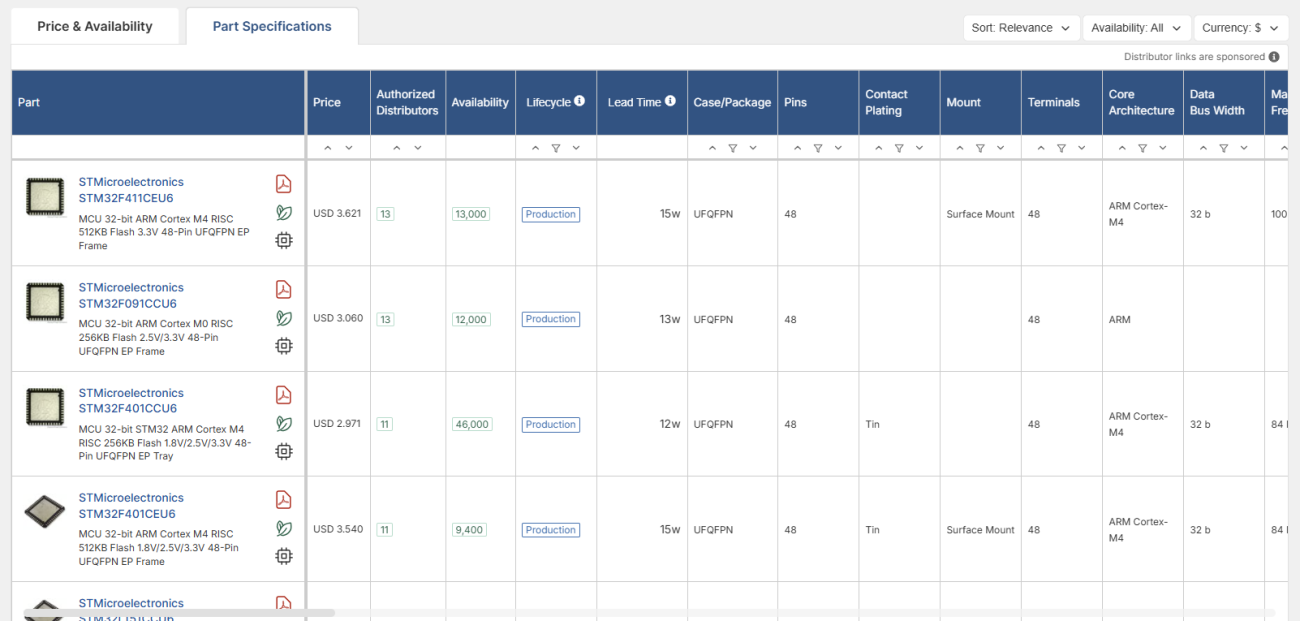
Octopart democratizes access to professional-grade risk management data, allowing an engineer at a five-person startup to avoid the same EOL-driven re-spin as an engineer at a Fortune 500 company.
4. A Seamless UI & Collaboration
A tool is only effective if it's usable. Octopart’s clean interface is designed to serve both engineering and procurement from a single, unified view. An engineer can instantly assess technical risk (lifecycle, specs) while a procurement manager can simultaneously assess commercial risk (price breaks, multi-source availability).
Conclusion
By providing the most comprehensive, up-to-date data, the Octopart BOM Tool offers practical benefits. It can help you identify and avoid EOL parts before you design them in, and source components with more confidence by giving you a broader view of global stock and pricing. It also provides commonly needed risk-management signals, such as lifecycle status, compliance, and detailed specifications, without the cost of an enterprise solution.
As a result, engineering and procurement teams can work from a shared source of information, reducing friction and supporting faster time-to-market.
While many tools focus on checking off features, the Octopart BOM Tool is positioned to provide the supply chain visibility needed to manage risk, control costs, and move to production more efficiently.
Try the Octopart BOM Tool today to see how it can simplify your sourcing workflow.

About Author
Related Resources
Related Technical Documentation
Table of Contents
- From "Part Checking" to "Market Intelligence"
- What Should You Look for in a BOM Management Tool?
- The Key Comparison Vectors
- Octopart as the Enabler: The Best of All Worlds, for FREE
- What Makes Octopart Stand Out?
- 1. Vendor-Agnostic Market View
- 2. The Most Extensive and Up-to-Date Data
- 3. Critical Risk and Lifecycle Signals for Free
- 4. A Seamless UI & Collaboration
- Conclusion
Solutions for Every Role and Team
- Discover and evaluate design options earlier
- Develop in one shared workspace
- Scale with control and compliance
- Connect every stage of hardware development
Learn More
Thank you, you are now subscribed to updates.