












Design For Alternates Might Help You Manage a Changing PCB Supply Chain

At a Glance
Reduce supply chain risk before shortages hit. Learn how designing for alternates helps engineers find qualified drop-in replacements faster.


Every engineer has lived through the same scramble: a critical line item goes NRND, lead times stretch from 12 weeks to 52, or a tariff change suddenly makes a sourcing region uneconomical. The BOM was locked around a single manufacturer part number, and now someone is burning a week chasing datasheets.
Then comes the most expensive question in electronics: Can we use another part instead?
Unfortunately, finding inventory is rarely the hardest part. Finding an alternate that engineering has already approved usually is.
Design for alternates helps teams identify qualified drop-in replacements early, reducing sourcing risk before shortages become production delays.
This article explores the component families that commonly support drop-in alternates, how to use description-based search, how to decode manufacturer part numbers, and what engineers should always verify before approving an alternate.
Key Takeaways
- A true drop-in alternate has to match on form, fit, and function.
- Standardized component packages and pinouts can make it easier to identify potential drop-in alternates across multiple manufacturers.
- Searching by component description and applying parametric filters can reveal compatible options that an exact part-number search may not show.
- If you already have a part in mind, the Alternates tab on an Octopart part page returns a shortlist of functionally similar components in one step.
- Understanding manufacturer part-number structures and common family stems can accelerate alternate-component evaluation.
- Octopart's component search, parametric filters, and lifecycle insights help engineers quickly compare, validate, and qualify alternate components across multiple manufacturers.
What Design for Alternates Really Means
Design for alternates means designing a PCB with multiple qualified components that can perform the same function without requiring layout changes.
In practice that means three habits: preferring parts that already have multiple sources over single-source ones, staying with standard values and packages wherever the design allows, and documenting approved alternates while the design is still open rather than during a shortage.
Changes after design freeze are common and expensive. Industry survey data shows 51% of professionals report that over 11% of their designs require component changes after freeze, 46% estimate a single post-freeze change costs more than US$50,000, and on complex aerospace, defense, and automotive programs those costs can reach US$250,000 per change event. At that stage a swap can mean new engineering reviews, testing, requalification, and potentially a PCB redesign.
Design for alternates reduces this risk by identifying compatible replacement components before they are actually needed.
A true drop-in alternate satisfies three conditions:
- Form: means the mechanical dimensions and PCB footprint are identical.
- Fit: means the pinout and assembly process remain unchanged.
- Function: means the electrical performance stays within the design requirements.
When all three conditions are satisfied, procurement can switch suppliers without asking engineering to redesign the PCB.
Component Families That Commonly Accept Drop-In Alternates
The following component categories frequently support pin-compatible replacements because their packages and electrical interfaces are based on widely adopted industry standards. Package and pinout compatibility is the starting point. DC resistance, saturation current, ESR, drive level, and temperature behavior still vary by manufacturer and should be checked against the datasheet.
Component Family | Common Package | Why They're Good Alternates |
MLCC Capacitors | 0201, 0402, 0603, 0805, 1206 | Standard EIA footprints and electrical ratings |
Thick-film Chip Resistors | 0201-2512 | Resistance values, tolerance, and footprints are |
Ferrite Beads | 0402, 0603, 0805 | Similar impedance ratings across manufacturers |
Chip Inductors | 0402, 0603, 0805 | Package sizes are standardized for many |
Signal Diodes | SOD-323, SOD-123, SOT-23 | Common JEDEC outlines with multiple |
Schottky Diodes | SOD-123, SMA, SMB | Large number of second-source suppliers |
TVS Diodes | SMAJ, SMBJ, SMCJ | Standardized package families and voltage |
Small-Signal MOSFETs | SOT-23 | Numerous industry-standard devices with |
Bipolar Transistors | SOT-23 | Standard transistor families available from |
Logic ICs | SOIC, TSSOP, QFN | 74HC, 74LVC, and similar families maintain |
Operational Amplifiers | SOIC-8, MSOP-8 | Many op-amp families share identical pin |
Comparators | SOIC-8, SOIC-14 | Standard dual and quad pin configurations |
Linear Voltage Regulators | TO-220, SOT-223, SOT-23-5 | Popular regulator families often maintain |
Crystals | 2016, 2520, 3225, 5032 | Mechanical footprint remains consistent across |
Oscillators | 2520, 3225, 5032 | Standard package dimensions simplify |
Example 1: Multi-layer ceramic capacitors
MLCCs are one of the easiest components to source from multiple manufacturers. A 0603, 10 µF, 10V, X5R, ±10%-±20% capacitor is typically available from several suppliers with comparable specifications.
All are: 10 µF, X5R, 10V, 0603 Multilayer Ceramic Capacitors
Manufacturer | Part Number |
KYOCERA AVX | |
Murata | |
Samsung | |
TDK | |
TAIYO YUDEN |
Although these parts may share the same footprint, engineers should still review DC bias characteristics and effective capacitance.
Example 2: 1117 Linear Regulator Family
Low-dropout regulators appear straightforward but require more careful evaluation than many passive components.
Examples include:
All have the same SOT-223 footprint
Manufacturer | Part Number |
Texas Instruments | |
Onsemi | |
STMicroelectronics | |
Diodes Inc |
Although these often share the same SOT-223 footprint, engineers should verify:
- Pin compatibility
- Dropout voltage
- Output current
- Stability requirements
- Recommended output capacitor characteristics
A Five-Step Workflow for Finding and Qualifying Alternates
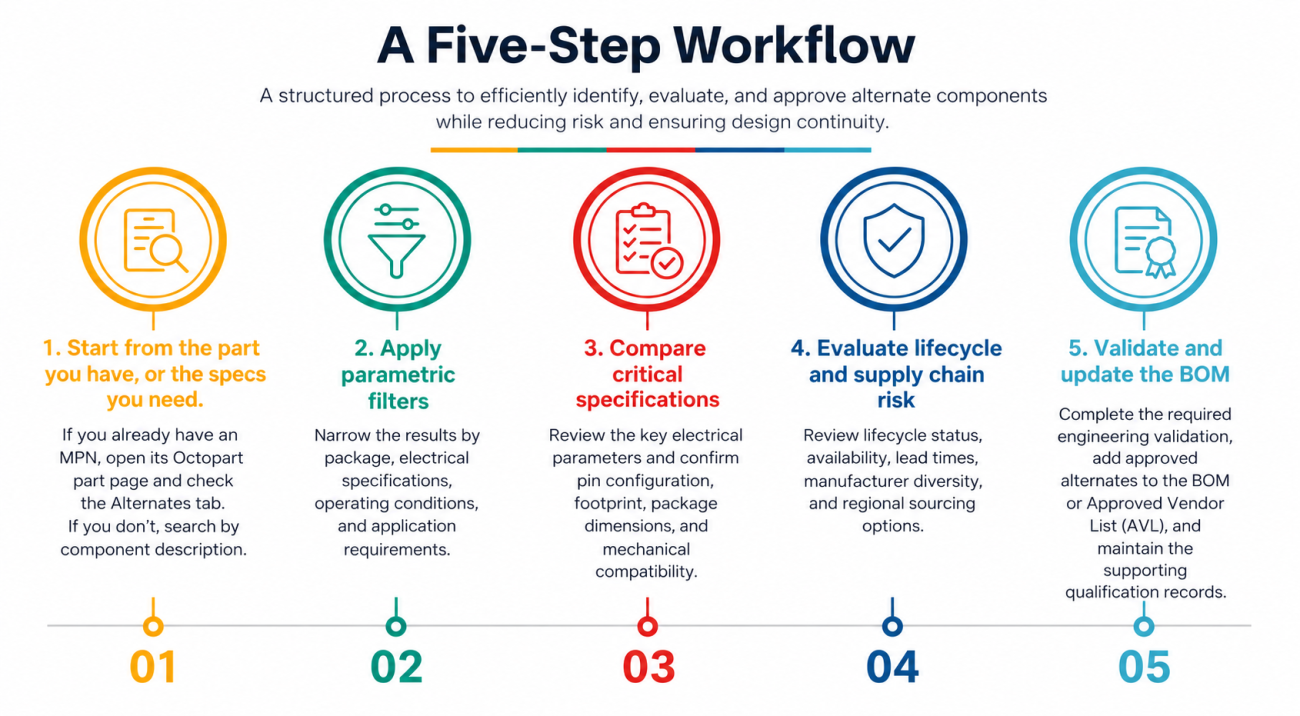
A practical five-step workflow:
- Start from the part you have, or the specs you need. If you already have an MPN, open its Octopart part page and check the Alternates tab. If you don't, search by component description.
- Apply parametric filters. Narrow the results by package, electrical specifications, operating conditions, and application requirements.
- Compare critical specifications. Review the key electrical parameters and confirm pin configuration, footprint, package dimensions, and mechanical compatibility.
- Evaluate lifecycle and supply chain risk. Review lifecycle status, availability, lead times, manufacturer diversity, and regional sourcing options.
- Validate and update the BOM. Complete the required engineering validation, add approved alternates to the BOM or Approved Vendor List (AVL), and maintain the supporting qualification records.
Two Ways to Start: From a Part Number, or From a Description
Most alternate searches begin one of two ways: you have a part that's become a problem, or you have a set of requirements and no part yet. Octopart handles both, and the fastest route depends on which one you're in.
If you already have a part number
Enter the MPN in the search bar, open the part page from the results, and select the Alternates tab.
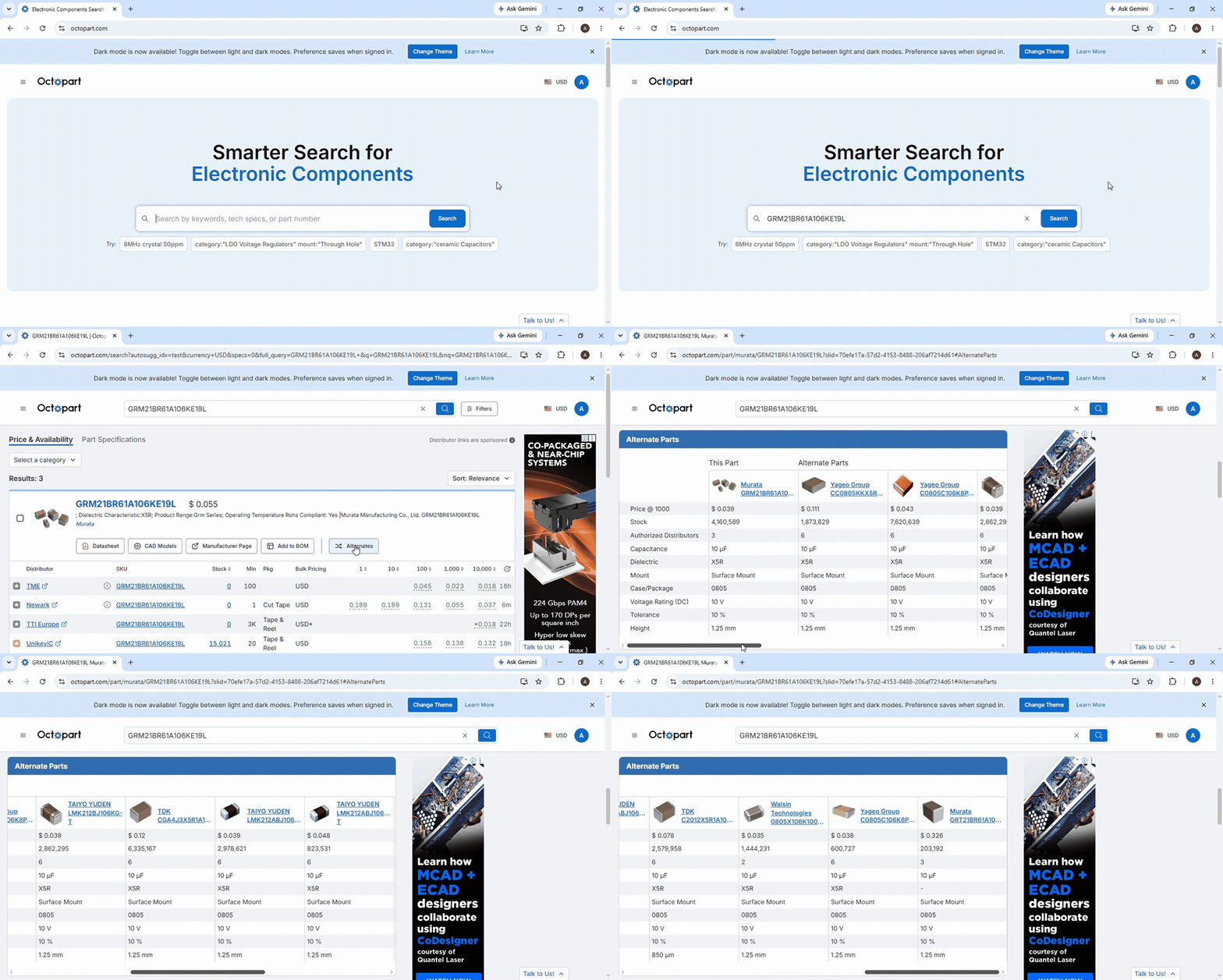
Octopart returns functionally similar parts matched on the parameters that matter for that component type — for a capacitor, that's capacitance, package size, voltage rating, and dielectric. It’s one of the fastest ways to move from a single-source dependency to a shortlist of viable options.
If you're starting from a set of requirements.
Search the description instead of a part number. For example, instead of searching: GRM21BR61A106KE19L, search using the component description: 10 µF, 0805, X5R, 10V, MLCC.
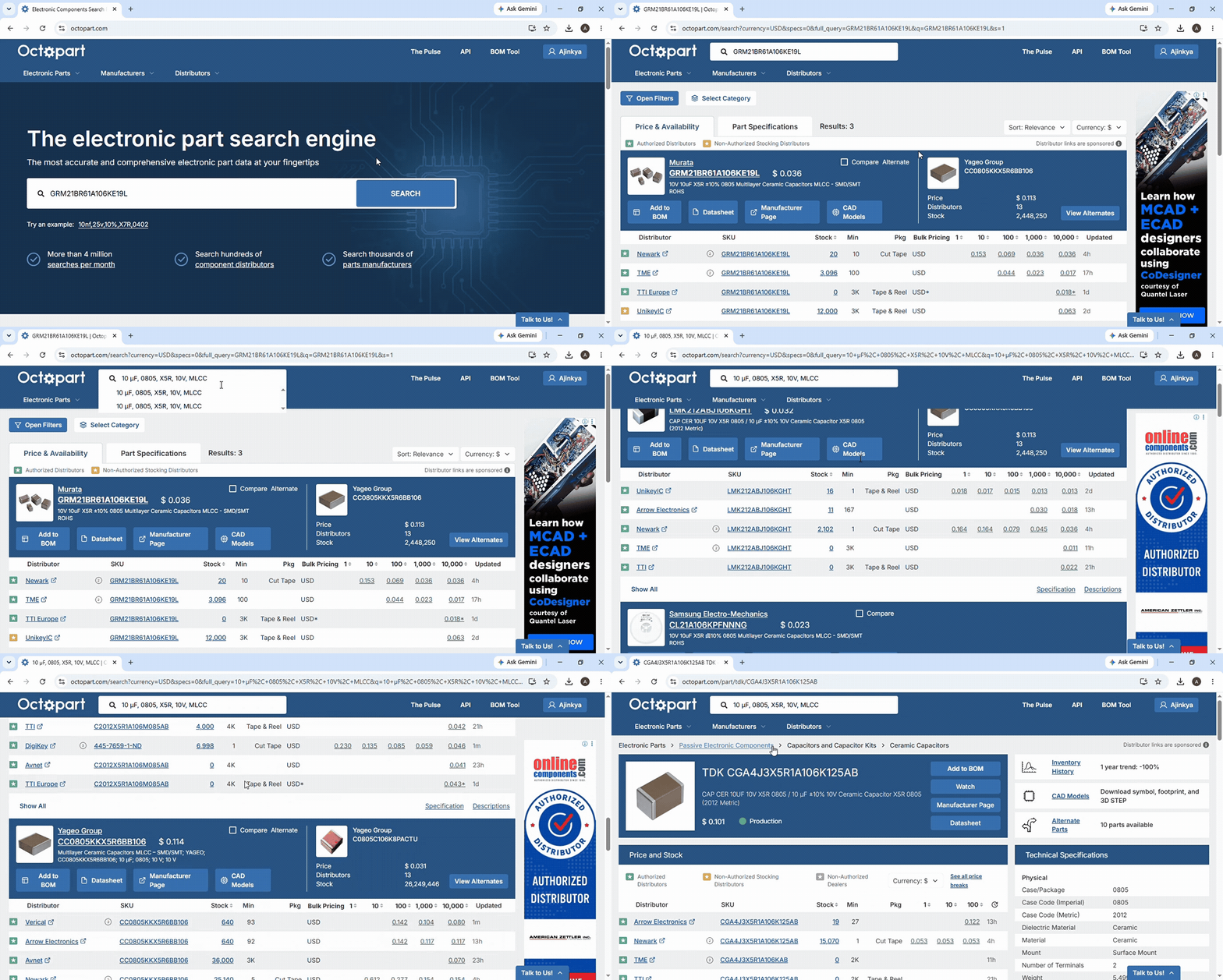
An exact part-number search is typically limited to the specified Murata component. In contrast, searching by component description can reveal products from multiple manufacturers that share the required electrical and mechanical characteristics.
This is why description-based and parametric search matter: 77% of engineers spend five or more hours a week reading datasheets and comparing alternates manually. Filtering on the requirements up front is what keeps that number down.
Using Parametric Search to Find Alternate N-Channel MOSFETs
Once the basic electrical requirements are defined, parametric search can quickly narrow thousands of MOSFETs to a shortlist of viable replacements.
For example, starting with a N-Channel MOSFET, 60 V, SOT-23, engineers can apply filters to eliminate incompatible devices before reviewing datasheets.
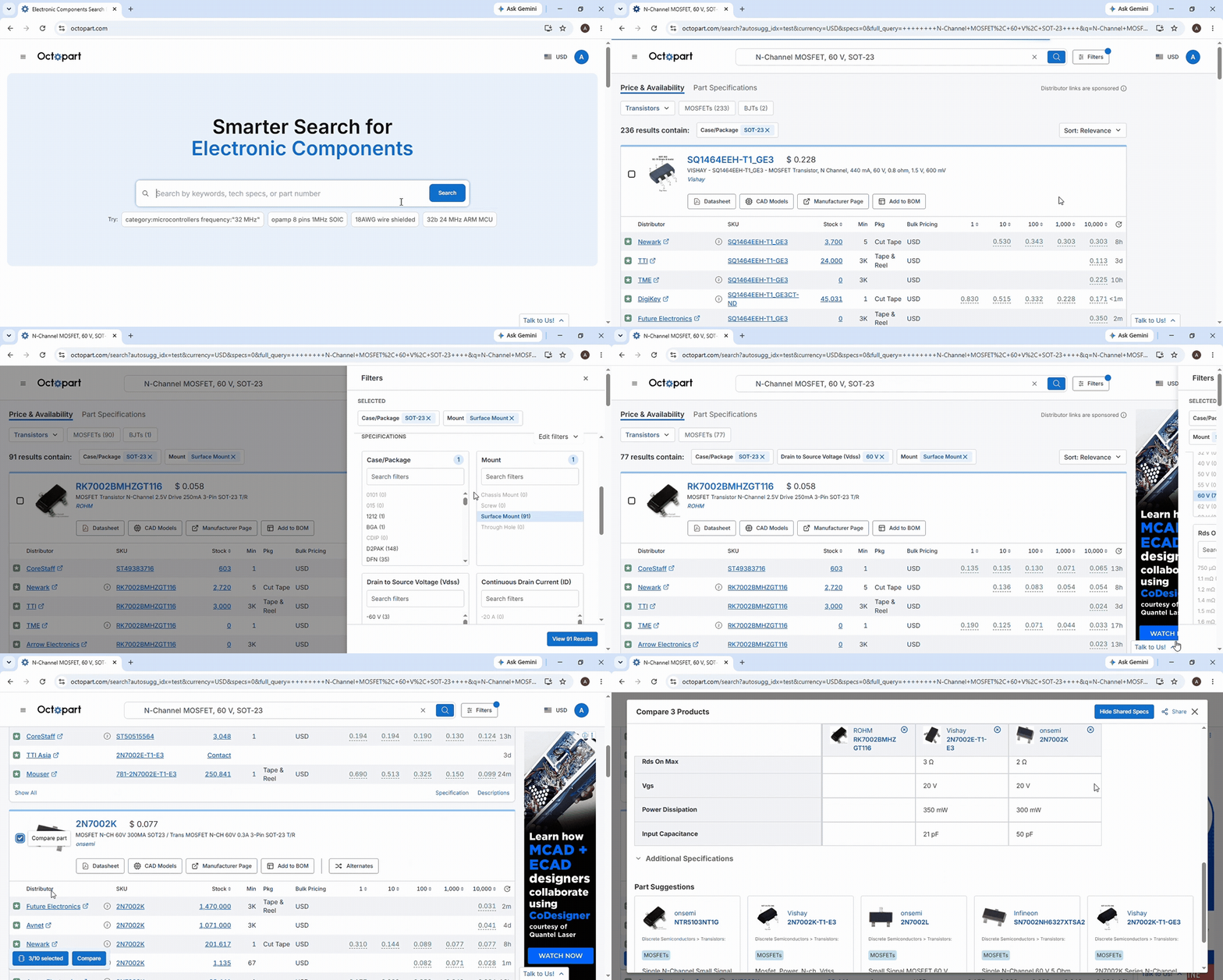
Typical filters for this example include:
- Drain-Source Voltage (VDS): 60 V
- Package: SOT-23
- Continuous Drain Current (ID)
- RDS(on)
- Power Dissipation
- Operating Temperature Range
- Mounting Style: Surface Mount
- Lifecycle Status
After applying these filters, the remaining MOSFETs can be compared side by side.
In just a few minutes, Octopart's parametric search can turn what began as a single-source 60 V SOT-23 N-Channel MOSFET into a qualified list of multi-source alternatives that meet the same electrical and mechanical requirements, reducing supply chain risk without requiring a PCB redesign.
Reading Manufacturer Part Numbers Like an Engineer
Once parametric search has identified a shortlist of potential alternates, learning how manufacturers structure their part numbers can help engineers evaluate them more efficiently.
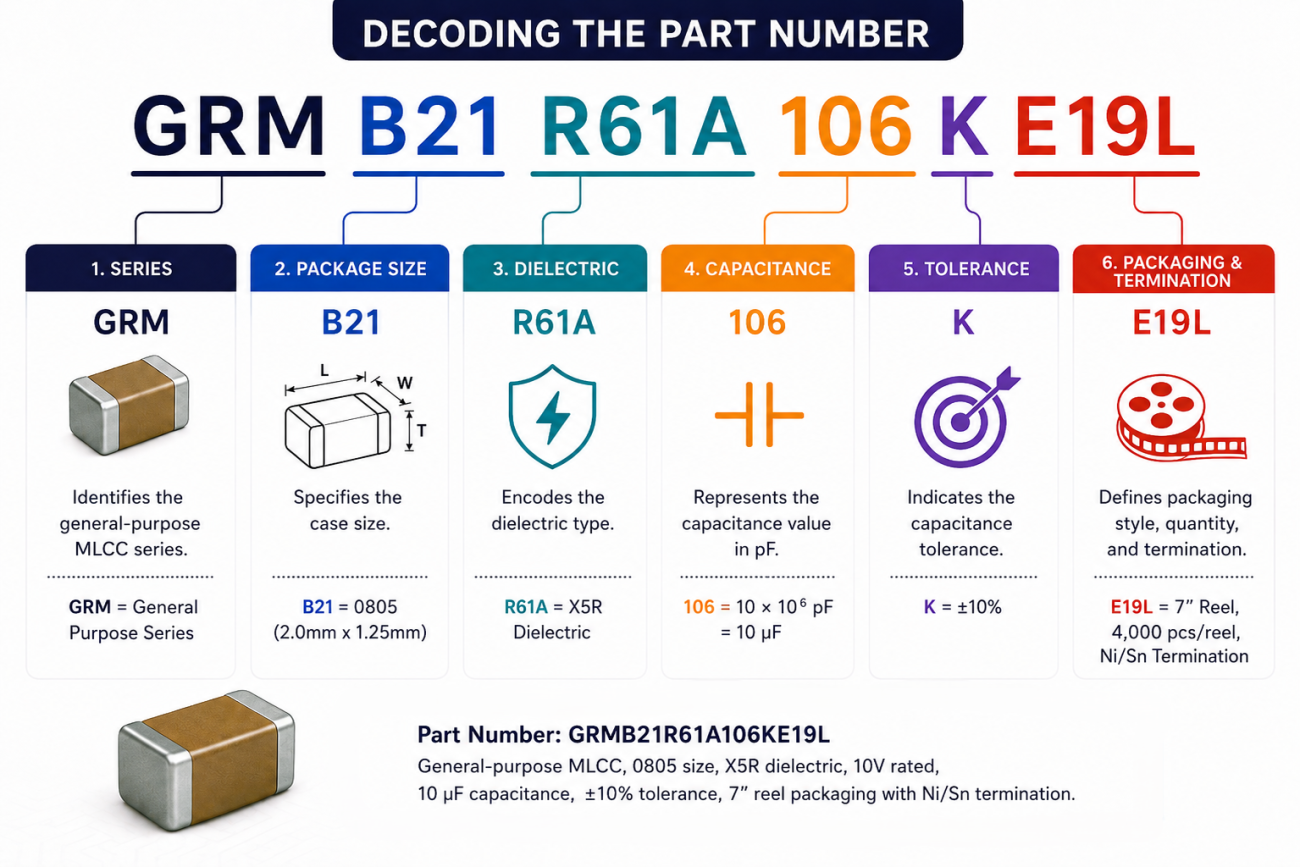
Most manufacturers build their part numbers from the same parameters in a fixed order: product series, package size, dielectric material, voltage rating, capacitance, tolerance, qualification level, and packaging suffix.
Consider the Murata part: GRMB21BR61A106KE19L (the same capacitor we searched for by description above), each section represents a different characteristic.
- GRM identifies the general-purpose series.
- 21 specifies the package size.
- R61A encodes dielectric and voltage information.
- 106 represents 10 µF.
- K indicates ±10% tolerance.
- E19L identifies packaging and termination details.
Another manufacturer may encode similar information using a different structure.
For example, Yageo's CC0805KKX5R7BB106 clearly includes:
- CC identifies the MLCC product series.
- 0805 indicates the package size (0805 / 2012 metric).
- K indicates a commercial-grade capacitor series.
- K identifies the tolerance (±10%).
- X5R specifies the dielectric material.
- 7B encodes the rated voltage (16 V in Yageo's nomenclature).
- B identifies an internal specification or packaging/termination option.
- 106 represents 10 µF (10 × 10⁶ pF).
Component Type | Common Families |
MLCC Capacitors | GRM, CL, C, CC |
Chip Resistors | RC, CRCW, ERJ, RK73 |
Schottky Diodes | SS14, SS24, SS34 |
TVS Diodes | SMAJ, SMBJ, SMCJ |
Linear Regulators | LM1117, LD1117, NCP1117, AZ1117 |
Logic Devices | 74LVC1G series |
Small MOSFETs | AO3400A, SI2302 class |
Once engineers become familiar with these naming systems, evaluating drop-in alternates becomes significantly faster.
Many semiconductor manufacturers build entire product families around a common part number stem.
Only the suffix changes to indicate:
- Tape and reel quantity
- Packaging style
- Plating finish
- Qualification revision
- Shipping configuration
Example: LM1117 Linear Regulators
The shared LM1117 stem tells us these devices belong to the same regulator family. The suffix simply specifies the regulated output voltage.
Consider the following devices:
- LM1117-3.3 - The 3.3 suffix indicates a fixed output voltage of 3.3 V
- LM1117-5.0 - The 5.0 suffix indicates a fixed output voltage of 5.0 V
- LM1117-1.8 - The 1.8 suffix indicates a fixed output voltage of 1.8 V
Evaluating Lifecycle, Supply Risk
Even if a part meets form, fit, and function, it still needs to be viable to source. A "perfect" alternate from a single vendor on a 40-week lead time reintroduces exactly the risk you were trying to remove.
Use tools like Octopart to check four things:
- Lifecycle status. Active, NRND, or obsolete. An NRND alternate may buy you months rather than years.
- Distributor breadth. How many distributors actually hold stock, not just how many list the part. One distributor is a sole-source problem wearing a different hat.
- Inventory history. Up to 12 months of stock and price trend. A part that repeatedly drops to zero is volatile even when it's in stock today.
- Manufacturer and regional diversity. If every source for your alternate manufactures in the same region, a tariff change or a regional disruption takes out the primary and the backup together.
An alternate that clears form, fit, and function but fails any of these isn't an alternate. It's a second way to have the same problem.
Validating and Recording the Alternate
Once an alternate is validated, record it where procurement will actually find it:
- Add the approved MPN to the BOM or AVL alongside the primary, not in a side document nobody opens during a shortage.
- Note the scope of approval. Unrestricted, or conditional: approved for this board but not the automotive variant, approved only above a given gate drive, approved pending a thermal check. A bare MPN with no conditions invites the wrong swap.
- Record what was checked - which parameters were compared, against which datasheet revision. This is what stops the same evaluation being repeated in eighteen months.
- Re-check periodically. Your alternate can go NRND too.
Kept current, this turns a shortage from a schedule risk into a purchasing decision procurement can make without coming back to engineering.
Conclusion
The scramble this article opened with – the NRND notice, the lead time going from 12 weeks to 52, the week spent chasing datasheets – is a scheduling problem created months earlier, when the BOM was locked around a single part number.
Description search, parametric filters, and part-number structure narrow thousands of devices to a handful. Lifecycle status, distributor breadth, and inventory history tell you whether that handful is worth anything. Neither replaces the last step: matching headline specifications is not the same as working in your circuit. Check DC bias on the capacitor, the output capacitor requirement on the regulator, RDS(on) at your actual gate drive on the MOSFET, then validate it and put it on the AVL.
The work is the same whether you do it now or during a shortage. Now it costs an afternoon. Later it costs a redesign.
Search a part on Octopart and open the Alternates tab. See how many options you already have →

About Author
Related Resources
Related Technical Documentation
Table of Contents
- Key Takeaways
- What Design for Alternates Really Means
- Component Families That Commonly Accept Drop-In Alternates
- A Five-Step Workflow for Finding and Qualifying Alternates
- Two Ways to Start: From a Part Number, or From a Description
- Using Parametric Search to Find Alternate N-Channel MOSFETs
- Reading Manufacturer Part Numbers Like an Engineer
- Evaluating Lifecycle, Supply Risk
- Validating and Recording the Alternate
- Conclusion
Solutions for Every Role and Team
- Discover and evaluate design options earlier
- Develop in one shared workspace
- Scale with control and compliance
- Connect every stage of hardware development
Learn More
Thank you, you are now subscribed to updates.