












Trust Your BOM: Ensuring Design Data Integrity in Fast-Paced Hardware Projects

At a Glance
Trust your BOM. Discover how integrating centralized data and live supply chain intelligence stops manufacturing delays and speeds up hardware projects.


Building hardware is hard. Building it fast under tight deadlines is even harder. But here's the problem: many engineering teams are still trying to manage complex electronics projects using the exact same tool they use for their personal finances: a spreadsheet.
In most organizations, especially small and mid-sized ones, this reliance creates severe functional silos: electrical engineers operate exclusively within their design environments, while sourcing teams remain confined to disconnected spreadsheets. Because these groups are disconnected, basic and fundamental coordination depends heavily on human effort. When teams rely on emails, status meetings, and manual file exports to share a BOM, handoffs inevitably introduce errors. And when critical design decisions take longer to communicate, surprises show up downstream in the manufacturing process, which costs exponentially more to fix.
Many years of experience across PCB design and global supply chains highlight one undeniable truth: Organizations cannot build a modern piece of hardware on a static list of parts; they need live data, rigorous governance, and systemic trust across their development lifecycle.
Key Takeaways
- Relying on disconnected files for BOM management leads to duplicated effort, outdated information, and costly manufacturing delays.
- Connecting design environments to real-time supply chain intelligence allows teams to catch part shortages before finishing layouts.
- Centralized cloud portals help clean up data, resolve duplicate parts, and maintain a single source of truth.
- When engineering and procurement can see the same data simultaneously, teams make faster, more confident decisions.
The Spreadsheet Trap
Consider a common scenario: Engineers frequently finalize complex printed circuit board layouts, balancing power planes and routing high-speed traces, only to export a static BOM for procurement handoff. Days later, the design team is notified that a critical power management integrated circuit is globally out of stock, with procurement lead times stretching past fifty weeks.
This scenario occurs because organizations force teams to navigate disparate tools, file-based exchanges, and ad-hoc workflows. Since design data and supply chain data exist in completely separate operational universes, neither department possesses the visibility to anticipate the shortage. The result: delays, duplicated effort, and a recurring need to align teams.
Procurement managers routinely spend hours manually comparing prices across distributor websites because in-house BOM tools are disconnected and cumbersome. This manual approach diverts time from technical problem-solving. The cost in both time and money is severe. If an electrical engineer has to rip up a board layout to accommodate a replacement component, the organization sacrifices days of engineering bandwidth. If these cumulative delays cause a missed manufacturing slot at the fabrication facility, the project timeline may slip by several weeks.
Bringing Supply Chain Intelligence to the Design Phase
Here's how to fix this. Organizations must stop treating the BOM as a finalized, static reporting step. It needs to be a living element of the continuous hardware design process. To do this effectively, teams need to manage BOM data in a cloud portal, not in Excel. This means bringing component data right to where engineers design PCBs.
When component selection is informed by continuously updated availability and risk data, both engineers and sourcing teams can see the market reality together. This shift is all about proactive decision-making. By establishing live connections to distributor and manufacturer component data, facilitated by industry platforms, organizations maintain fresh, accurate part libraries.
Teams can define alternative components and swiftly execute drop-in replacements. Instead of just reacting to a sudden semiconductor shortage, organizations can strategize for market volatility before drafting the initial schematic. If a part looks risky, engineers can choose a different component with a healthier procurement profile or approve verified drop-in replacements right from the start. This keeps the assembly line moving and eliminates the need for the procurement team to guess the original engineering intent.
Centralized Governance and Traceability
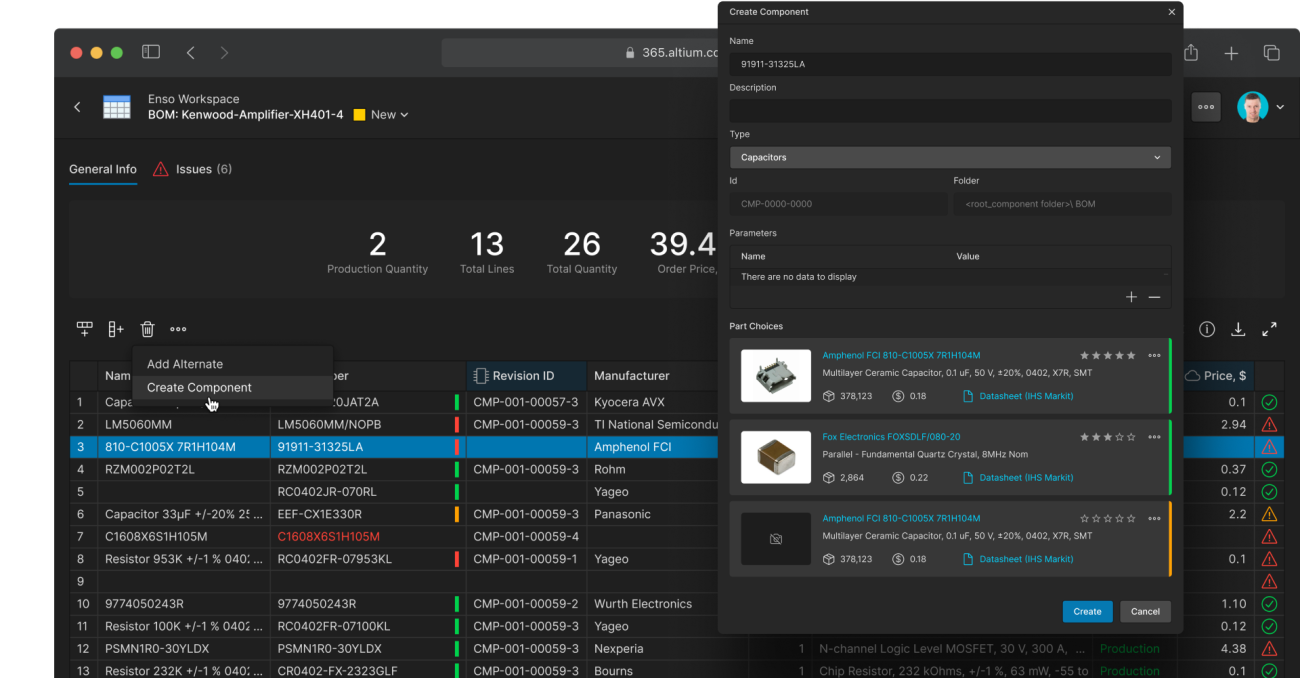
But having visibility into the supply chain is only half the battle; organizations also need control over their own data. When a hardware product goes into production, manufacturers must know exactly which components are used, the authoring engineer, and the precise time of approval. This is where centralized BOM governance comes in, providing enterprise-level structure. Platforms like Altium Agile Teams are built exactly for this. They add an enterprise layer of structure for repeatable processes, migrating operations out of spreadsheets and into a governed environment. A solid system helps to maintain a central part library and enforce its structure across the whole team.
Here's a look at how a traditional manual process compares to a structured, centralized approach.
Capability | Spreadsheet-Based Process | Centralized BOM Management |
Data Synchronization | Manual updates lead to high risks of version conflicts and old data. | Continuously syncs BOM data across teams, reducing the risk of costly late-stage surprises. |
Sourcing Insights | Static data requires staff to manually check external distributor websites. | Maintains a live connection to component supply chain data. |
Data Normalization | Requires heavy manual scrubbing to fix formatting and manufacturer names. | Standardizes and cleans BOMs, resolving duplicates, inconsistencies, and formatting differences. |
Traceability | Almost impossible to accurately track changes over time or across versions. | Tracks all changes, ensuring complete traceability, accountability, and audit readiness. |
With centralized governance through Altium Agile Teams, teams can clean BOMs automatically, independently resolving the formatting inconsistencies and duplicate entries that confuse manufacturing partners. And when something does go wrong, they have complete visibility, allowing quality assurance to identify every product utilizing a specific component, down to the exact board revision. This kind of traceability is invaluable during critical incident investigations and error-mitigation processes.
Trust and Proactive Collaboration
At the end of the day, deploying modern hardware relies heavily on systemic trust. Engineers need to possess absolute confidence that specified schematic components are physically procurable. Meanwhile, procurement departments require strict assurance that the BOM they receive is the final, officially approved iteration, not an outdated draft from last Tuesday. Connecting people, processes, and data correctly naturally yields true co-creation
Instead of just isolating departments and throwing files over the wall, Altium Agile Teams allows concurrent collaboration. This means up to 25 electrical engineers can co-author the exact same printed circuit board simultaneously. It also handles the mechanical side with advanced ECAD-MCAD codesign, ensuring that mechanical and electrical experts design together without the risk of falling out of sync.
Teams can also co-design BOMs. Departments manage component lifecycles collaboratively and make critical adjustments for end-of-life parts long before they threaten to halt production lines. This secure flexibility allows organizations to adapt to inevitable changes without slowing progress or worrying about data breaches. It creates an environment where people spend less time tracking down files and more time building great hardware.
Breaking the Spreadsheet Habit
Relying on spreadsheets for hardware design is a habit the industry needs to break. The accumulated costs of engineering rework, cross-departmental miscommunication, and delayed market entry are simply too high. By adopting centralized BOM management and integrating live supply chain intelligence directly into core engineering tools, organizations transition from reactive hope to proactive, reality-based planning. It’s simple: trust the BOM and keep data connected, and hardware projects will move faster and run much smoother.
Frequently Asked Questions
How does component normalization actually work in a centralized system?
When different engineers or procurement staff enter part numbers into a system, they often use different formats. One person might add dashes, another might use a supplier-specific prefix, and another might misspell the manufacturer's name. Normalization automatically cleans up these messy entries by matching them against a massive, standardized master database. This removes duplicates and ensures everyone is looking at the exact same manufacturer part number before you send it to a fabrication house.
Can a live BOM system handle sudden market shortages better than a spreadsheet?
Yes. Because a centralized system is connected to real-time distributor and manufacturer APIs, a sudden drop in global inventory can trigger an alert directly in your design portal. Instead of finding out weeks later during the purchasing phase, the engineering team sees the shortage immediately. This allows them to swap in a verified alternative part while the design is still open, completely avoiding a major delay.
Why is knowing the specific board revision important for a single component?
If the manufacturer finds a specific batch of voltage regulators defective, you need to know exactly which of your products contain that part. A centralized data system gives you a deep "where-used" history. It allows you to trace the bad part down to the specific board revision and the exact product run. This turns what could be a massive, expensive product recall into a highly targeted and manageable fix.

About Author
Related Resources
Related Technical Documentation
Table of Contents
- Key Takeaways
- The Spreadsheet Trap
- Bringing Supply Chain Intelligence to the Design Phase
- Centralized Governance and Traceability
- Trust and Proactive Collaboration
- Breaking the Spreadsheet Habit
- Frequently Asked Questions
- How does component normalization actually work in a centralized system?
- Can a live BOM system handle sudden market shortages better than a spreadsheet?
- Why is knowing the specific board revision important for a single component?
Solutions for Every Role and Team
- Discover and evaluate design options earlier
- Develop in one shared workspace
- Scale with control and compliance
- Connect every stage of hardware development
Learn More
Thank you, you are now subscribed to updates.