


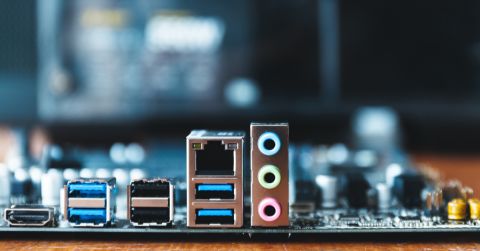






Top Trends in Emerging Connector Technologies

At a Glance
Plan connector choices earlier in the design. See 2026 trends in bandwidth, power density, and sustainability.


Key Takeaways
- Connectors are now upstream architecture choices that set ceilings for bandwidth, power density, reliability, and compliance.
- 224G interconnects, co-packaged optics, 800 V EV connectors, rugged miniaturization, smart connectors, modular hybrids, and sustainability pressures are all trending in 2026.
- Designing resilient systems means standardizing on connector families, planning headroom for the next speed/voltage step, and building in multi-source and sustainability considerations early in the design.
Why Connectors Are Having a Moment
The technical demands on connectors are intensifying across industries. AI servers are demanding 112–224 Gbps per lane, EVs are moving toward 800–1000 V battery packs, and wearable and medical devices now require tiny, sealed interconnects with high mating-cycle durability. Meanwhile, EU common charger rules are pushing USB-C deeper into the catalog. These forces are spurring connector innovation and driving growth, with the market expected to grow from $74.5 billion in 2025 to $109.2 billion by 2035.
Here are eight connector trends worth watching, along with a few standout parts that show where the market is heading.
1. 224G-Class High-Speed Interconnects (PCIe 7.0 & Beyond)
At 112–224 Gbps PAM4, traditional backplanes struggle. Flyover cable systems and near-chip interconnects move high-speed paths off FR-4 and into low-loss twinax. The connector and launch are now part of the channel model and loss budget, which means signal integrity (SI), mechanics, and service models all converge on the same decision.
Featured Product: Samtec Si-Fly® HD
Samtec Si-Fly® HD is a 224 Gbps four-level pulse-amplitude modulation (PAM4)-capable near-chip and co-packaged cable system with very high pair density and application-specific integrated circuit (ASIC)-adjacent launches.
2. Co-Packaged / Near-Packaged Optics Around the Switch ASIC
Co-packaged and near-packaged optics push the electrical-optical boundary right up against the switch ASIC, shrinking electrical reach and tightening power and signal-integrity budgets. That shift drives denser front panels, more cabled card-edge solutions, and extremely short electrical runs on the board. Layout and mechanical teams have to coordinate early because heatsinks, cages, and cable management all compete for the same space.
Featured Product: Molex CX2 / CX2 Dual-Speed Interconnects
Molex CX2 and CX2 Dual-Speed connectors and cable assemblies are built for near-ASIC connectivity with twinax cabling and up to 224 Gbps PAM4 per lane.
3. 800 V+ EV and High-Voltage Power Connectors
On the power side, EV and industrial platforms are jumping from 400 V to 800–1000 V. Connectors now have to manage creepage and clearance, partial discharge, the high-voltage interlock loop (HVIL) safety circuit, and real thermal derating. Many designs also require 10 to 15-year lifetimes across wide temperature and vibration ranges, which makes connector qualification and supplier stability part of the architecture decision.
Featured Product: TE Connectivity AMP+ HVP 800
The AMP+ HVP 800 series is a sealed, high-voltage connector family for hybrid and electric vehicles, delivering up to 250 A at up to 1000 V with an HVIL safety circuit and packaging options for different harness routes. It’s the kind of part that defines your pack, inverter, and service strategy.
4. Rugged Miniaturization for Wearables, Medical, and Edge
Wearables and compact edge devices are fighting for fractions of a millimeter. Reliability is driven by contact design and how well the connector withstands real-world handling and strain.
Featured Product: Molex SlimStack™ 0.35 mm Series
Molex’s SlimStack board-to-board family offers multiple options, including parts like 504618-2010, a 0.35 mm-pitch, low-profile receptacle. The series combines very small mated heights with optional armor housings and usable current ratings, making it a good fit for dense mobile and wearable designs.

5. USB-C Everywhere – Including Lab and Industrial Gear
USB-C has escaped laptops and phones. USB Power Delivery (USB PD) 3.1 can support up to 240 W over USB-C, which is pushing many barrel jacks and proprietary plugs toward retirement. In harsh environments, rugged USB-C parts often target lower power levels with better sealing, strain relief, and mounting options. That is driving a wave of ruggedized, panel-mount, and sealed USB-C connector variants.
Featured Product: Neutrik NAUSBC-5G-FL
The Neutrik NAUSBC-5G-FL is a D-shape USB Type-C chassis connector for pro AV and industrial panels. It supports up to 5 Gbps of USB 3.2 Gen 1 data and 100 W USB PD in a halogen-free, UL 94 V-0-rated housing with 10,000 mating cycles. It’s great for when you need USB-C without consumer-level fragility.
6. Smart and Sensor-Integrated Connectors
Connectors are increasingly incorporating sensors, microcontrollers, and communication capabilities, particularly for solenoid valves, hydraulics, pneumatics, and rotating machinery. This turns the connector into a condition-monitoring node.
Featured Product: ATAM SMART Form A (DIN-style valve) Connectors
ATAM’s SMART Form A sensor-integrated connectors embed micro-sensors and electronics into a standard DIN-style valve connector footprint, feeding condition data like temperature or vibration back to the control system. When a connector can “talk,” it becomes part of your firmware and safety case.
7. Modular / Hybrid Power + Signal + RF Systems
Modular connector systems let you mix power, signal, data, and sometimes pneumatic inserts in a single housing. That’s compelling in robotics, cobots, AGVs, and test rigs, where simplifying panels and harnesses reduces costs, shortens build time, and makes customization easier.
Featured Product: HARTING Han-Modular® Domino modules
The HARTING Han-Modular® Domino series extends the established Han-Modular platform with new hybrid power, signal, data, and pneumatic modules while improving space utilization and sustainability. It lets you standardize on a common rectangular housing across machines and vary only the Domino module mix per configuration, so you can tune power and I/O density without redesigning the connector interface.
8. Sustainability- and Sourcing-Aware Connector Choices
Connectors are now part of sustainability and sourcing discussions. For example, halogen-free plastics and low smoke zero halogen (LSZH) jackets are becoming common requirements. PFAS and other substances face increasing scrutiny from customer restrictions and evolving regulations. As EU “common charger” rules push ecosystems toward USB-C and more standardized interfaces, teams are increasingly wary of exotic, single-sourced connector families that are hard to replace.
Featured Product: HARTING Han-Eco®
HARTING Han-Eco® heavy-duty connectors use lightweight polymer housings and are widely deployed in power distribution and industrial systems. Broad adoption, clear material data, and long support horizons make families like this easier to keep on the approved vendor list across product generations.

From Trends to Practice: Pro Tips for Design and BOM Strategy
Across these eight trends, connector choices are moving upstream. You’re choosing high-speed systems alongside serializer-deserializer (SerDes) and laminates; high-voltage interfaces with your pack architecture; wearable-grade connectors with your flex and enclosure; and modular or smart connectors with your maintenance model. Here are a few pro tips to keep that complexity under control.
On the design and validation side:
- Read derating curves, not just headline specs. Current and mating-life ratings can change quickly with ambient temperature, duty cycle, and wire gauge. Treat the derating tables as design inputs, not fine print.
- Audit how connectors will actually be used. For wearables, involve mechanical/industrial designers; for EV and industrial gear, talk to service techs. If a connector is hard to access, align, or latch in the real world, field failure rates will rise.
- Make verified ECAD data a requirement. Using vetted symbols, footprints, and 3D models for connectors reduces last-minute footprint changes and silent SI/clearance errors, especially on dense boards.
On the BOM and sourcing side:
- Standardize on connector families. Pick families that cover multiple pin counts, pitches, stack heights, and sealing options so you can reuse footprints and shells instead of scattering one-off SKUs.
- Flag the high-risk connectors and define alternates. High-speed, high-voltage, miniature, smart, or modular connectors are the ones most likely to stall a build. Give them viable alternates, or at a minimum, clear second-best options.
- Revisit connector lines at each board revision. Use each spin as an opportunity to check for newer variants with better speed, current, ruggedness, or compliance before the board is locked again.
Octopart makes these practices fast and repeatable. Use parametric search to explore connector families and see which part numbers are actually stocked, then drop your candidates into the BOM Tool to compare pricing, availability, and lifecycle status side by side. If you bring that connector discipline into your BOM early, your 2026 designs are much more likely to ship on time and stay buildable for years.

About Author
Related Resources
Related Technical Documentation
Table of Contents
- Key Takeaways
- Why Connectors Are Having a Moment
- 1. 224G-Class High-Speed Interconnects (PCIe 7.0 & Beyond)
- Featured Product: Samtec Si-Fly® HD
- 2. Co-Packaged / Near-Packaged Optics Around the Switch ASIC
- Featured Product: Molex CX2 / CX2 Dual-Speed Interconnects
- 3. 800 V+ EV and High-Voltage Power Connectors
- Featured Product: TE Connectivity AMP+ HVP 800
- 4. Rugged Miniaturization for Wearables, Medical, and Edge
- Featured Product: Molex SlimStack™ 0.35 mm Series
- 5. USB-C Everywhere – Including Lab and Industrial Gear
- Featured Product: Neutrik NAUSBC-5G-FL
- 6. Smart and Sensor-Integrated Connectors
- Featured Product: ATAM SMART Form A (DIN-style valve) Connectors
- 7. Modular / Hybrid Power + Signal + RF Systems
- Featured Product: HARTING Han-Modular® Domino modules
- 8. Sustainability- and Sourcing-Aware Connector Choices
- Featured Product: HARTING Han-Eco®
- From Trends to Practice: Pro Tips for Design and BOM Strategy
Solutions for Every Role and Team
- Discover and evaluate design options earlier
- Develop in one shared workspace
- Scale with control and compliance
- Connect every stage of hardware development
Learn More
Thank you, you are now subscribed to updates.