





What Is an Analog Front-End Encoder?

At a Glance
Learn what an analog front-end encoder does and how GreenPAK devices can classify, condition, and encode analog signals for embedded systems.


Many embedded systems do not need a continuous analog measurement of a sensor signal at the main controller. They sometimes need a digital representation, e.g., a simple logic state representation, of the analog signal being monitored. This is where an analog front-end encoder becomes useful as a way to digitally process analog signals. These custom-designed circuits sit between the analog source and the digital system, giving logic-level information that can be acted on immediately.
In a GreenPAK design, this function can be implemented with a customized combination of analog comparators, voltage references, ADC resources, counters, LUTs, latches, and digital outputs. The result is a small mixed-signal circuit that can classify an analog input, detect threshold crossings, validate operating windows, debounce noisy events, and generate encoded outputs without requiring the MCU to constantly sample and process the signal.
Encoder Function in an Analog Front-End
The encoder block of an analog front-end receives an analog signal, conditions it through amplification or filtering, and converts the relevant signal information into a digital representation. That representation can be a simple thresholded DC output, a multi-level code, a pulse train, a windowed DC output, or a structured logic-level encoding.
Consider practical examples. A thermistor signal can be encoded into three states: over-temperature, normal, and under-temperature. A current sense voltage maps naturally into normal load, overload, and short-circuit conditions. A photodiode signal can be classified as light detected, saturation, or no-signal. A battery voltage divides into low, valid, charging, and fault states. In each case, the analog waveform carries far more data than the system actually needs to act on.
By encoding these classifications directly in hardware, simple analog interpretation moves out of firmware and into deterministic logic. The MCU no longer polls, converts, and evaluates continuously. Instead, it receives pre-classified digital states that can trigger interrupts, drive protection logic, or feed directly into system-level state machines with zero processing latency.
Signal Conditioning Before Encoding
Useful encoding depends on a controlled input range. Before the signal reaches a comparator, ADC, or logic decision block, the analog front end may need gain, attenuation, filtering, biasing, or clamping. Without proper conditioning, threshold decisions become unreliable and encoding outputs become ambiguous.
At a practical level, the conditioning chain addresses several requirements:
- Gain or attenuation matches the sensor signal range to the available input range of the decision element, whether that is a comparator input span or an ADC full-scale window.
- Biasing and level shifting move bipolar or offset sensor signals into a single-supply range so that the entire signal excursion remains within the device's linear operating region.
- Filtering reduces noise bandwidth before a threshold or ADC decision, preventing false crossings and erroneous state transitions.
- Input protection limits transient and fault energy before it reaches the encoding device, preserving reliability under abnormal operating conditions.
- Reference generation defines stable switching thresholds or measurement limits that remain consistent across temperature and supply variation.
- Thresholding or windowing defines a logic state based on whether a signal passes above, below, or between defined voltage levels.
Several GreenPAK and AnalogPAK devices from Renesas include on-chip analog blocks that address these conditioning requirements directly. Programmable gain amplifiers (PGAs), voltage references, analog comparators, ADCs, DACs, and digital macrocells are available within a single device. The SLG47011, for example, integrates a PGA, 14-bit ADC, data buffers, a memory table, MathCore arithmetic block, LUTs, flip-flops, and counter/delay blocks. This level of integration means the conditioning and encoding chain can often be implemented entirely within one programmable IC, eliminating external discrete analog circuitry.
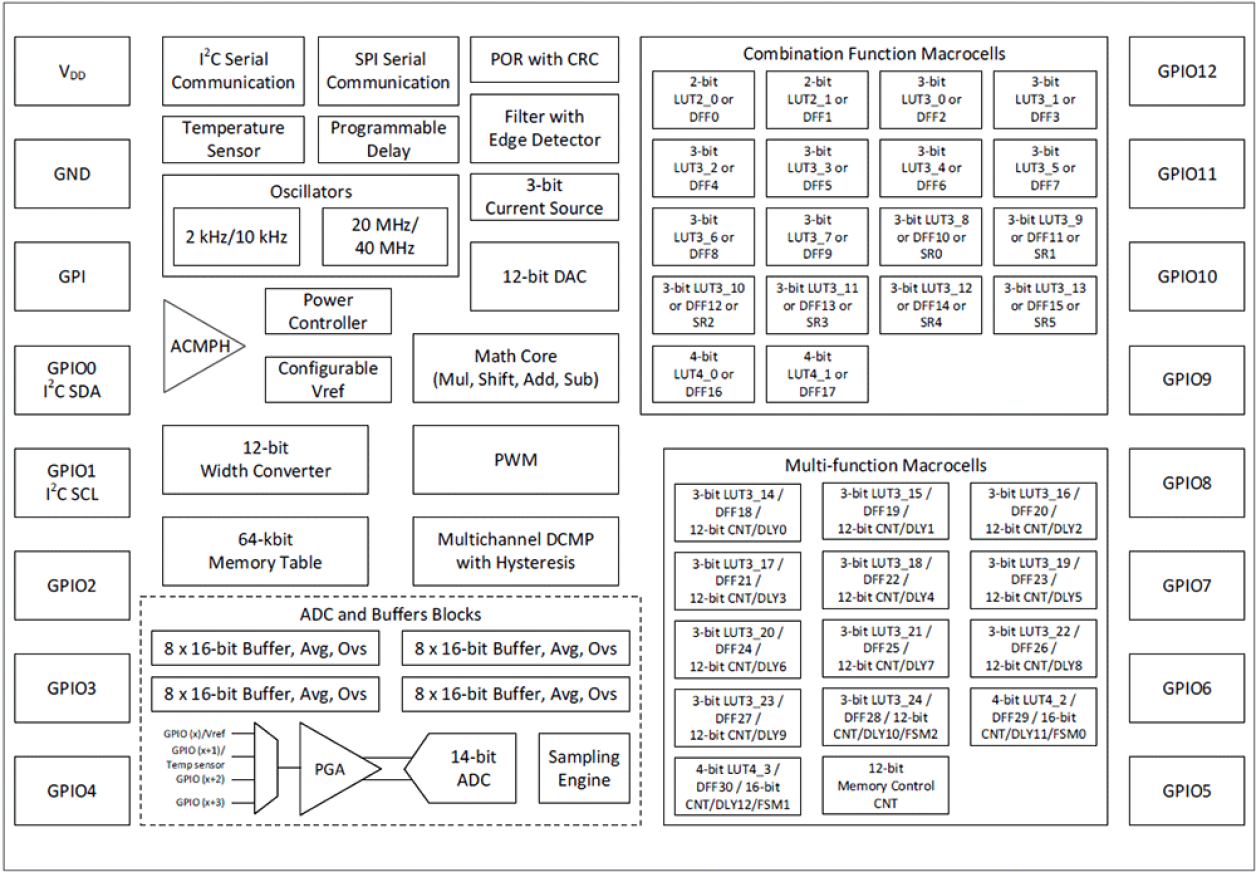
Block diagram showing the capabilities in the SLG47011
A Better Approach With Programmable Mixed-Signal Processing
Traditional analog front-end encoding requires discrete comparators, resistor divider references, op-amp gain stages, and glue logic to produce classified digital outputs. Each design iteration demands board respins, component changes, and re-validation of threshold accuracy. The result is a fixed-function circuit that cannot adapt to revised sensor ranges, updated threshold requirements, or new operating modes without hardware modification.
Programmable mixed-signal processors change this equation fundamentally. Encoding in the analog front-end can be implemented inside a single configurable device that combines analog signal conditioning with digital logic processing. The approach eliminates discrete component count, reduces board area, and consolidates the entire analog-to-digital classification function into one IC. The device behaves like a CPLD for analog signals: threshold levels, window boundaries, gain settings, timing constraints, and output encoding are all defined in configuration rather than in copper and silicon discretes.
Programmability provides a direct path to design reuse. A single hardware platform can serve multiple sensor types or product variants by loading different configurations. Threshold adjustments that previously required resistor value changes become register writes. New encoding states or fault detection logic can be added without layout changes. Validation cycles shorten because the analog and digital behavior can be simulated together before committing to hardware.
|
Traditional Discrete Approach |
Programmable Mixed-Signal Approach |
|
Fixed thresholds set by resistor dividers |
Configurable thresholds via internal references |
|
Separate comparators, logic ICs, passives |
Integrated comparators, LUTs, counters in one device |
|
Board respin required for threshold changes |
Configuration update only |
|
No simulation of combined analog/digital behavior |
Full design simulation before programming |
|
Higher component count and board area |
Single-chip implementation |
GreenPAK Implementation
GreenPAK is a family of programmable mixed-signal devices from Renesas that integrate configurable analog blocks, digital logic macrocells, and interconnect resources into small, low-power packages. Each device provides a matrix of comparators, references, LUTs, flip-flops, counters, delay blocks, and I/O cells that can be connected and configured to implement custom mixed-signal functions without writing firmware or using external components.
Designers build and simulate analog front-end encoder configurations using the Go Configure Software Environment from Renesas. The tool provides a schematic-style interface where analog and digital blocks are placed, connected, and parameterized. Simulation verifies threshold behavior, timing, and output encoding before the device is programmed. This workflow allows rapid iteration on comparator thresholds, window logic, debounce timing, and output state encoding within a single design environment.

The Go Configure Software environment provides a graphical programming interface for Renesas components.
To learn more, take a look at the GreenPAK components and reference examples.
Whether you need to build reliable power electronics or advanced digital systems, use the complete set of PCB design features and world-class CAD tools offered by Altium to implement your GreenPAK solutions. Altium provides the world’s premier electronic product development platform, complete with the industry’s best PCB design tools and cross-disciplinary collaboration features for advanced design teams. Contact an expert at Altium today!
Related Resources
Related Technical Documentation
Thank you, you are now subscribed to updates.