








GreenPAK vs. AnalogPAK vs. Power GreenPAK: What's the Difference?

At a Glance
Renesas provides multiple programmable mixed-signal processor options for electrical engineers and systems architects. Learn about AnalogPAK, Power GreenPAK, and GreenPAK in this article.


By now, readers of Altium resources will have noticed that we are advocates of the GreenPAK product line for systems architects, electrical engineers, and PCB designers. GreenPAK components can be thought of as general-purpose mixed-signal processors in which the analog and digital portions of the components are programmable. Programming is set initially when the device is configured, or settings can be changed through communication over the I²C interface on these components.
There are two other product lines with similar capabilities that also offer the ability to program and develop a custom ASIC from a programmable platform. These are AnalogPAK and Power GreenPAK. We will examine these additional programmable mixed-signal processor product lines in this article.
Mixed-Signal Processing Approach in GreenPAK
The GreenPAK product line consists of a set of integrated circuits and software tools for programming the on-chip features. The structure of these chips is similar to standard programmable logic for digital systems, but it is extended to include configurable analog blocks on the chip. For example, digital logic elements can be used to process quantized values from analog elements on the same chip using the Go Configure Software Hub.
Users can craft a custom analog front end, digital conversion, and data-processing flows on-chip with the following built-in components:
- Configurable lookup tables, flip-flops, latches, and state-machine logic
- Counters, timers, programmable delays, edge detectors, and PWM resources
- Internal oscillators, clock dividers, and clock-routing resources
- Analog comparators, voltage references, and device-dependent analog macrocells
- Power-on reset, voltage detection, temperature sensing, and supervisory functions
- Configurable GPIO, level shifting, and I²C communication
- Nonvolatile configuration memory and programmable matrix interconnects
This is a basic and highly adaptable set of building blocks for mixed-signal processing. So, what happens when we extend this to additional on-chip components? That is where AnalogPAK and Power GreenPAK come into play.
AnalogPAK
AnalogPAK extends the GreenPAK architecture with programmable analog resources for signal conditioning, conversion, calibration, and control. Depending on the selected device, these resources can include operational amplifiers, comparators, voltage references, analog switches, digital rheostats, amplifiers, ADCs, and mathematical functions.
The configurable matrix connects these analog blocks to digital logic, timing resources, GPIO, and communication interfaces. This allows engineers to build compact signal chains that combine analog processing with digital decision-making inside one programmable device.
Typical AnalogPAK applications include:
- Programmable gain and offset correction
- Sensor excitation and signal conditioning
- Analog multiplexing
- Data conversion and calibration
- Closed-loop control
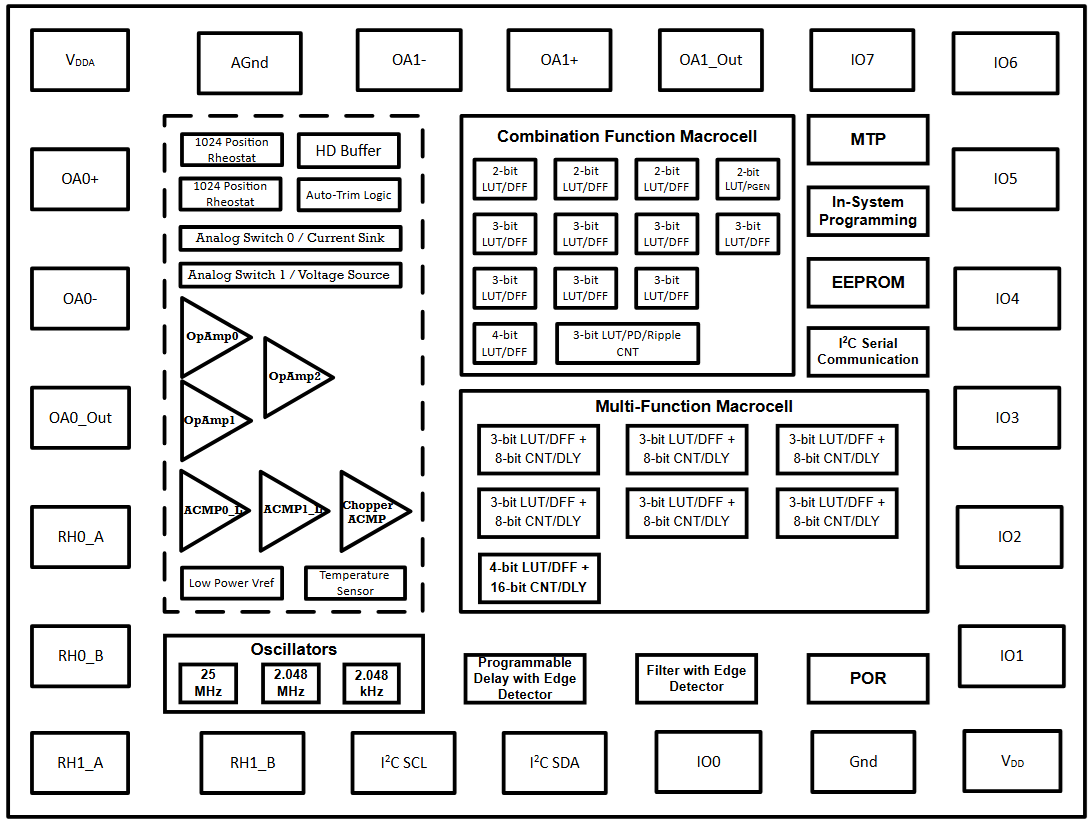
AnalogPAK block diagram for SLG47004
The main advantage is functional consolidation. AnalogPAK can replace several separate analog and logic components on the PCB while preserving the ability to modify thresholds, gains, timing, and operating modes through configuration.
Device selection should begin with input range, accuracy, bandwidth, noise, conversion resolution, channel count, and calibration requirements. Engineers should also verify behavior across temperature, supply variation, and production tolerances before finalizing the configuration. This verification prevents late component substitutions from forcing changes to the intended analog processing architecture.
Power GreenPAK
Power GreenPAK combines configurable GreenPAK logic with integrated power-management resources. Depending on the selected device, these resources can include low-noise LDOs, load switches, voltage monitoring, current limiting, sequencing controls, and device-specific protection functions.
Internal timers, logic, GPIO, and I²C resources allow engineers to coordinate startup, shutdown, enable timing, fault responses, and low-power operating states. This can replace several discrete power-control devices with one programmable component.
Typical Power GreenPAK functions include:
- Multi-rail startup and shutdown sequencing
- Programmable enable delays
- Load-switch control
- Voltage regulation
- Fault detection and protection
- Low-power state control
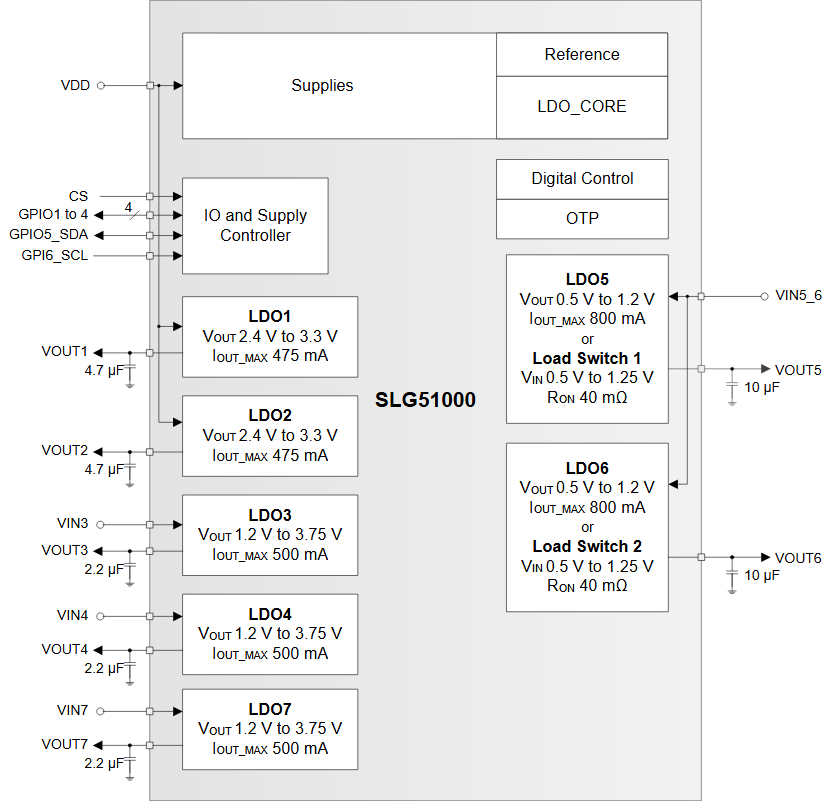
Example block diagram for the SLG51000 configurable load switch.
The main advantage is reduced power-management complexity. Power GreenPAK can consolidate regulation, distribution, monitoring, and control functions on the PCB while allowing engineers to modify timing and system behavior without redesigning the complete power architecture.
Device selection should account for output current, dropout voltage, output noise, PSRR, transient response, thermal limits, and sequencing requirements. Engineers should also verify startup timing, fault recovery, power-state transitions, and worst-case loading before releasing the configuration for production. This review ensures the programmed behavior remains valid across supply variation, temperature, and expected load conditions.
GreenPAK Product Comparison
The correct product family depends on which functions must be integrated. Standard GreenPAK addresses logic, timing, and basic mixed-signal control. AnalogPAK adds resources for analog signal processing, while Power GreenPAK adds integrated power-management and power-distribution functions.
Product family | Primary programmable resources | Best-fit functions |
Standard GreenPAK | Logic macrocells, counters, delays, oscillators, analog comparators, GPIO, and device-dependent supervisory resources | Glue logic, timing control, resets, threshold detection, simple sequencing, and hardware state machines |
AnalogPAK | GreenPAK logic with op amps, rheostats, analog switches, references, comparators, and device-dependent ADC, DAC, or PGA resources | Sensor interfaces, programmable gain, tunable filtering, calibration, analog multiplexing, and data conversion |
Power GreenPAK | GreenPAK logic with integrated LDOs, load switches, sequencing, monitoring, and protection resources | Multi-rail power control, power distribution, startup sequencing, shutdown control, and fault handling |
At their core, these GreenPAK products are all programmable components with customizable digital and analog blocks. The device architecture allows a single device to replace what would otherwise require multiple discrete circuits in different packages, and their configuration is written directly to an on-chip NVM. These components are very compact and yet offer flexibility in I/O count with multiple package options.
The developer tools in Renesas GreenPAK give designers the ability to develop fully custom digital, analog, or mixed signal ICs. These programmable mixed-signal processors allow consolidation of functions found in clock and signal management circuitry, allowing for smaller, more efficient systems.
To learn more, take a look at the GreenPAK components and reference examples.
Whether you need to build reliable power electronics or advanced digital systems, use the complete set of PCB design features and world-class CAD tools offered by Altium to implement your GreenPAK solutions. Altium provides the world’s premier electronic product development platform, complete with the industry’s best PCB design tools and cross-disciplinary collaboration features for advanced design teams. Contact an expert at Altium today!
Related Resources
Related Technical Documentation
Thank you, you are now subscribed to updates.