












Power Monitoring, Shutdown, and Reset in a Single ASIC

At a Glance
Consolidate power monitoring, shutdown, and reset logic into a single Renesas GreenPAK ASIC. Improve efficiency over discrete designs with programmable ICs.


Monitoring voltage/current, triggering shutdowns of remote loads, and determining appropriate reset conditions sounds like a tall order for any power system. Many designers would probably wire up an ADC, a discrete op-amp or in-amp circuit with some comparators, and a microcontroller, and all the logic would be implemented in firmware. This means you have to build an embedded application and write drivers for peripherals, and that's in addition to designing, simulating, and bench testing the hardware.
A better option is to consolidate all these features onto a single ASIC. Normally, programmable logic only handles the digital side of the equation, but power monitoring and system reset also require monitoring analog signals. A better option is mixed-signal processing in a programmable ASIC like GreenPAK. Here's why you should look at GreenPAK as a solution for consolidating these functions into a compact programmable ASIC.
Power Monitoring Functionality
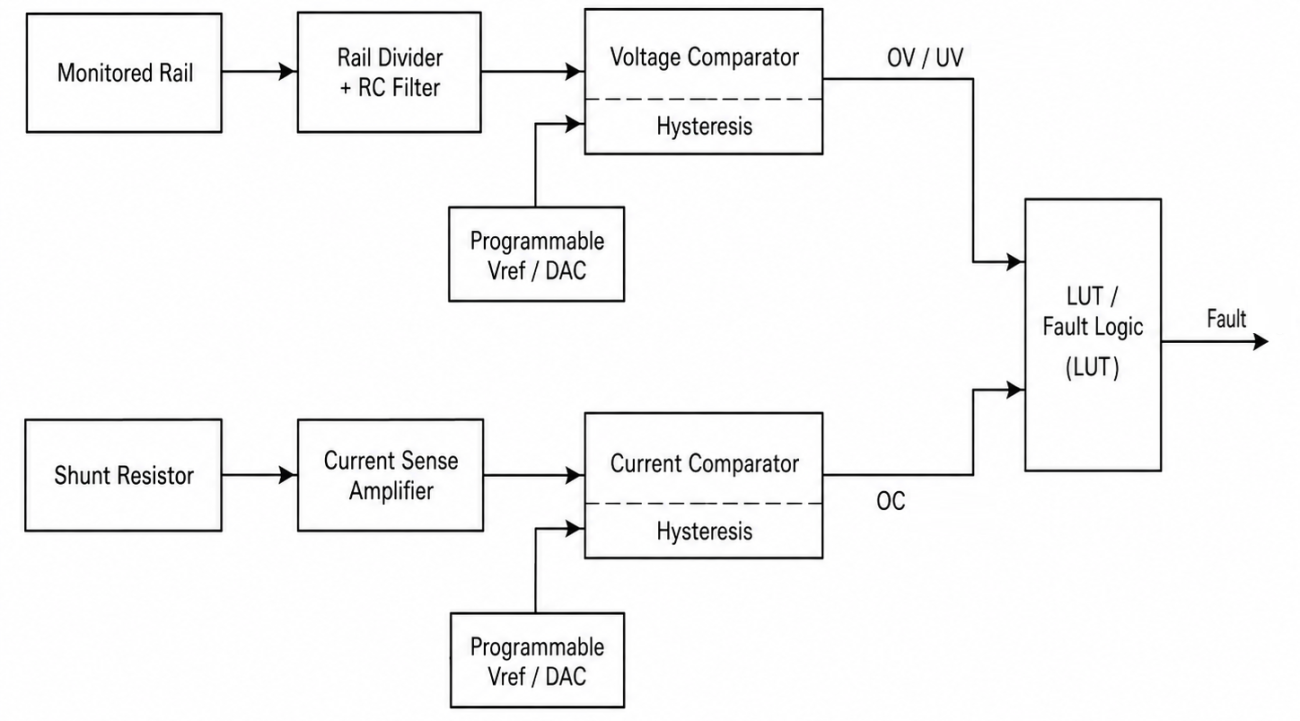
Discrete voltage monitoring usually starts with a resistive divider scaled to bring a rail into the input range of a comparator or ADC, followed by an RC filter to reject switching noise from the converter. Current monitoring is typically a low-side or high-side shunt with a current sense amplifier or in-amp providing the gain, since shunt voltages at reasonable power dissipation are in the tens of millivolts. Both signals then need conditioning: gain, offset trim, filtering, and protection against transients on the sensed node.
The measured analog value only becomes useful once it is converted into a logic state. This can be done with a comparator and a fixed or programmable reference, giving a single-bit overvoltage, undervoltage, or overcurrent state, with hysteresis preventing noise toggling near threshold. An ADC produces a digital value that firmware compares against a threshold, but this adds conversion latency and must be done in firmware. For protection logic, comparator-based thresholding is faster and does not depend on code execution.
Implementing this thresholding on a programmable mixed-signal device requires:
- Analog comparators with programmable hysteresis
- An internal programmable voltage reference or DAC for threshold setting
- Analog input pins with divider or buffer capability
- Look-up tables to combine multiple flags into a single fault condition
System Shutdown Functionality
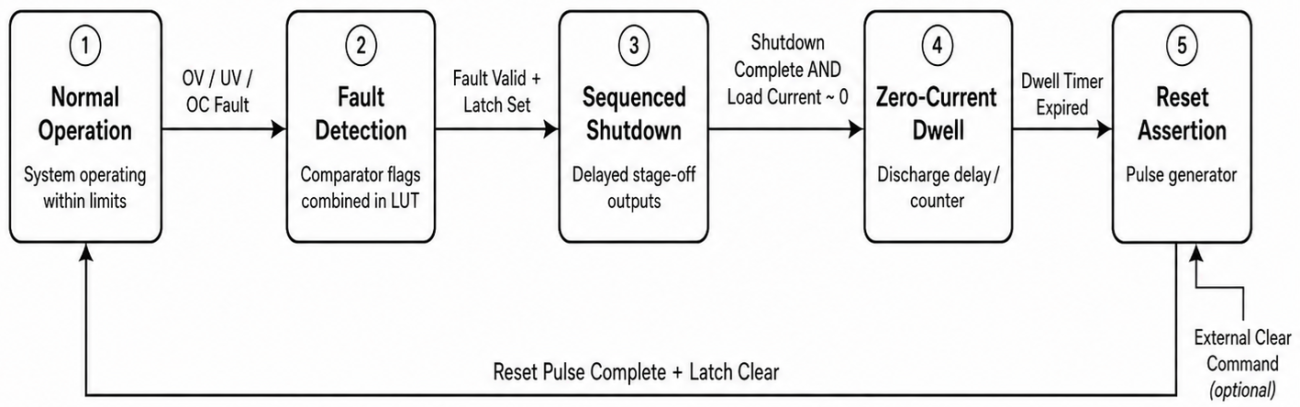
Once a fault is identified, the shutdown block has to act on that logical output. In a consolidated solution, the shutdown logic sits directly downstream of the monitoring comparators and drives enable pins on regulators, gate drivers for FETs, and/or a fault line back to the host processor. A comparator output routed through combinational logic to an output pin can disable a converter in well under a microsecond, which is fast enough to protect a MOSFET during a short-circuit event.
Shutdown is rarely a single output toggle in power electronics because loads usually need to be shutdown in reverse order of the power-up sequence. That requires sequenced outputs with independent delays, plus a latch so a transient fault does not allow the system to restart on its own.
Digital features needed to implement shutdown logic:
- Look-up tables for combining fault and enable conditions
- Delay and one-shot blocks for sequencing and inrush blanking
- SR latches to hold the fault state until a deliberate clear
- Counters for setting delays between fault checks
- Open-drain or push-pull outputs capable of driving enable and gate pins
System Reset Functionality
The logic in a reset block watches two things: the current (or voltage) monitoring comparator indicating that load power has decayed near zero, and a logic indicator from the shutdown sequencer confirming that all stages of the shutdown sequence have completed. Only when both conditions hold for a defined dwell time should the reset sequence. Applying a delay timer between the zero-current detection state and the reset output gives the rails time to fully discharge.
Digital features needed to implement reset logic:
- Look-up tables to AND the zero-current flag with the shutdown-complete indicator
- Delay blocks or counters for the discharge dwell period
- Edge detectors and pulse generators to produce a defined-width reset pulse
- A latch clear path driven by either the reset block or an external command
- Power-on reset circuitry so the device itself starts in a known state
Create a Custom ASIC With GreenPAK
GreenPAK from Renesas is a family of programmable mixed-signal ICs that combine analog comparators, references, delay and counter blocks, latches, and configurable look-up tables on a single small die, all configured in a free graphical design tool rather than in firmware. Well-documented reference designs cover power sequencing, monitoring, and reset applications, so most of this logic can be adapted rather than built from scratch.
The developer tools in Renesas GreenPAK give designers the ability to develop fully custom digital, analog, or mixed signal ICs. These programmable mixed-signal processors allow consolidation of functions found in clock and signal management circuitry, allowing for smaller, more efficient systems.
To learn more, take a look at the GreenPAK components and reference examples.
Whether you need to build reliable power electronics or advanced digital systems, use the complete set of PCB design features and world-class CAD tools offered by Altium to implement your GreenPAK solutions. Altium provides the world’s premier electronic product development platform, complete with the industry’s best PCB design tools and cross-disciplinary collaboration features for advanced design teams. Contact an expert at Altium today!
Related Resources
Related Technical Documentation
Thank you, you are now subscribed to updates.