





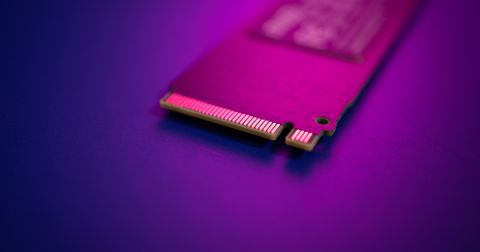






224G QSFP-DD Transceivers for AI Interconnects

At a Glance
Fiber optics may become the dominant interconnect medium for long-range data transmission and high-bandwidth transmission in the data center for artificial intelligence compute.


AI in the data center is here to stay, and these large-scale implementations are only made possible through high-bandwidth interconnects between servers and server clusters. Fiber optics will continue to play a major role in these areas due to the limitations of copper cabling (in terms of reach), as well as challenges fabricating and placing connectors for copper cabling operating at today's bandwidths. Current implementations are running on 112G and 224G interconnects, with 224G being commercialized and marketed by multiple vendors.
The huge volumes of data being transmitted in data centers is not going to slow down, with 448G standards currently being debated by industry organizations like the Ethernet Alliance and SNIA/SFF. Products designed to run at these data rates implement some key components as part of interconnect design, namely connectors and transceivers. This article will discuss how these systems are designed in terms of their overall architecture and the major components providing these extremely high data rates.
Fiber or Copper?
There are two main types of optical fiber, each of which is appropriate for different applications and will require different transceivers:
-
Multimode Fiber (MMF): this type of fiber can be used to transmit multiple channels simultaneously. Greater mode density leads to greater modal dispersion that accumulates over the distance of the fiber, thus these fibers are best used for short-run links, such as in MAN and LAN networks.
-
Single-mode Fiber (SMF): This fiber is designed for longer distances and will provide faster data transmission rates in a single channel with the correct transceivers. These fibers are often bundled in a single cable for massive data transmission over long distances.

Single-mode optical fiber
Within SMF and MMF classes of fiber, there are different fiber types that provide different data rates and are rated for use over different distances under TIA/EIA standards for fiber optics. Your optical power budget will also determine the limit transceiver you can use for a given link length, and your output on the transmitting side may need to increase the output from your transmitting transceiver to compensate losses in a link.
Copper is also still a viable medium for data transmission at 224G-PAM4, and a recent study by Molex and a major semiconductor vendor found that 448G may also be supported over copper depending on the modulation format used, as well as the level of overall noise (including crosstalk) in the system. Transceivers operating at 224G-PAM4 can support active copper, passive copper, or fiber in the same connector and cage form factor. Currently, to ensure low signal loss at 112G and 224G, near-chip connectors or co-packaged copper is interface between the GPU package and transceivers.
Connector Form Factor
Just like lower speed SFP connectors, the connectors for faster serial interfaces consist of an edge connector that holds the transceiver and a cage that holds the transceiver module in place. This applies for copper and fiber interconnects. The family of connector form factors that support fiber optic modules are QSFP, which are standardized under MSA among the major fiber optic transceiver, connector, and cabling manufacturers. The current generation supporting 112G-PAM4 per lane data rates is QSFP-DD, with the same connector family spec'd for 224G-PAM4 data rates per lane. When aggregated over 8 lanes, the total data rate for a single Ethernet link is 1.6 Tb/s.
These connectors and their cages are used in the same way as the lower speed SFP/QSFP variants; the enclosure is molded around the cage and the connector's corresponding placement is selected to fit the transceiver dimensions. An example QSFP-DD connector cage from Amphenol and the transceiver module pinout are shown below. Note that the QSFP-DD cage in the example has an integrated heat sink, something which is becoming more common as transceiver modules push to higher data rates. More innovative mechanisms for heat dissipation are also being developed which may integrate passive or active cooling into a larger housing that shrouds a group of QSFP-DD transceivers.

Looking Ahead to 448G
As of 2025, while the hyper-scaler tech companies implement 224G interconnects in their own data center installations, industry standards groups are debating the use of various modulation formats in 448G interconnects. The choice of modulation format will determine whether PCBs even remain viable components in AI systems, or whether everything collapses into substrate-like PCBs (SLPCBs) in order to eliminate problematic via transitions into the main PCB. This is because the modulation format defines the channel bandwidth required to transfer data at 448 Gbps, and it will be a pivotal decision that determines whether standard approaches to PCBs and packages can continue to be used.
Once the modulation format and corresponding channel bandwidth are determined, this will impact where transceivers are placed in these systems and whether co-packaging will be needed for intermediate connections to reach the transceiver. We think that PCBs will still be viable, but not in the traditional silicon-package-PCB stack. Instead, SLPCBs will likely be the best path forward as it eliminates co-packaged connectors that also have difficulty ensuring sufficient channel bandwidth.
Related Resources
Related Technical Documentation
Design to Release, Without the Friction
- Keep reviews tied to the right version
- Reduce handoff confusion and rework
- Spot sourcing and release risk earlier
- Work solo, share when needed
Get Started
Thank you, you are now subscribed to updates.