






EMC Documentation for Medical Devices: What to Include for Faster, Stronger FDA Submissions

At a Glance
The article delves into the critical role that electromagnetic compatibility (EMC) documentation plays in the FDA submission process for medical devices, emphasizing how strong EMC files can streamline product reviews. It highlights the importance of providing clear and structured EMC evidence that connects directly to risk, intended use, and performance standards, thus facilitating an efficient FDA review.


McKinsey has argued that a “smart quality” approach in pharma and MedTech could accelerate time to market by more than 30 percent, while also increasing manufacturing and supply chain responsiveness by 20 to 30 percent. That matters because some of the slowest work in medical electronics is not the circuit design, but the clinical trials and evidence trail.
Electromagnetic compatibility, or EMC, sits right in the middle of that trail. If the EMC file is weak, the product review slows down. If the EMC file is clear, structured, and tied to risk, the whole submission moves with less friction.
Key Takeaways
- EMC documentation is part of the regulatory submission, not a separate report.
- Define intended-use environment and essential performance early. IEC 60601-1-2 and the FDA both make environment central, and home, professional, and special environments can drive different expectations.
- Link test evidence directly to risk, pass/fail criteria, and the final tested configuration.
- Treat EMC failures as controlled quality events with investigation, corrective action, and verification. Tie it into risk, root cause analysis, CAPA, and documented effectiveness checks.
- Keep labelling, modifications, and submission content aligned with the final design.
FDA Guidance
EMC means a device can work safely and effectively in its intended electromagnetic environment, while also not creating excessive electromagnetic disturbances that could interfere with other equipment. The United States Food and Drug Administration, or FDA, says its EMC guidance applies to medical devices, including in vitro diagnostic products, or IVDs, and accessories that are electrically powered or that have functions or sensors implemented using electrical or electronic circuitry.
The FDA guidance is framed around:
- premarket submissions, including 510(k) premarket notification
- premarket approval (PMA)
- humanitarian device exemption (HDE)
- investigational device exemption (IDE)
- De Novo requests
- Certain biologics license applications
The FDA says the review of EMC information in a submission is based on the risk associated with malfunction or degradation of the device, where inadequate EMC could cause harm. The same guidance says manufacturers should include EMC information in the submission under defined section headings and in a set order, covering device characteristics, risk, standards used, essential performance, configuration tested, results, allowances, deviations, modifications, common electromagnetic emitters, and labelling. In short, EMC documentation is both a test record and a risk story.
For FDA submissions, EMC documentation is part of the regulatory package rather than a stand-alone certificate. The strongest files read as a connected narrative: what the device is, where it will be used, what risks matter, how it was tested, what happened, and how the final design was controlled.
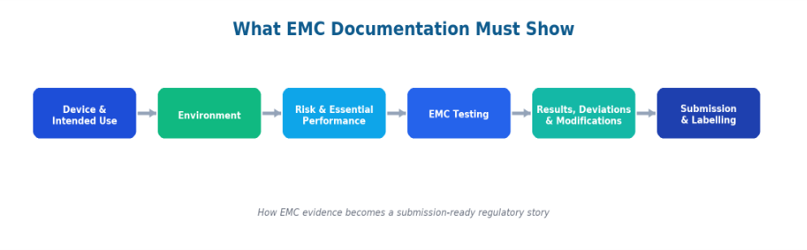
Figure 1. EMC documentation links device design, intended environment, risk, testing, and final submission evidence into one regulatory story.
What EMC Means in Medical Devices
EMC asks two simple questions:
- Can the device continue to operate when exposed to expected electromagnetic disturbance?
- Can it avoid creating excessive disturbance that affects nearby equipment?
In practice, teams usually talk about immunity and emissions. Immunity is the ability to withstand disturbance such as radio-frequency energy, electrostatic discharge, surges, and power-related events. Emissions are the disturbances generated by the device itself. EMI, or electromagnetic interference, is the harmful effect when those disturbances disrupt performance.
Clear terminology matters because EMC work crosses engineering, quality, and regulatory teams. Consistent use of terms such as EMC, EMI, RF, IVD, CAPA, QMS, and DHF improves readability and traceability.
What to Include in EMC Documentation for Medical Devices
A submission-ready EMC file begins with context. Reviewers need to understand the device, its intended use, the power supply, the presence of wireless features or intentional RF emitters, and the electromagnetic environment in which the device is expected to operate.
The documentation then needs to connect directly to risk. It should explain what could happen if electromagnetic disturbance caused malfunction, disruption, or degradation, and it should show how severity and acceptability were assessed.
In most cases, the core document set includes the intended-use environment statement, links to risk management, a clear definition of essential performance, the EMC test plan, the test report or summary, pass and fail criteria, any deviations or modifications, and the final labelling or instructions that matter for EMC-safe use.
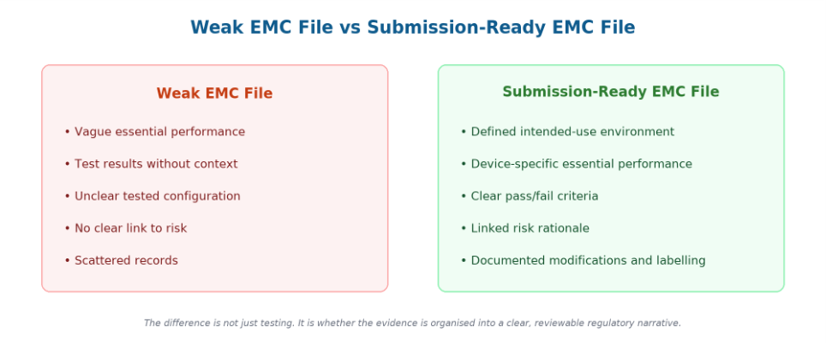
Figure 2. The difference is not just testing but whether the evidence is organized into a clear, reviewable regulatory narrative
IEC 60601-1-2 and the EMC Standard Most Teams Work Around
For many medical electrical devices, IEC 60601-1-2 is the central standard used to frame EMC work. It is widely applied to basic safety and essential performance in the presence of electromagnetic disturbance and to the control of emissions generated by the device.
The important nuance is that testing to a recognized standard does not remove the need for device-specific judgement. A standard provides a framework, but it does not define the clinical importance of each function or the level of degradation that creates unacceptable risk.
That is why two devices can be tested under the same broad EMC framework and still require very different documentation. A blood analyser, infusion pump, patient monitor, or consumer-style product with a medical claim will not carry the same risk profile.
Essential Performance: The Hinge Point in EMC Documentation
Essential performance is often the point that separates a strong EMC file from a superficial one. It describes the critical function, the limits within which that function must operate, and why loss or degradation beyond those limits would create unacceptable risk.
This is also where many files become too vague. A statement such as “the device remained functional during testing” does not tell a reviewer which function mattered, what level of degradation was acceptable, or what risk assessment supports that threshold.
A better record states the function clearly, defines the acceptable limit, links it to the risk analysis, and shows how performance was assessed during testing. That makes the file easier to review and more credible.
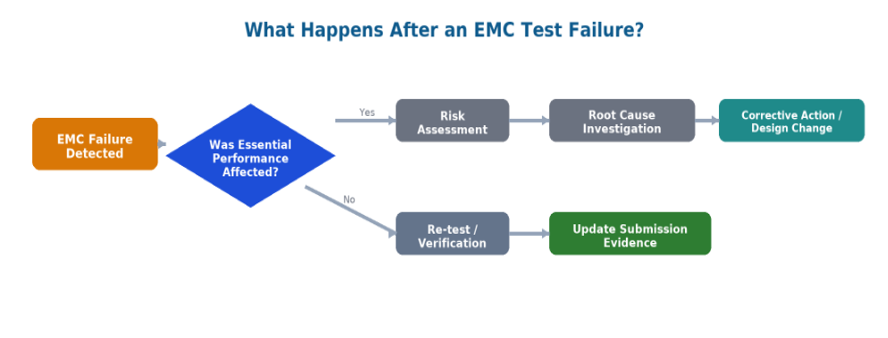
Figure 3. An EMC failure should be documented as a controlled quality event, not treated as an isolated lab issue
EMC failures do happen, and they do not automatically derail a programme. What matters is how they are investigated, corrected, and documented.
A mature response records the failure clearly, assesses whether essential performance was affected, investigates the likely cause, defines corrective action, verifies the outcome, and updates the submission evidence so the final configuration matches the design that was actually tested.
Engineering, quality, and regulatory all have a role. Engineering explains the mechanism, quality connects the issue to risk and CAPA discipline, and regulatory ensures the final submission reflects the controlled and verified design.
How EMC Documentation Affects FDA Review
EMC evidence supports the quality and completeness of the premarket submission. It helps show that the manufacturer has considered the expected electromagnetic environment, applied a suitable test approach, and grounded the results in device-specific risk.
This is why language matters. EMC documentation feeds the relevant FDA pathway rather than existing as a separate approval. When the file is weak, reviewers are more likely to raise questions. When it is clear, structured, and risk-based, the review is more likely to move efficiently.
Medical Devices vs Personal Care Devices
Not every electrically powered beauty, wellness, or consumer-care product is regulated like a medical device. The dividing line is intended use.
If a product is positioned for diagnosis, cure, mitigation, treatment, prevention of disease, or to affect the structure or function of the body in a medical sense, regulatory expectations change significantly. Form factor and marketing style do not determine the pathway on their own.
That is why EMC documentation should be built around intended use, product claims, and risk, not just product appearance.
Where Altium Can Help
Altium supports requirements traceability, links requirements directly to schematics and PCB designs, captures design changes with versioning, and allows teams to share version-controlled release packages with feedback tied to the design for traceability. Altium also supports structured BOM management, up-to-date part intelligence, and lifecycle approvals. Those are not EMC chambers or immunity generators, but they are exactly the kind of controls that help teams keep the EMC evidence trail coherent.
That matters in medical electronics because EMC documentation is cross-functional by nature. The EMC file touches requirements, risk, configuration control, component choice, revisions, and release status. A platform that can keep requirements linked to design data, control versions, and package release evidence can reduce the admin burden around DHF-style records and design reviews.
Whether you need to build reliable power electronics or advanced digital systems, use Altium’s complete set of PCB design features and world-class CAD tools. Altium provides the world’s premier electronic product development platform, complete with the industry’s best PCB design tools and cross-disciplinary collaboration features for advanced design teams.

About Author
Related Resources
Related Technical Documentation
Table of Contents
- Key Takeaways
- FDA Guidance
- What EMC Means in Medical Devices
- What to Include in EMC Documentation for Medical Devices
- IEC 60601-1-2 and the EMC Standard Most Teams Work Around
- Essential Performance: The Hinge Point in EMC Documentation
- How EMC Documentation Affects FDA Review
- Medical Devices vs Personal Care Devices
- Where Altium Can Help
Solutions for Every Role and Team
- Discover and evaluate design options earlier
- Develop in one shared workspace
- Scale with control and compliance
- Connect every stage of hardware development
Learn More
Thank you, you are now subscribed to updates.