






Reduce Your MCU Pin Count: Offload Analog Tasks to GreenPAK

At a Glance
Reduce MCU pin count and system cost by offloading analog monitoring, GPIO logic, timing, and low-level processing to GreenPAK devices.


It's all too common that designers try to do everything in a single processor, and nowhere is that more true than with microcontrollers. Today's microcontrollers include a diverse array of interfaces and features, often developed in coordination with major customers or to support specific applications. This pushes the pin count for many popular microcontrollers to be unnecessarily high, and these components tend to be physically quite large to accommodate the number of pins.
If your microcontroller is being used for a mixed-signal system and you are using its analog pins, consider offloading all of that analog processing onto a mixed-signal processor. These components can help reduce total BOM cost by reducing the required size of the microcontroller.
Which MCU Pins Can You Eliminate?
The first candidates are pins supporting relatively simple analog or logic functions that do not require direct MCU processing. A GreenPAK can sit between external circuitry and the MCU, perform the required signal conditioning or decision-making, and present the processor with a smaller number of digital results. This can eliminate dedicated analog inputs and reduce the number of GPIOs consumed by housekeeping functions.
Typical candidates include:
- Analog comparator inputs used for threshold detection
- GPIO inputs used for switches, buttons, or discrete status signals
- GPIO outputs used for enables, resets, or simple control signals
- Interrupt inputs generated from multiple external conditions
- PWM outputs used for repetitive timing or control functions
- Reset and supervisory signals
- Pulse, frequency, or edge-detection inputs
- Simple sequencing and interlock signals
Comparator functions are particularly useful targets. If the MCU is only sampling an analog voltage to determine whether it is above or below a threshold, that decision can be made externally. The GreenPAK can then provide a digital state or interrupt, allowing the MCU selection to be based on the interfaces and processing resources the application actually requires.
GPIO consolidation can produce a similar result. Several status or control signals can be combined through configurable logic, timers, counters, and state elements before reaching the MCU. Instead of allocating individual processor pins to every event, the GreenPAK can qualify those events and report only the conditions that require firmware attention.
The amount of pin reduction depends on the application, but the architectural goal is straightforward. Repetitive analog monitoring and deterministic control should not force the use of a larger MCU package when those functions can be implemented in a small mixed-signal device.
Move Low-Level Signal Processing Out of the MCU
Pin reduction is only part of the benefit. Many mixed-signal systems also burden the MCU with repetitive processing that does not need firmware. Threshold qualification, switch debouncing, pulse counting, delay generation, edge detection, and simple state transitions can be implemented with configurable hardware blocks and executed independently of the processor.
A threshold detector provides a good example. An analog comparator can detect when a sensor crosses a defined level, while a timer can require the condition to remain valid for a specified period. Logic can then generate a single interrupt for the MCU. This replaces continuous ADC sampling, software comparisons, and timing code with a hardware function that produces only the event the firmware needs.
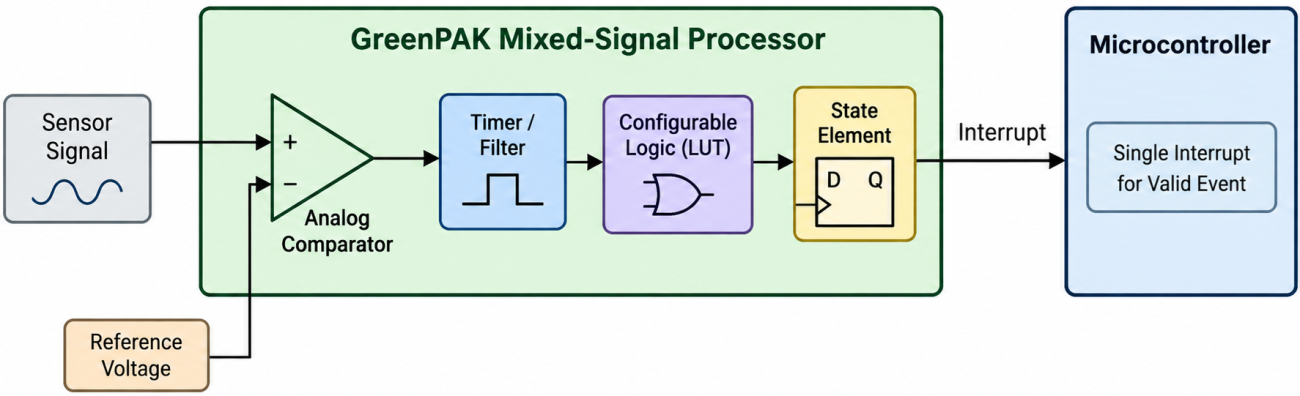
Similar hardware can handle button debouncing, pulse-width qualification, frequency or event counting, delayed enables, reset timing, and power sequencing. LUTs and state elements can also combine several digital conditions into interlocks or simple control states. These functions are deterministic and generally do not benefit from being implemented as firmware loops.
Moving these functions out of the MCU changes component selection at the system level. The processor no longer needs enough ADC channels, timer resources, or GPIOs to accommodate every low-level interface directly. A smaller MCU can then handle communications, higher-level control, and application code while the GreenPAK handles local mixed-signal functions close to the circuitry that generates them.
Use GreenPAK to Reduce MCU Resource Requirements
GreenPAK can absorb many low-level functions that would otherwise consume MCU pins and peripheral resources. Comparator decisions, reset generation, switch debouncing, pulse detection, timing, sequencing, and simple logic can be handled before signals reach the processor. The MCU then receives a smaller number of qualified digital inputs instead of every raw signal in the system.
This can directly affect MCU selection. A design that originally required several ADC inputs, timer channels, interrupt pins, and GPIOs may be able to use a smaller processor once those functions are consolidated. GreenPAK can also qualify events, combine conditions, and generate timed outputs without continuous firmware polling.
The Go Configure tools support configuration of these analog, timing, and logic functions. Engineers can connect comparators, LUTs, counters, timers, flip-flops, and GPIO resources into the required signal flow, define thresholds and timing behavior, simulate the resulting logic, and program the configuration into the selected GreenPAK device.
To learn more, take a look at the GreenPAK components and reference examples.
Whether you need to build reliable power electronics or advanced digital systems, use the complete set of PCB design features and world-class CAD tools offered by Altium to implement your GreenPAK solutions. Altium provides the world’s premier electronic product development platform, complete with the industry’s best PCB design tools and cross-disciplinary collaboration features for advanced design teams. Contact an expert at Altium today!
Related Resources
Related Technical Documentation
Thank you, you are now subscribed to updates.