




When Quick-Turn Rigid-Flex Goes Wrong: The 3 Most Common Root Causes

At a Glance
Learn why quick-turn rigid-flex builds fail. Avoid the 3 most common root causes: stackup gaps, undefined transition zones, and material surprises.


I got a call a few years ago from a designer that I had worked with for years. He is smart and experienced, not someone who makes “rookie mistakes”. He had a rigid-flex that needed to be built on an extremely quick turn time, and just received a call from the fabricator with a stack-up question that was going to push the lead-time out by two weeks. As we talked through the stack up, his exact words were, “I didn’t think I needed to check that part.”
That phrase stuck with me, and honestly, it comes up in different forms in most quick turn rigid flex situations that go wrong. It is not carelessness or inexperience, but often simply an assumption that felt easy to make and turned out to have a much greater impact than expected.
Quick-turn doesn’t just apply to the manufacturing process steps. Often, things like DFM review, fabricator consultation, and stack up confirmation are also being done at a faster pace and can be easy to skip when the pressure is on. That is a mistake, especially with rigid flex, where all of these things need greater thought and scrutiny.
Here's what tends to go wrong.
Key Takeaways
- Always get your stackup reviewed by the fabricator before layout, even under time pressure. A 15-minute conversation can prevent a two-week delay.
- Transition zones must be explicitly defined in your fab notes. CAD tools don't capture them automatically, and fabricators build to what's documented, not what you intended.
- Confirm material availability before you lock the design. Flex-specific materials have longer lead times, and a two-minute conversation early on keeps your options open.
- The root cause of most quick-turn failures is gaps, not errors. Closing those gaps before submission is what separates smooth builds from costly surprises.
The Stackup Was Never Reviewed by the Fabricator
Time pressure is almost always the reason this one gets skipped. A designer is working against a deadline, the stackup looks similar to something that worked before, and a fabricator review feels like a step that can be skipped or handled after submission. It can't.
Rigid-flex stackups aren't generic. What builds reliably at one shop may be outside tolerance at another. Layer counts, material combinations, adhesive versus adhesiveless construction, transition zone planning all need to match what that specific fabricator can produce at the quality level your design requires. Every fabricator has different preferences and capabilities.
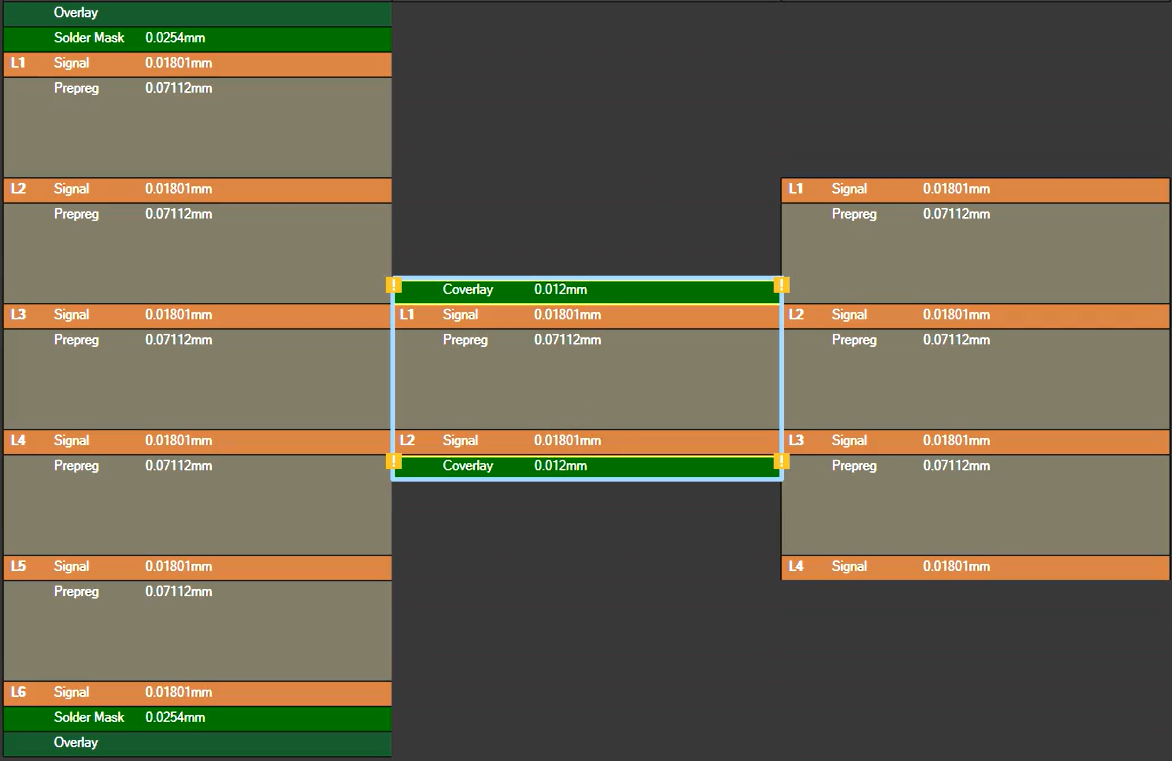
A simple stackup diagram is enough for the fabricator to review material selection and layer arrangement.
Most of the time, fabricators can spot the stress points in the stack-up within minutes of looking at it. And, even if not perfect 100% of the time, that quick review can catch many potential issues. If that review happens before layout, fabricators can usually help simplify the design, improve yield, and head off surprises. If the review happens after files are submitted, they're managing risk.
A simple 15-minute conversation before layout, talking about material availability and options is all it takes to consistently avoid stack up issues. This is important in any PCB build, but it is most important in rigid flex and especially rigid flex that is needed in a quick turn environment.
Transition Zones Weren't Defined in the Fab Notes
After working so hard on the layout it is surprising how many times a documentation error sneaks in. These tend to hit both experienced and inexperienced designers. Under schedule pressure, fab notes get abbreviated. Sometimes they're copied from a previous job without being updated for the new design. The fabricator builds to what's documented, not what was intended, and the gap between those two things is where rigid-flex issues can be found.
The rigid-to-flex transition zone is the area where stress concentrates. It's also the area that CAD tools don't define explicitly. There's no dedicated layer for transition zone location or size. That information has to be captured in the fab notes, clearly and specifically. When it isn't, the fabricator is making assumptions. Those assumptions may be reasonable, but they may not match your design intent.
The failures don't always show up right away. Transition zone problems frequently appear during depanelization, assembly, or after the product has been installed and flexed in the field. Cracking, delamination, and copper fatigue aren't always visible at incoming inspection. Before you finalize the documentation package, ask your fabricator exactly how they want the transition zone defined and in what format.
Material Availability Wasn't Confirmed Before Design Lock
While material lead-time issues are a common conversation, the impact is much greater in a quick-turn environment. Flex-specific materials such as polyimide films, adhesiveless laminates, and specialty coverlay have longer lead times and less supply redundancy than standard materials.
This is compounded by the vast number of options available in terms of copper thickness, adhesive thicknesses, and polyimide thicknesses. Fabricators can’t possibly stock all of the available combinations and it is critical to understand what materials are preferred, used most commonly in their facility and are more likely to be available for the build.
I've seen technically solid designs sit for days waiting on material that nobody confirmed was in stock before the design was locked. The designer did everything right from an engineering standpoint, yet the schedule still slipped.
The conversation that prevents this takes two minutes. Before the design is locked, ask your fabricator specifically about material availability for your proposed construction. If there's a constraint, you still have time to engineer around it. After you've submitted, your options get much narrower.
The Pattern Underneath All Three
The designers and teams I've seen navigate successful quick-turn delivery with rigid flex technology share one key habit. They bring their preferred fabricator in with early conversations, even when the timeline is tight. A stackup review, a documentation check, and availability confirmation will always be time well spent.
The pattern underneath all three failures is the same: critical decisions get made in gaps: between the designer and the fabricator, between the intent and the documentation, between the design and what actually gets built. Good fabricator habits close some of those gaps. Your workflow needs to close the rest.
Altium Develop is built for hardware designers who want to move a design forward without the friction that builds up around it. When your manufacturing data, version history, and release outputs live in one place, you're not chasing the latest file before you call the fab or second-guessing whether the stackup you sent matches what's in the tool. The design and the documentation stay connected, so the conversations that matter start from a shared source of truth rather than an exported file and a hope.
Get started with Altium Develop →
Frequently Asked Questions
What information does a fabricator need to review a rigid-flex stackup?
A simple stackup diagram showing layer count, material types, copper weights, and the rigid-to-flex transition zone is enough for an initial review. The fabricator can use it to check material compatibility, flag stress points, and confirm whether the construction matches their process capabilities. Providing this before layout, not after file submission, is what makes the review useful.
Why do rigid-flex transition zone failures often appear after assembly rather than at inspection?
The transition zone concentrates mechanical stress when the board is bent, depanelized, or installed. Cracking, delamination, and copper fatigue in that area develop gradually under load and are rarely visible to the naked eye at incoming inspection. By the time a failure surfaces in the field, the root cause is almost always an underdefined transition zone in the original fab notes.
What flex-specific materials are most likely to cause lead time problems on a quick-turn build?
Polyimide films, adhesiveless laminates, and specialty coverlay are the most common culprits. They have longer replenishment cycles and less distributor redundancy than standard FR-4 materials, and fabricators cannot stock every combination of copper, adhesive, and polyimide thickness. Confirming material availability before design lock, not at file submission, is the only reliable way to protect a quick-turn schedule.
How early in the design process should you involve your fabricator on a rigid-flex build?
Before layout. A short conversation at the stackup stage gives the fabricator time to flag material constraints, suggest construction simplifications, and align on transition zone requirements while changes are still low-cost. Once files are submitted under a quick-turn timeline, engineering questions from the fab become schedule risk, not design feedback.

About Author
Related Resources
Related Technical Documentation
Table of Contents
- Key Takeaways
- The Stackup Was Never Reviewed by the Fabricator
- Transition Zones Weren't Defined in the Fab Notes
- Material Availability Wasn't Confirmed Before Design Lock
- The Pattern Underneath All Three
- Frequently Asked Questions
- What information does a fabricator need to review a rigid-flex stackup?
- Why do rigid-flex transition zone failures often appear after assembly rather than at inspection?
- What flex-specific materials are most likely to cause lead time problems on a quick-turn build?
- How early in the design process should you involve your fabricator on a rigid-flex build?
Design to Release, Without the Friction
- Keep reviews tied to the right version
- Reduce handoff confusion and rework
- Spot sourcing and release risk earlier
- Work solo, share when needed
Get Started
Thank you, you are now subscribed to updates.